



Most people assume drywall is drywall. They go to the store, grab 4×8 sheets, and figure that’s that. For a lot of projects, that works fine. But picking the wrong size or thickness creates extra seams, adds unnecessary finishing work, and in some cases produces a wall that doesn’t meet code.
Drywall comes in multiple sheet dimensions and several thickness options, each suited to specific applications as defined by ASTM C1396 gypsum board specifications. The difference between choosing well and choosing by default shows up during installation, during finishing, and sometimes years later when a ceiling starts to sag or a wall fails a fire inspection.
This article covers sheet dimensions, thickness options, specialty products, and how to match the right combination to the job you’re actually doing.
Key Takeaways
- Match Length to Height: Use 4×8 for 8-foot walls, 4×10 for 9-foot walls, and 4×12 for 10-foot walls to avoid filler strips and extra seams.
- Choose Thickness Wisely: 1/2-inch suits most interior walls, while 5/8-inch is preferred for ceilings, fire-rated assemblies, and added rigidity.
- Reduce Seam Work: Longer sheets cost more upfront but save significant finishing time by minimizing butt joints.
- Use Specialty Boards Correctly: Green board resists humidity, Type X improves fire resistance, and acoustic drywall boosts sound control.
- Plan for Handling: Larger and thicker sheets improve performance but often require delivery, extra labor, or a drywall lift for safe installation.
Standard Drywall Sheet Dimensions
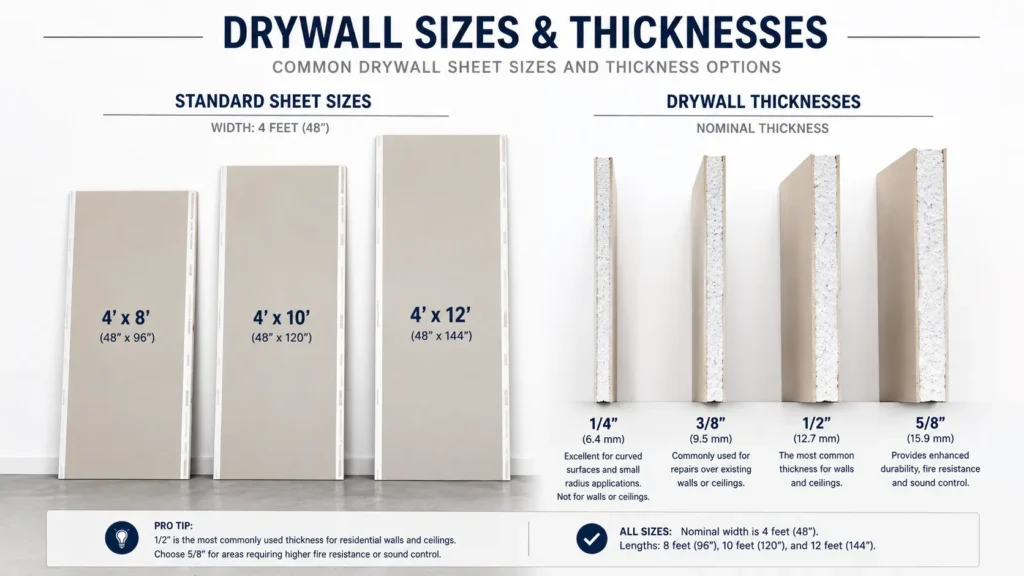
All standard drywall sheets are 4 feet wide. The variable is length, and that choice matters more than most people realize before they start hanging.

4×8 Sheets
The 4×8 is the most common size. It’s available at every home improvement store and most lumber yards, it fits in a full-size pickup truck without an overhang problem, and it’s light enough that one person can handle it with some practice, though a second person always helps.
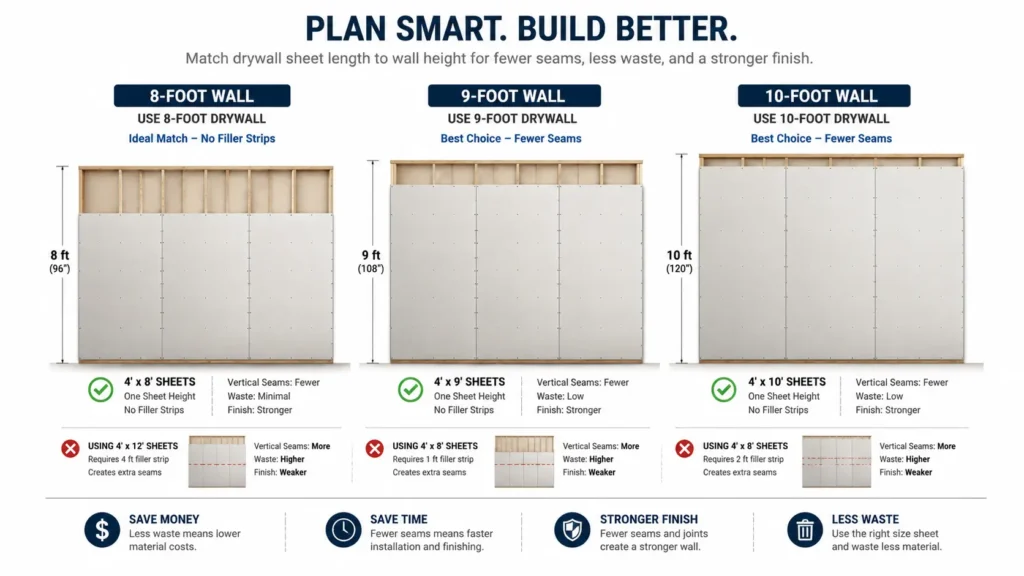
On standard 8-foot walls, 4×8 sheets hung vertically work cleanly. Sheets touch the ceiling, the bottom edge sits near the floor, and there’s no gap to fill. Hung horizontally, they place the seam at mid-wall height, which is a common professional practice since it puts the tapered edge joint at a comfortable working height and keeps butt joints away from floor and ceiling lines.
The limitation is anything taller than 8 feet. On a 9-foot wall, a 4×8 sheet hung vertically leaves a 12-inch gap at the top that needs a filler strip. That filler strip creates an additional seam, and that seam is a butt joint sitting near the ceiling where it’s difficult to finish cleanly. It’s not impossible to deal with, but it adds work and finishing complexity that a longer sheet eliminates entirely.
If your walls are exactly 8 feet, 4×8 is the right choice, though it’s still worth using a drywall sheet calculator to verify your material requirements before ordering. Any taller, and you should be looking at a longer sheet before defaulting to what’s easiest to load into your car.
4×10 Sheets
The 4×10 is the right size for 9-foot walls. Hung vertically, it covers the full wall height cleanly with no filler strip needed. That means one less seam to tape, one less butt joint to feather, and a cleaner finished wall.
These are available at most lumber yards and larger home improvement stores, but availability varies more than with 4×8 sheets. It’s worth confirming stock before planning around them, especially in smaller markets. They’re heavier and longer than 4×8, which rules out most standard vehicles for transport. Delivery from the supplier is worth pricing in from the start.
For new construction with 9-foot ceilings, the 4×10 is the cleaner call. The small bump in material cost is easily offset by the finishing labor you save by not having to deal with filler strips and the extra seam work that comes with them.
4×12 Sheets
The 4×12 is designed for 10-foot ceilings and large commercial wall runs where minimizing seams is a priority. It’s also used in high-ceiling residential spaces, vaulted areas, and any project where the layout benefits from spanning more wall with fewer sheets.
The handling requirement is the main consideration. A standard 1/2-inch 4×12 sheet weighs roughly 77 to 82 pounds. You need two people to move and position these safely, and a drywall lift is strongly recommended for ceiling installation at this length. For anything beyond a small number of sheets, arranging delivery from a drywall supplier rather than hauling them yourself is the practical choice.
These aren’t reliably stocked at general home improvement stores. Sourcing from a dedicated drywall supplier is usually necessary, and that’s worth factoring into your project timeline.
Hung horizontally on standard walls, 4×12 sheets can eliminate all horizontal seams in some configurations, which is a meaningful finishing advantage in high-end work where wall quality matters.
Other Lengths
4×9 sheets exist and are useful in specific situations, particularly where a 4×8 leaves a small gap but a 4×10 is more sheet than you need. Availability is limited.
Some manufacturers produce 4×14 and 4×16 sheets for commercial and specialty applications. These are rarely relevant for residential work but worth knowing exist if you’re ever working on an unusual project with very high ceilings.
The core principle across all lengths: sheet length should be chosen based on ceiling height and layout to minimize butt joints and eliminate filler strips wherever possible.
Drywall Thickness Options
1/4-Inch Drywall
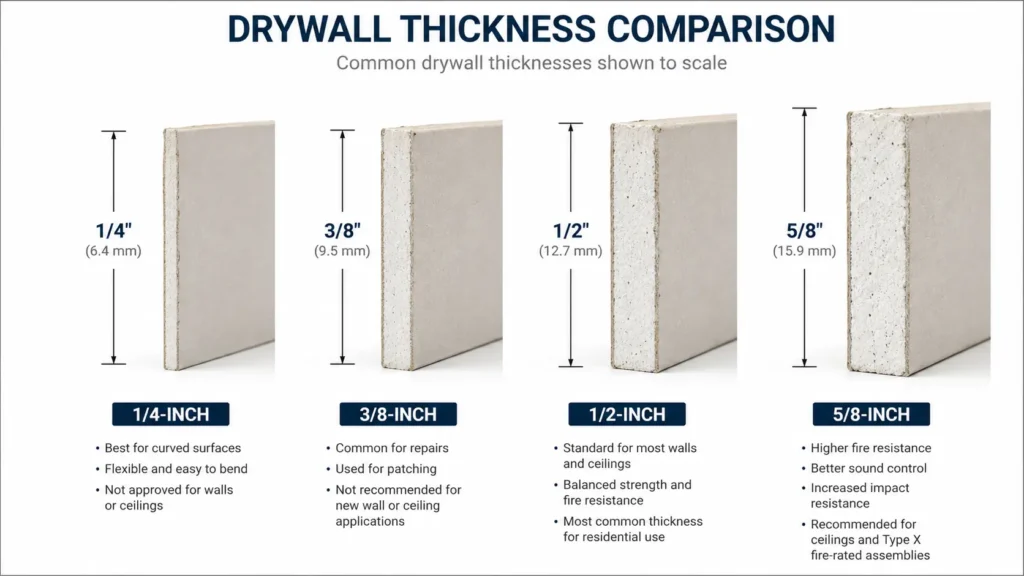
The thinnest option available and not a structural wall product. Its two main uses are laminating over existing drywall or plaster to refresh a surface without full demolition, and bending around curved walls or arched openings where thicker panels would crack.
It’s flexible enough to follow tight radii that standard thickness panels won’t take, which makes it genuinely useful for decorative curved features. As a standalone wall surface in standard applications, it doesn’t provide meaningful fire resistance or structural contribution and isn’t appropriate.
In renovation work, laminating 1/4-inch over damaged plaster is a legitimate approach when you want to avoid the mess and cost of demo. It’s not a substitute for proper repair in every case, but it solves certain problems cleanly.
3/8-Inch Drywall
A less common middle option that doesn’t see much use in standard residential work today. It occasionally shows up in curved applications where 1/4-inch isn’t rigid enough but 1/2-inch won’t bend to the required radius. It’s also sometimes used as a second layer in double-layer wall assemblies for sound or fire performance.
Availability at retail is limited. Plan on a special order if your project requires it.
1/2-Inch Drywall
The standard thickness for most residential wall applications. It balances weight, rigidity, and cost effectively for walls on 16-inch on-center stud framing, and it’s available everywhere in all sheet lengths. Any contractor, any store, any market.
The limitation worth knowing: 1/2-inch is not ideal for ceilings where framing is spaced wider than 16 inches on center. Over time, it can sag between joists or trusses at 24-inch spacing, which is a visible and difficult-to-fix problem. For ceilings at that framing spacing, 5/8-inch is the correct choice.
For standard interior walls on normal framing, 1/2-inch is the default and the right one.
5/8-Inch Drywall
Heavier, more rigid, and better performing than 1/2-inch across several dimensions. It’s the preferred thickness for ceilings and a better choice for walls where additional sound attenuation, fire resistance, or impact resistance matters.
The fire resistance point is worth taking seriously. Type X 5/8-inch drywall is required by code in most jurisdictions for fire-rated assemblies, including garage-to-living-space separations, stairwell enclosures, and some mechanical room applications. This isn’t optional on those applications. A full breakdown of fire-rated drywall covers what Type X actually provides and where it’s required.
The weight difference is noticeable. A 4×8 sheet of 5/8-inch weighs roughly 70 to 74 pounds versus 54 to 57 pounds for the same size in 1/2-inch. That adds up fast on larger projects and affects how you plan installation.
Some builders use 5/8-inch across all walls and ceilings as a quality upgrade. The added rigidity produces walls that feel more solid and that perform better acoustically without any additional soundproofing measures.
Specialty Drywall Types
Moisture-Resistant Drywall (Green Board)
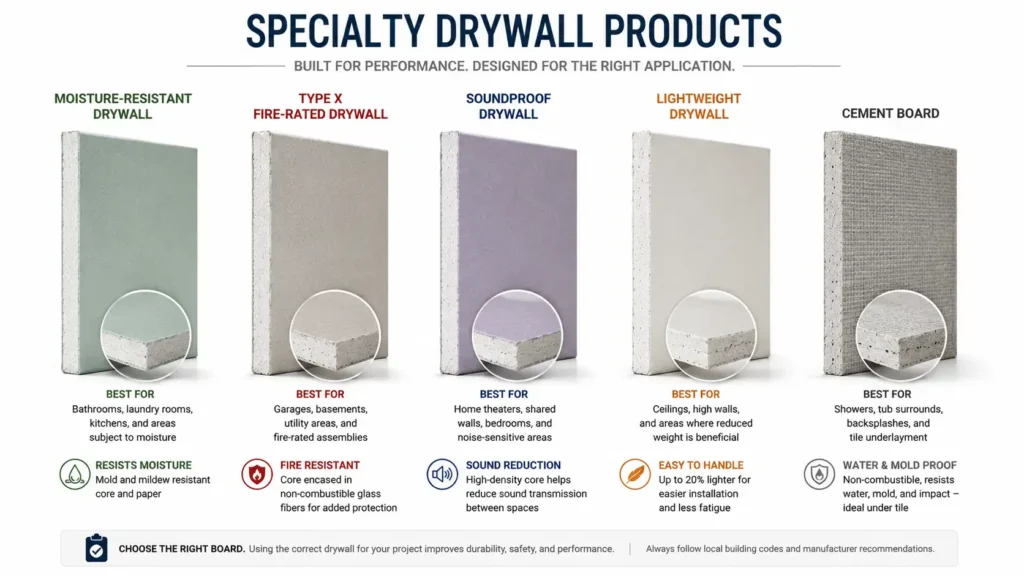
Designed for areas with elevated humidity but not direct water contact. Appropriate for bathrooms away from the shower surround, laundry rooms, and some basement applications. The paper facing is treated to resist moisture absorption, which gives it an advantage over standard drywall in humid environments.
It is not waterproof. This misconception causes real problems. Green board used as a tile backer in a shower without an additional waterproofing membrane will eventually fail. For wet area tile applications, cement board or a purpose-built waterproofing system is the correct substrate. The moisture-resistant drywall guide for bathrooms clarifies exactly where green board is appropriate and where it isn’t.
Available in 1/2-inch and 5/8-inch thicknesses. It’s one of several specialized drywall types designed for specific environments.
Cement Board and Fiber Cement Backer
Not technically drywall, but worth a mention here because it’s frequently compared to moisture-resistant gypsum board. Cement board is the correct substrate for tile in wet areas: shower surrounds, tub decks, wet room floors. It’s heavy, harder to cut, and not paintable. Strictly a tile backer. The cement board vs drywall comparison covers the differences in detail for anyone deciding between the two.
Type X Drywall
Contains glass fibers added to the gypsum core to slow fire penetration through the assembly, as demonstrated in UL fire-rated wall and ceiling assemblies. 5/8-inch Type X is the standard fire-rated product in residential construction and is required in specific locations by most building codes.
Always check local code requirements before ordering. Fire-rating specifications vary by jurisdiction and project type, and what’s required in one area may differ from another. Don’t assume the generic specification applies to your specific situation.
Soundproof Drywall
Products like QuietRock and similar acoustic panels incorporate damping compounds between multiple gypsum layers to reduce sound transmission significantly more than standard drywall at the same thickness. They’re worth considering for home theaters, music rooms, shared walls in multi-family construction, and bedroom walls where noise is a genuine concern.
One layer of acoustic drywall often outperforms two layers of standard drywall at lower total wall thickness. When labor cost is factored in, the economics frequently favor the specialty product over double-layering standard board. A full soundproof drywall guide covers STC ratings and product comparisons for anyone making this decision seriously.
Lightweight Drywall
Some manufacturers produce lightweight formulations that cut sheet weight by 20 to 30 percent compared to standard gypsum board. Performance is comparable to standard drywall for most residential applications. The main benefit is handling: lighter sheets reduce physical strain on larger projects, particularly on ceilings where every pound matters.
Slightly more expensive per sheet, but the labor cost reduction on bigger jobs can offset the material premium. Worth considering for any ceiling application or project where you’re working without a large crew. A closer comparison of lightweight vs regular drywall covers the performance tradeoffs in more detail.
Matching Sheet Size to Ceiling Height
| Ceiling Height | Recommended Length | Orientation | Notes |
| 8 feet | 4×8 | Vertical or horizontal | Standard, no filler needed |
| 9 feet | 4×10 | Vertical | Avoids filler strip and extra seam |
| 10 feet | 4×12 | Vertical | Minimizes seams on tall walls |
| Vaulted / irregular | 4×12 or custom cuts | Varies | Plan layout before ordering |
The goal is to avoid filler strips and minimize butt joints. A filler strip at the top of a wall is annoying to finish cleanly, creates a butt joint near the ceiling where it’s hard to hide, and adds finishing time for a problem that the right sheet length would have prevented. This is the same principle explained in the drywall finish levels article: decisions made during installation directly affect how much work finishing requires and how good the result looks.
Hanging drywall horizontally on standard-height walls is common practice in professional work. It places the tapered edge seam at a comfortable height and keeps butt joints away from the floor and ceiling lines where they’re hardest to blend.
For ceilings, sheet length should be chosen to span as many joists or trusses as possible while remaining manageable to position. A drywall lift makes longer sheets practical on ceilings where hand-lifting would be dangerous or impossible. The drywall lift guide covers equipment options for anyone tackling ceiling installation.
Weight and Handling
Approximate weights for common sheet sizes:
| Sheet Size | 1/2-Inch | 5/8-Inch |
| 4×8 | 54 to 57 lbs | 70 to 74 lbs |
| 4×10 | 68 to 72 lbs | 85 to 90 lbs |
| 4×12 | 77 to 82 lbs | 100+ lbs |
Ceiling installation at any of these weights requires at minimum two people while following OSHA material handling safety guidance. For sheets longer than 8 feet, a drywall lift isn’t optional, it’s a safety and quality issue. Hand-lifting 4×10 or 4×12 sheets overhead is impractical for most crews and genuinely dangerous solo.
Lightweight drywall cuts these figures by roughly 20 to 25 percent, which is a meaningful difference when you’re moving dozens of sheets through a house.
For transport, 4×8 sheets fit in most full-size pickup trucks. Anything longer needs a flatbed, trailer, or delivery. Factor delivery cost into your material budget from the start, especially for 4×12 sheets. For any order beyond 10 to 15 sheets, arranging supplier delivery is usually the right call. The time, vehicle wear, and physical effort of self-hauling large quantities typically exceeds what delivery costs.
Store sheets flat on the job site, off the ground, and in a dry location. Leaning sheets against a wall for extended periods causes bowing, particularly in humid conditions, and bowed sheets are harder to hang cleanly.
Quick Reference: Which Drywall Should You Buy?
| Application | Thickness | Sheet Size |
| Standard walls (8 ft ceiling) | 1/2-inch | 4×8 |
| Standard walls (9 ft ceiling) | 1/2-inch | 4×10 |
| Standard walls (10 ft ceiling) | 1/2-inch | 4×12 |
| Ceilings (16″ OC framing) | 1/2-inch | Longest manageable |
| Ceilings (24″ OC framing) | 5/8-inch | Longest manageable |
| Garage / fire-rated separation | 5/8-inch Type X | 4×8 or 4×10 |
| Humid areas, not wet | 1/2-inch moisture resistant | 4×8 |
| Curved walls | 1/4-inch | 4×8 |
| Sound isolation priority | Acoustic panel | Match standard dimensions |
| Laminating over existing surface | 1/4-inch | 4×8 |
This table covers the most common scenarios, but local code requirements should always be confirmed before finalizing thickness and product type, particularly for fire-rated assemblies and moisture-sensitive applications. What’s standard in one jurisdiction may be specifically required in another, and the building department is the right place to verify before materials are ordered.
For a full walkthrough of how sheet layout and fastening work together once you’ve chosen the right product, the drywall installation guide covers the process from first sheet to finished wall.
Frequently Asked Questions
What is the most common drywall size?
The 4×8 sheet in 1/2-inch thickness is the most widely used size in residential construction. It suits standard 8-foot walls, is stocked everywhere, and is manageable to handle without specialized equipment. For most basic interior wall projects on standard ceiling heights, it’s the default starting point.
What size drywall do I need for 9-foot ceilings?
A 4×10 sheet hung vertically covers a 9-foot wall cleanly without a filler strip. It eliminates the extra butt joint seam near the ceiling that comes from using 4×8 sheets with a strip added at the top. The slightly higher material cost and more involved transport are worth it for the cleaner installation.
What thickness drywall should I use for ceilings?
For framing at 16 inches on center, 1/2-inch is acceptable. For framing at 24 inches on center, 5/8-inch is the right choice to prevent sagging. When in doubt, 5/8-inch is the safer option for any ceiling. The added weight is worth the added rigidity and long-term stability.
What is the difference between 1/2-inch and 5/8-inch drywall?
Weight, rigidity, fire resistance, and sound performance. The 5/8-inch is heavier and more rigid, better for ceilings, fire-rated assemblies, and walls where durability or acoustic performance matters. The 1/2-inch is the standard for most interior walls where those factors aren’t critical. For garage separations and other fire-rated locations, 5/8-inch Type X is typically required by code.
Can I use 4×8 drywall on 9-foot walls?
Yes, but you’ll need a filler strip to cover the gap at the top or bottom, and that strip creates a butt joint that’s difficult to finish cleanly near the ceiling. Using 4×10 sheets is the cleaner approach for 9-foot walls and avoids the problem rather than working around it.
Is green board drywall waterproof?
No. Moisture-resistant drywall resists humidity and incidental moisture, but the gypsum core remains vulnerable to prolonged wetness. Using it as a tile backer in a shower without an additional waterproofing layer is a common mistake that leads to wall failure over time. Cement board or a dedicated waterproofing system is the correct substrate for direct water exposure.
Conclusion
Sheet length should match your ceiling height to avoid filler strips and minimize butt joints. Thickness should match the application and framing spacing. Specialty products exist for specific situations that standard gypsum board isn’t built for, and using the wrong one in the wrong place creates problems that are expensive to fix after the fact.
If you’re uncertain about fire-rated assembly requirements or moisture-resistant specifications for your project, confirm with your local building department before ordering materials. Code requirements vary by jurisdiction, and the right product for one project may not be the right product for yours.


Elena Hart is the founder and lead writer of Better Home Pro. She writes about drywall, home repair, and practical DIY home improvement topics, focusing on clear, useful information that helps homeowners make better decisions. Her work combines firsthand experience, manufacturer documentation, industry resources, and careful research to create content that is accurate, practical, and easy to understand. Through Better Home Pro, Elena aims to simplify complex home improvement topics and provide guidance that is genuinely helpful to homeowners and DIYers.










No Comments