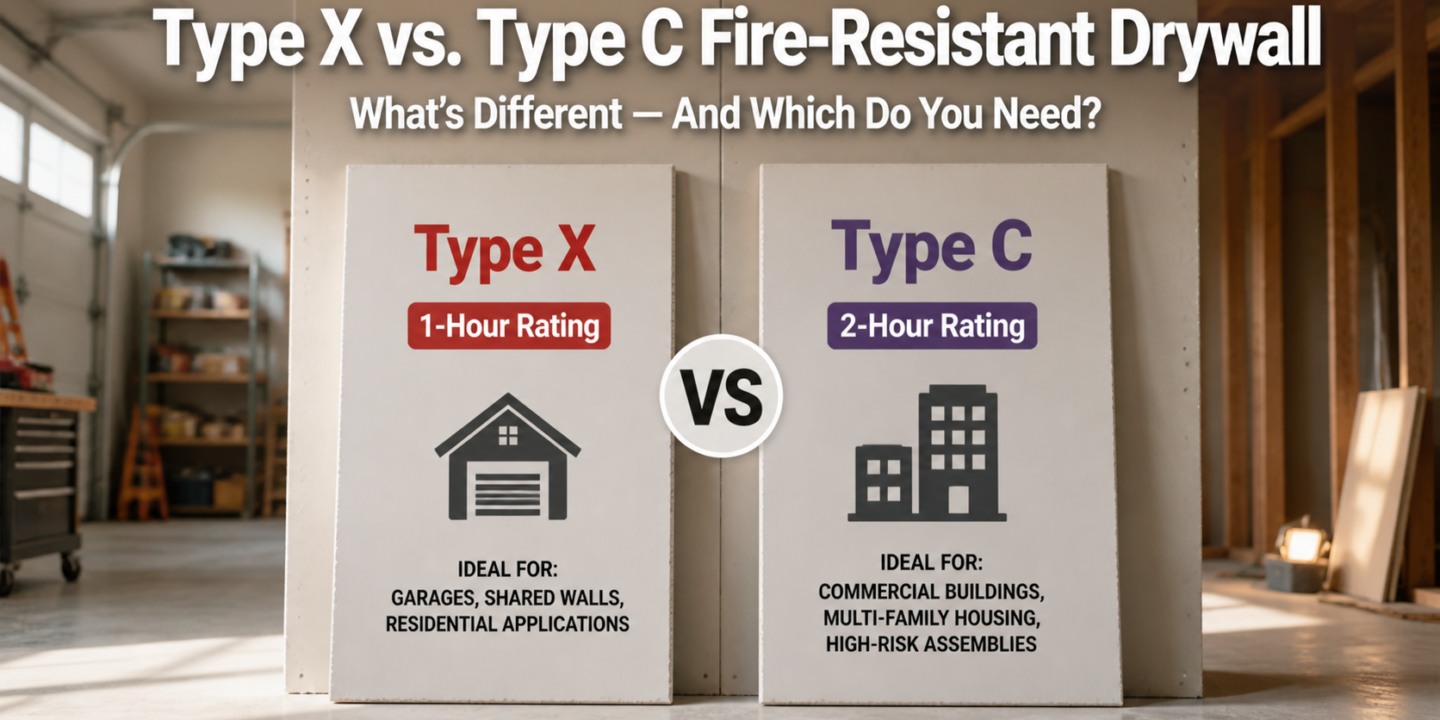



Picture this: you're finishing your attached garage, converting it into a workshop, or renovating the basement utility room — and your contractor mentions you need "fire-rated drywall." You nod along, then head to the hardware store and find two products with nearly identical names sitting next to each other on the shelf: Type X and Type C.
Same thickness. Similar price. Both labeled "fire-resistant." So what's actually different?
Fire-resistant drywall is a specially engineered panel designed to slow the spread of fire through a wall or ceiling assembly, buying occupants critical time to evacuate. It's required by building code in dozens of specific applications — and using the wrong type, or skipping it entirely, can mean a failed inspection at best and a genuine safety hazard at worst.
This guide breaks down exactly what Type X and Type C fire-resistant drywall are, how they work, where each is required, and how to decide which one belongs in your project.
Key Takeaways
- The Primary Difference: While both are fire-rated, Type X uses fiberglass for structural integrity, whereas Type C contains additives like vermiculite that expand when heated to prevent shrinkage and gaps.
- Residential Gold Standard: For most home projects—including attached garages and utility rooms—Type X (5/8-inch) is the code-compliant and standard choice.
- When to Use Type C: Type C is typically reserved for commercial buildings or high-risk assemblies (like elevator shafts) where a 2-hour fire rating must be achieved with a single layer of drywall.
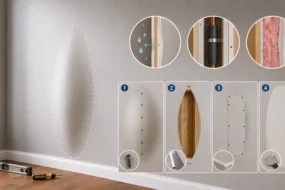
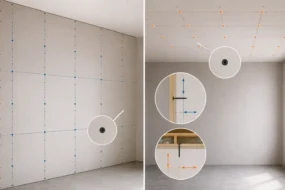
- It’s a System, Not Just a Sheet: A fire rating applies to the entire wall assembly. To maintain the rating, you must follow specific fastener spacing, use fire-rated joint compound, and seal all penetrations (like electrical boxes).
- Worth the Upgrade: Upgrading from standard to Type X drywall costs roughly $8–$12 more per panel, but it can double the time your wall resists fire penetration, providing critical minutes for evacuation.
What Makes Drywall Fire-Resistant?
To understand the difference between the two types, you first need to understand how standard drywall behaves in a fire and why that's a problem. While standard panels are the most common choice for general finishing, you can explore the full range of options in our complete guide to the different types of drywall to see how fire-rated boards compare to moisture-resistant or soundproof alternatives
How Standard Drywall Fails
Regular gypsum drywall actually has some passive fire resistance built in. Gypsum contains chemically bound water — about 21% by weight — that must be driven off as steam before the core begins to deteriorate. This process is called calcination, and it buys time. But as the water evaporates, the gypsum core crumbles and loses structural integrity. The paper facing ignites. The wall collapses. In a standard wall assembly, this can happen in 20–30 minutes.
What Fire-Rated Drywall Does Differently
Fire-rated drywall slows this process in three ways:
1. Non-combustible glass fiber reinforcement. Both Type X and Type C panels have fiberglass strands mixed directly into the gypsum core. When the gypsum begins to calcine and crumble, the glass fibers hold the core together — like rebar in concrete — maintaining the wall's integrity longer.
2. Thicker panel construction. Fire-rated panels are almost always ⅝ inch thick (vs. ½ inch for standard drywall). More mass means more time required to heat through.
3. Shrinkage-compensating additives (Type C only). More on this below — this is the key technical difference between the two types.
What Does a "1-Hour Fire Rating" Actually Mean?
A fire rating doesn't describe the panel alone — it describes a tested wall or ceiling assembly. A "1-hour rated assembly" means that a specific combination of framing, insulation, fasteners, and drywall type was tested in a furnace at temperatures exceeding 1,700°F, and the assembly maintained structural integrity and prevented flame penetration for at least 60 minutes.
The rating is for the complete system, not just the drywall sheet. This is why fastener spacing, joint compound type, and even electrical box placement all matter for maintaining a rated assembly.
What Is Type X Drywall?
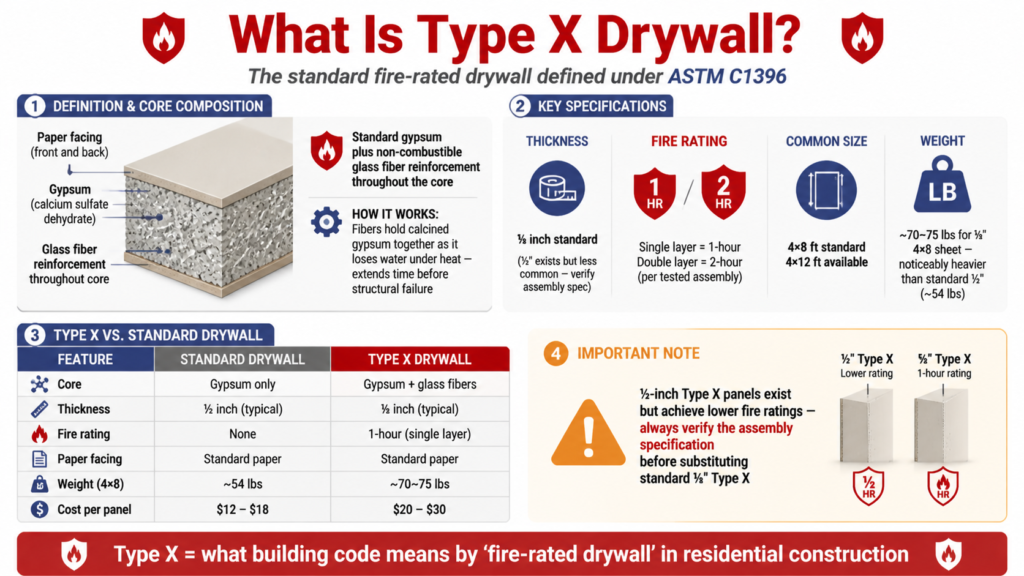
Type X is the standard fire-rated drywall product, defined under ASTM C1396 (the manufacturing standard for gypsum board). It is the baseline product the building code refers to when fire-rated drywall is required in residential construction.
Core composition: Standard gypsum plus non-combustible glass fiber reinforcement distributed throughout the core. The fibers hold the calcined gypsum together as it loses water under heat, significantly extending the time before structural failure.
Standard thickness: ⅝ inch. A ½-inch Type X panel exists but is less common and achieves lower fire ratings — always verify the assembly specification before substituting.
Fire rating:
- Single layer of ⅝" Type X: typically 1-hour fire resistance
- Double layer of ⅝" Type X: typically 2-hour fire resistance (dependent on the specific tested assembly)
Common panel size: 4×8 ft standard, with 4×12 ft available. Expect panels to weigh approximately 70–75 lbs for a ⅝" 4×8 sheet — noticeably heavier than the ~54 lbs of a standard ½" panel.
How it differs from standard drywall at a glance:
| Feature | Standard Drywall | Type X |
| Core | Gypsum only | Gypsum + glass fibers |
| Thickness | ½ inch (typical) | ⅝ inch (typical) |
| Fire rating | None | 1-hour (single layer) |
| Paper facing | Standard paper | Standard paper |
| Weight (4×8) | ~54 lbs | ~70–75 lbs |
| Cost | $12–$18/panel | $20–$30/panel |
What Is Type C Drywall?
Type C is an enhanced version of Type X — it meets and exceeds the Type X standard by incorporating additional ingredients that address a specific failure mode that Type X doesn't fully solve.
The Problem Type C Solves
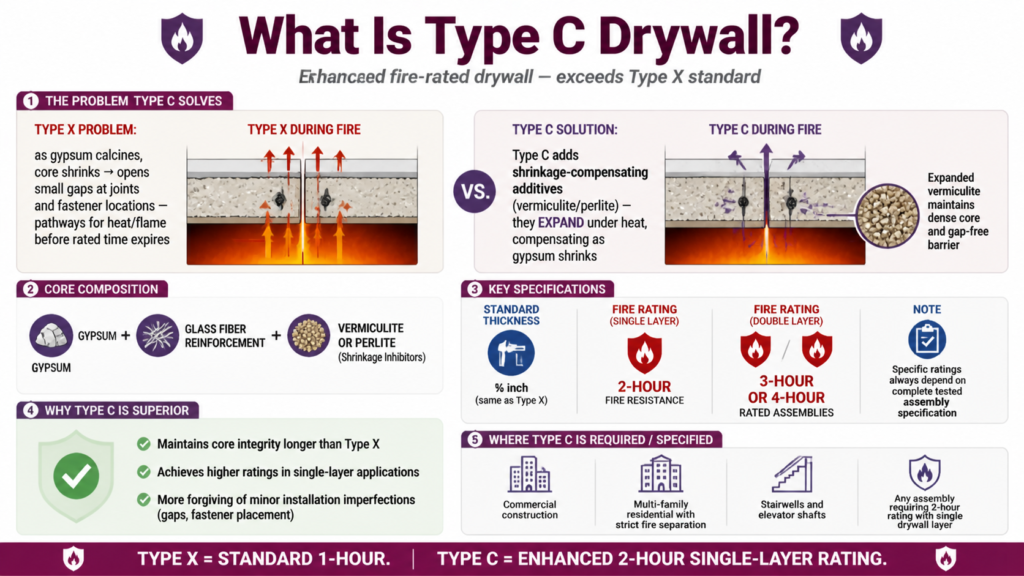
Here's what happens to Type X during a fire: as the gypsum calcines and the glass fibers hold the crumbling core together, the core still tends to shrink. In a real fire, this shrinkage can open small gaps at joints and fastener locations — pathways for heat and flame to penetrate before the rated time is up.
Type C adds shrinkage-compensating additives — typically vermiculite or perlite — to the gypsum core. These materials do the opposite of shrinking: when exposed to intense heat, they expand. As the gypsum shrinks, the vermiculite expands to compensate, keeping the core dense and gap-free significantly longer than Type X.
Core composition: Gypsum + glass fiber reinforcement + vermiculite or perlite shrinkage inhibitors
Standard thickness: ⅝ inch (same as Type X)
Fire rating:
- Single layer: typically 2-hour fire resistance
- Double layer: can achieve 3-hour or 4-hour rated assemblies
- Note: specific ratings always depend on the complete tested assembly specification
Why it's considered superior: Type C maintains core integrity longer, achieves higher ratings in single-layer applications, and is more forgiving of minor installation imperfections (gaps, fastener placement) than Type X.
When manufacturers specify Type C over Type X: Commercial construction, multi-family residential with strict fire separation requirements, stairwells and elevator shafts, and any assembly where a 2-hour rating must be achieved with a single layer of drywall.
Type X vs. Type C — Side-by-Side Comparison
| Feature | Type X | Type C |
| Core additive | Glass fibers | Glass fibers + shrinkage inhibitors (vermiculite/perlite) |
| Standard thickness | ⅝ inch | ⅝ inch |
| Typical fire rating (single layer) | 1 hour | 2 hours |
| Typical fire rating (double layer) | 2 hours | 3–4 hours |
| Shrinkage resistance | Moderate | High |
| Cost per panel | $20–$30 | $25–$40 |
| Primary use | Garages, shared walls, residential | Commercial, high-risk assemblies, multi-family |
| IRC code minimum? | Yes, in most residential applications | Required in specific high-rated assemblies |
| Availability | Every hardware store | Specialty suppliers, some big-box stores |
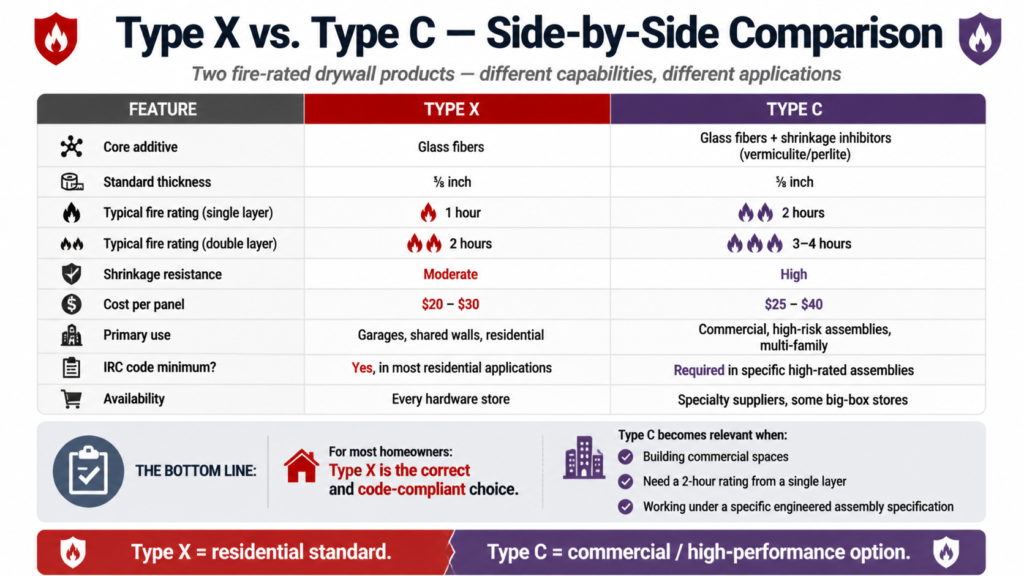
The bottom line: For most homeowners, Type X is the correct and code-compliant choice. Type C becomes relevant when you're building commercial spaces, need a 2-hour rating from a single layer, or are working under a specific engineered assembly specification.
Where Is Fire-Resistant Drywall Required?
This is the section that matters most for your actual project decision. Fire code requirements vary by jurisdiction, but the International Residential Code (IRC) sets the baseline that most local codes follow. Here's where fire-rated drywall is required — and what's typically specified.
A. Attached Garages
This is the most common residential application. The wall and ceiling separating an attached garage from the living space is a critical fire barrier — garage fires spread fast due to fuel (vehicles, stored chemicals) and typically have no early warning before spreading into the home.
IRC Section R302.6 requires fire separation between the garage and the dwelling. The typical minimum is:
- ½-inch drywall on the garage side of the separation wall (minimum)
- ⅝-inch Type X required when the garage is below a habitable room
Most local codes and building departments require Type X as the practical standard for garage separation walls. If in doubt, use Type X — it's not significantly more expensive and eliminates ambiguity at inspection.
What goes wrong without it: According to the U.S. Fire Administration, residential fires cause an average of 2,500 civilian deaths and $7 billion in property damage annually — and vehicle fires in attached garages are among the fastest-spreading house fire scenarios due to stored fuel and chemicals. A garage fire against standard drywall can breach the living space wall in under 30 minutes. Type X extends that barrier to 60+ minutes — enough time for occupants to evacuate and for fire suppression to respond.
B. Garage Ceilings Below Living Space
When the garage sits below a bedroom, living room, or any habitable space, the ceiling of the garage must be fire-rated as well. This typically requires:
- ⅝-inch Type X on the ceiling of the garage
- In some assemblies, fire-resistant insulation above the drywall layer
The garage ceiling is often the most overlooked application — many renovation projects correctly address the wall separation but forget the ceiling.
C. Shared Walls Between Units (Townhomes and Duplexes)
The wall separating two units in a townhome, duplex, or semi-detached home is called a fire separation wall or party wall. These assemblies typically require a 1-hour or 2-hour fire rating depending on the building type:
- 1-hour assembly: Often achievable with Type X (single or double layer, depending on the specific assembly)
- 2-hour assembly: May require double-layer Type X or single-layer Type C, depending on the tested assembly specification
These requirements come from IRC Section R302.3 for two-family dwellings. Multi-family construction follows the stricter IBC (International Building Code), which typically demands 2-hour fire-rated assemblies.
D. Basement and Utility Rooms
Furnace rooms, mechanical rooms, and boiler rooms in basements are common code-required fire-rating locations. The logic: these spaces contain ignition sources (furnaces, water heaters, electrical panels) and combustible materials, making them higher-risk for fire origin.
Requirements vary significantly by local code — some jurisdictions require Type X in any mechanical room; others only require it when the room is adjacent to sleeping areas. Check with your local building department before assuming standard drywall is acceptable.
E. Commercial Buildings
In commercial construction governed by the IBC, fire-rating requirements escalate significantly:
- Stairwells and exit corridors: 1–2 hour rated assemblies typically required
- Elevator shafts: 2-hour assemblies common
- High-rise corridors: 2-hour assemblies; Type C becomes the practical specification
- Occupancy separations (e.g., restaurant above retail): Can require 3-hour rated assemblies
This is where Type C becomes essential. Achieving a 2-hour rating from a single drywall layer is significantly easier with Type C than stacking two layers of Type X. Labor cost and wall thickness often make Type C the more economical choice in commercial applications.
F. Voluntary Upgrades — When Should You Go Beyond Code Minimum?
Building code sets the minimum — not the optimal. Consider upgrading voluntarily in these situations:
- Home workshops or hobby rooms adjacent to living space (chemical storage, welding equipment)
- Home theaters — often packed with electronics in enclosed spaces
- Rental properties — fire separation between landlord and tenant spaces
- Attached ADUs (accessory dwelling units) — even where not required, fire separation adds genuine protection
- Homes in wildfire-prone areas — exterior-facing assemblies in high-fire-hazard zones
The cost difference between standard and Type X is typically $8–$12 per panel. For a single garage wall, that's a $50–$80 total upgrade for a meaningful safety improvement.
How to Check Your Local Fire Code Requirements
The most important thing to understand: Building codes in the US are not uniform. The IRC and IBC provide model codes, but every state and municipality can adopt, amend, or replace them. What's required in one county may not be required in the next.
How to find your local requirements:
- Identify your local building department. Search "[your city/county] building department" — most have websites with code references.
- Ask specifically about "fire separation requirements" for your project type (garage, shared wall, utility room). Building department staff are typically helpful with code clarification questions.
- Look for the adopted code version. Many jurisdictions have adopted the 2021 IRC but with local amendments. The amendments matter.
- Pull a permit. If your project involves new drywall in a fire-rated application, pulling a permit means your work gets inspected. That inspection protects you — a licensed inspector confirms the assembly meets code before you close the wall.
When to work with a contractor vs. DIY: Fire-rated assemblies are DIY-friendly in terms of installation — the drywall goes up the same way. The complexity is in specifying the correct assembly. If you're doing this yourself, research the specific tested assembly before buying materials. UL (Underwriters Laboratories) maintains a publicly searchable Fire Resistance Directory where you can look up exact assembly specifications — framing type, insulation, drywall type, fastener pattern — for any rated wall or ceiling configuration. Match your installation to a listed assembly exactly. If you're unsure, a consultation with a licensed contractor is worth the hour.
Installation Tips for Fire-Rated Drywall
Fire-rated drywall installs similarly to standard drywall, but several details matter for maintaining the integrity of the rated assembly.
Plan for the weight. A ⅝-inch Type X 4×8 panel weighs 70–75 lbs. That's manageable solo for walls, but ceiling installation genuinely requires two people or a drywall lift. Don't attempt ⅝-inch ceiling drywall solo — injury risk is real and panel damage is almost guaranteed.
Follow fastener spacing requirements exactly. Rated assemblies specify fastener type, diameter, and spacing — a common requirement is screws every 8 inches in the field and 6 inches at edges. The Gypsum Association's GA-600 Fire Resistance Design Manual is the industry reference document for rated gypsum assemblies and lists tested configurations in detail. Deviating from the tested assembly's fastener pattern technically voids the rating, even if the drywall itself is correct.
Use fire-rated joint compound and tape. Standard joint compound is acceptable in most residential fire-rated assemblies. However, some commercial assemblies specify fire-rated (intumescent) tape and compound. Check your specific assembly requirements.
Address every penetration. This is where most DIY fire-rated assemblies fail. Every opening through a fire-rated wall — electrical boxes, pipes, wiring penetrations — must be fire-stopped. Electrical boxes in fire-rated walls require fire-rated boxes or intumescent putty pads behind standard boxes. Pipes need intumescent collars. An unsealed penetration effectively nullifies the assembly's fire rating at that location.
Do not mix Type X and standard drywall in a rated assembly. If the assembly spec calls for ⅝-inch Type X, the entire assembly must use Type X. Substituting one or two sheets of standard drywall to save money creates weak points that the fire will find first.
Cost Comparison
| Product | Avg. Cost per Panel | Typical Project Cost (Single Garage Wall ~20 panels) |
| Standard ½" drywall | $12–$18 | $240–$360 |
| Type X ⅝" drywall | $20–$30 | $400–$600 |
| Type C ⅝" drywall | $25–$40 | $500–$800 |
| Double-layer Type X | $40–$60 (combined) | $800–$1,200 |
Labor cost considerations: Type X and Type C cost more to install than standard drywall, primarily because of weight. A crew that can hang 50 sheets of ½-inch drywall per day may only manage 35–40 sheets of ⅝-inch Type X. Budget for slightly higher labor hours, particularly on ceiling work.
Is upgrading beyond code minimum worth it? In most residential applications, yes. The material premium between standard and Type X is modest — typically $200–$400 for a full garage separation wall. Given that the application is specifically a fire barrier, the cost-benefit calculation is obvious. The upgrade to Type C over Type X is harder to justify in standard residential projects unless the assembly specification requires it.
FAQ
Is ⅝-inch drywall always fire-rated? No. Thickness alone does not determine fire rating. ⅝-inch standard (non-rated) drywall exists and is commonly used for ceilings and commercial applications for its rigidity. Fire rating comes from the core composition (glass fibers, shrinkage inhibitors) and the specific tested assembly — not thickness alone. Always look for the "Type X" or "Type C" designation on the panel edge stamp.
Can I use Type X in place of Type C? It depends on what the assembly specification requires. In most standard residential applications (garage separation walls, party walls at 1-hour rating), Type X meets code. If the specification calls for Type C — or if you need a 2-hour rating from a single layer — Type X is not a direct substitute. Check the specific assembly specification, not just the fire rating number.
What's the difference between fire-resistant and fireproof drywall? Nothing is truly fireproof. "Fire-resistant" is the accurate term — these products resist fire for a rated duration, they don't prevent fire damage indefinitely. Any drywall will eventually fail given sufficient time and heat exposure. The ratings describe time-to-failure under standardized test conditions, not absolute protection.
Does fire-rated drywall need special paint? No special paint is required, and standard latex paint does not affect fire rating. However, avoid thick insulating paint products (sometimes marketed for energy efficiency) — some of these have not been tested in rated assemblies and could theoretically affect performance. Standard interior paint, applied normally, is always safe on fire-rated drywall.
How do I know if my existing drywall is Type X? Look at the long edges of the panel (the factory edges, not cut edges). Type X panels have a stamp or printing along the edge that includes the manufacturer name, product type, thickness, and "Type X" designation. If you're looking at installed drywall with no visible edges, the only reliable method is to remove a section for inspection — or assume it's standard drywall unless you have documentation otherwise.
Can I install fire-rated drywall myself? Yes — the installation process is the same as standard drywall. The critical requirements are following the specific tested assembly (correct fastener spacing, fire-stopping penetrations, correct tape and compound), not the physical installation technique. If you're comfortable hanging standard drywall, Type X is equally DIY-friendly. The weight is the biggest practical challenge.
Conclusion
The choice between Type X and Type C fire-resistant drywall comes down to what your assembly specification requires — and in most residential projects, that's Type X.
Type X is the standard code-compliant product for garages, party walls, and residential fire separation applications. It achieves a 1-hour rating in a single layer and meets IRC requirements for the vast majority of residential use cases. If your contractor or building department says "fire-rated drywall," Type X is almost certainly what they mean.
Type C is the enhanced product — more expensive, higher rated in single-layer applications, and primarily specified for commercial construction, multi-family residential, and assemblies where a 2-hour rating must be achieved without doubling up panels.
The most important takeaway: fire rating is a system, not a product. The drywall panel, framing, insulation, fastener pattern, and penetration details all contribute to the assembly's performance. Get the panel right, then get the rest of the assembly right too.
When in doubt about what your specific project requires, contact your local building department before you buy materials — not after the drywall is up.


Elena Hart is the founder and lead writer of Better Home Pro. She writes about drywall, home repair, and practical DIY home improvement topics, focusing on clear, useful information that helps homeowners make better decisions. Her work combines firsthand experience, manufacturer documentation, industry resources, and careful research to create content that is accurate, practical, and easy to understand. Through Better Home Pro, Elena aims to simplify complex home improvement topics and provide guidance that is genuinely helpful to homeowners and DIYers.








No Comments