{
“@context”: “https://schema.org”,
“@type”: “FAQPage”,
“mainEntity”: [
{
“@type”: “Question”,
“name”: “Is green board the same as water-resistant drywall?”,
“acceptedAnswer”: {
“@type”: “Answer”,
“text”: “Yes. ‘Green board’ and ‘moisture-resistant drywall’ are the same product. The green color is a functional design choice that helps contractors and building inspectors easily identify moisture-resistant panels on a job site.”
}
},
{
“@type”: “Question”,
“name”: “Can green board get wet during construction?”,
“acceptedAnswer”: {
“@type”: “Answer”,
“text”: “Brief exposure to rain during the framing stage is usually fine, but prolonged saturation is dangerous. If panels become significantly wet, they must be allowed to dry completely. Any panels that show signs of swelling or core damage should be replaced.”
}
},
{
“@type”: “Question”,
“name”: “Does green board prevent mold growth?”,
“acceptedAnswer”: {
“@type”: “Answer”,
“text”: “Not reliably. While green board resists moisture absorption, it does not contain antimicrobial agents. For superior mold protection, ‘purple board’ is a better alternative as it includes specific inhibitors to prevent mold and mildew.”
}
},
{
“@type”: “Question”,
“name”: “Can I use green board on a bathroom ceiling?”,
“acceptedAnswer”: {
“@type”: “Answer”,
“text”: “Yes, but you must use a product specifically rated for ceilings. Standard green board can sag if joist spacing is too wide. Look for moisture-resistant panels rated for 12-inch on-center framing from manufacturers like USG or Georgia-Pacific.”
}
},
{
“@type”: “Question”,
“name”: “Do I need a vapor barrier behind green board?”,
“acceptedAnswer”: {
“@type”: “Answer”,
“text”: “This depends on your specific climate zone. In cold climates, a vapor retarder is often required on the warm side of the wall. However, in hot or mixed climates, a vapor barrier can trap moisture. Always consult your local building code for regional requirements.”
}
},
{
“@type”: “Question”,
“name”: “Is green board required by code in bathrooms?”,
“acceptedAnswer”: {
“@type”: “Answer”,
“text”: “Many jurisdictions require water-resistant backing in humid areas. However, modern codes often exclude green board from wet zones like shower surrounds, where cement board is now the standard requirement. Check your local IRC amendments for specifics.”
}
}
]
}
Green board is one of those building materials that gets used in a lot of the right places — and a surprising number of the wrong ones. It’s more capable than regular drywall, but less capable than many homeowners and even some contractors assume. Understanding where that line falls can save you from a mold problem, a failed tile installation, or a costly tear-out a few years down the road.
Quick answer: Moisture-resistant drywall (green board) is ideal for rooms with elevated ambient humidity — bathrooms away from the shower surround, kitchens, laundry rooms, and garages. It is not suitable for any surface with direct water contact, including shower surrounds, tub enclosures, steam rooms, or below-grade walls. For those applications, cement board or a glass-mat tile backer is required.
Key Takeaways:
Green board is engineered with a wax-treated core and coated face paper to handle high humidity and steam, but it will fail if exposed to direct, standing, or running water.
While ideal for bathroom walls, kitchens, and laundry rooms, green board should never be used as a tile substrate in showers or tub surrounds; these areas require cement board or glass-mat backers.
The distinctive green paper facing is a functional coding system that allows contractors and building inspectors to quickly verify that moisture-resistant panels are installed in the correct humid zones.
To prevent structural failure, panels must be installed with a 1/2-inch gap from the floor to stop “wicking” moisture, and all cut edges must be sealed to protect the untreated gypsum core.
Standard green board resists water absorption but lacks antimicrobial agents; for areas prone to mold growth, upgrading to “purple board” provides the necessary mold-inhibiting treatment.
What Is Green Board Drywall?
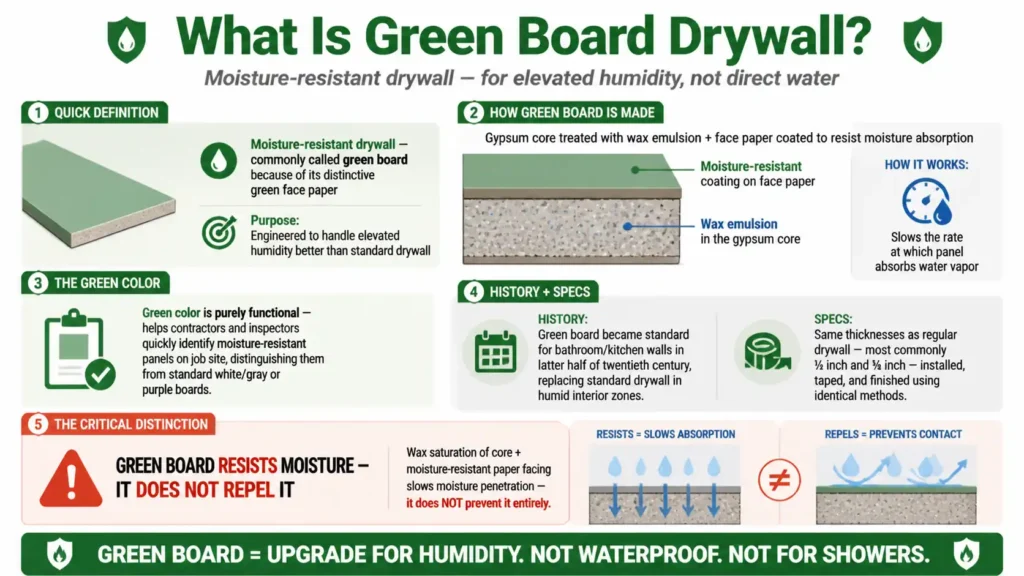
Moisture-resistant drywall commonly called green board because of its distinctive green face paper — is one of the most essential specialized panels in the industry. As outlined in our comprehensive types of drywall guide, this specific gypsum panel is engineered to handle elevated humidity significantly better than standard drywall. The gypsum core is treated with a wax emulsion, and the face paper is coated to resist moisture absorption. That combination slows the rate at which the panel absorbs water vapor, making it a sensible upgrade in rooms where steam and condensation are part of daily life.
The green color is purely functional. It helps contractors and inspectors quickly identify moisture-resistant panels on a job site, distinguishing them from standard white or gray drywall and from the purple boards used in higher-performance applications. You can verify panel specifications against the American Wood Council and Gypsum Association, the primary trade body setting quality standards for all gypsum products.
Green board became a standard recommendation for bathroom and kitchen walls in the latter half of the twentieth century, replacing standard drywall in humid interior zones. It comes in the same thicknesses as regular drywall — most commonly ½ inch and ⅝ inch — and is installed, taped, and finished using identical methods.
How green board is made
The core of green board is standard gypsum, the same calcium sulfate dihydrate used in all drywall. What makes it different is the wax saturation of that core and the moisture-resistant treatment applied to the paper facing. Together, these slow moisture penetration rather than preventing it entirely. This is an important distinction: green board resists moisture — it does not repel it. For a deeper look at gypsum chemistry, the USGS National Minerals Information Center publishes ongoing statistics and material properties for gypsum in the United States
Green board vs. purple board vs. cement board
These three products are frequently confused, but they serve meaningfully different purposes.
Product
Core material
Resistance
Best use
Green board
Wax-treated gypsum
Moisture (humidity)
Humid rooms away from direct water
Purple board
Enhanced gypsum
Moisture + mold + mildew
High-humidity rooms, improved longevity
Cement board (Durock, HardieBacker)
Portland cement + fiberglass mesh
Fully waterproof substrate
Shower surrounds, tub enclosures, wet floors
Glass-mat board (DensShield)
Gypsum + fiberglass mat facing
Moisture + mold, near-waterproof
Wet areas, high-performance tile substrate
Moisture resistance vs. waterproof: the critical distinction
This is the single most important concept in this guide. Moisture-resistant means the panel slows the rate of water absorption. Waterproof means water cannot penetrate the material. Green board is the former, not the latter. Prolonged or direct water contact will eventually saturate the gypsum core, causing swelling, crumbling, and mold growth.
No amount of paint, primer, or sealer applied over green board changes this — the vulnerability is in the core, not the surface. The EPA’s Mold Course (Chapter 2) explains exactly how mold colonizes building materials, including saturated gypsum — helpful context if you’re advising clients on health risks.
Where to Use Moisture-Resistant Drywall
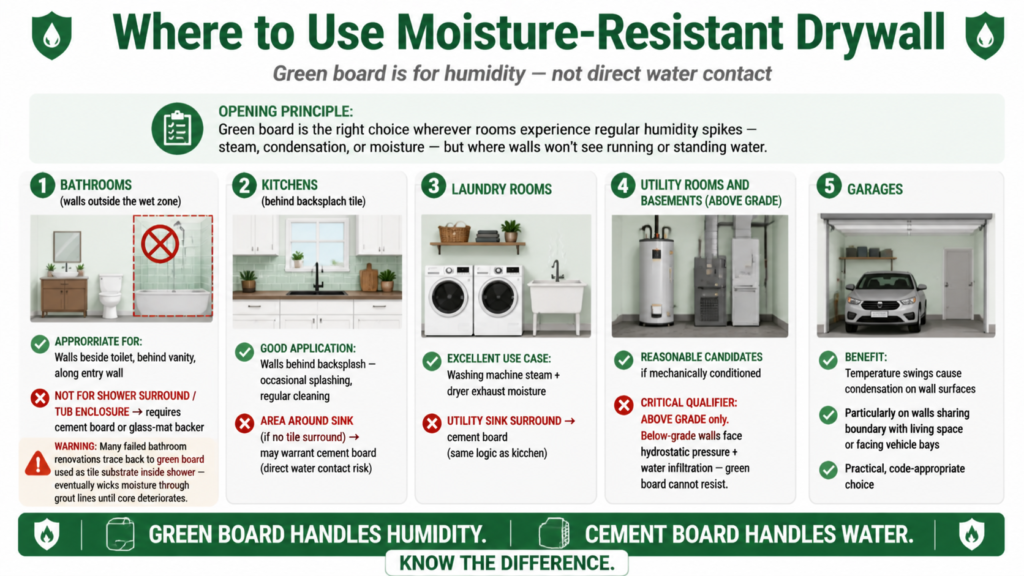
Green board is the right choice wherever a room experiences regular humidity spikes — steam from a shower, condensation from a washing machine, or moisture from an attached garage — but where the walls themselves won’t be subjected to running or standing water.
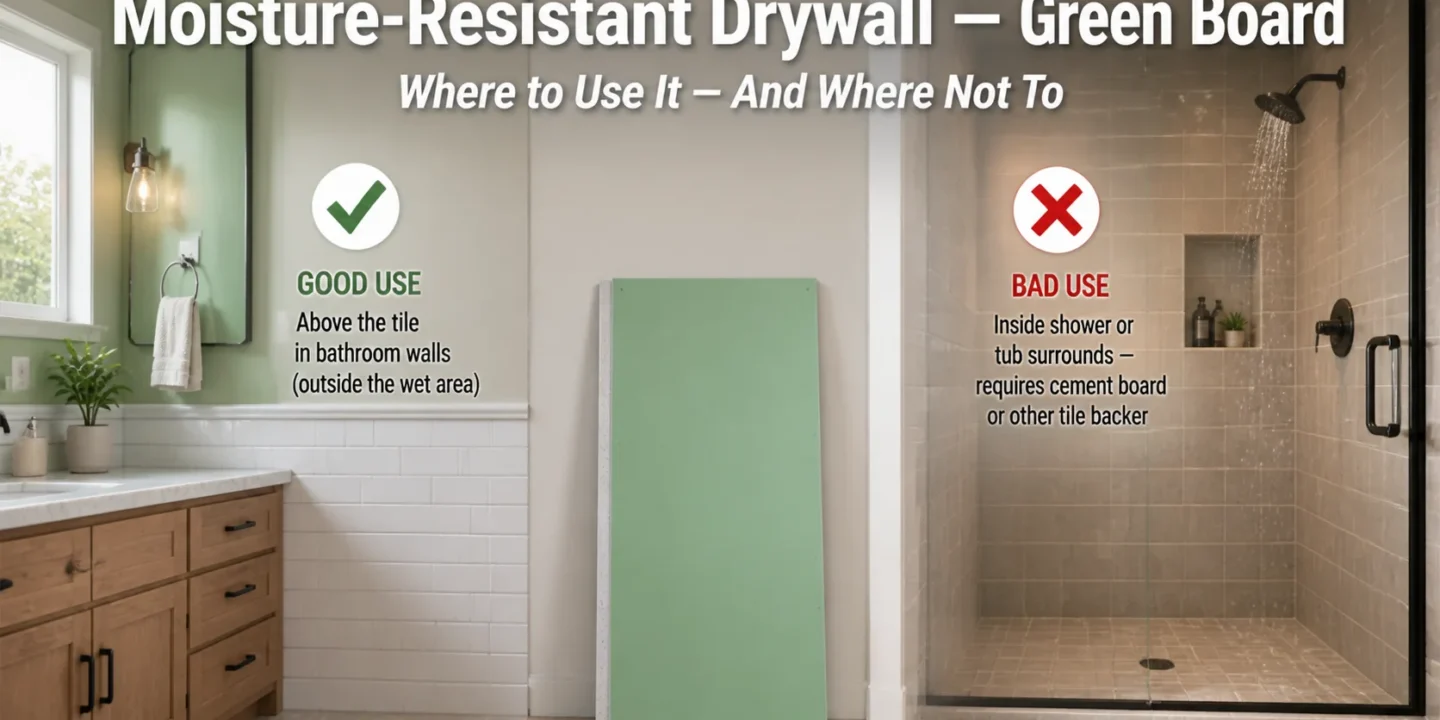
In a typical bathroom, green board is appropriate for everything except the shower surround and tub enclosure. The walls beside the toilet, behind the vanity, and along the entry wall are all appropriate for green board. For bathroom ventilation requirements that directly affect how hard green board has to work, see IRC Section R303 (Ventilation) — proper exhaust fan sizing is one of the best investments you can pair with green board.
The shower surround — any surface within the tile or stone installation that may contact spray or splash — requires cement board or a glass-mat backer. Many failed bathroom renovations trace back to this misapplication: green board used as a tile substrate inside the shower, which eventually wicks moisture through grout lines until the core deteriorates.
Kitchens (behind backsplash tile)
The walls behind a kitchen backsplash are a good application for green board. These surfaces see occasional splashing and regular cleaning but are not exposed to sustained water flow. Green board behind ceramic or porcelain tile provides a stable, humidity-tolerant substrate for most kitchen installations.
The area directly around the sink — especially if it lacks a tile surround — may warrant upgrading to cement board, since it can receive more direct water contact during dishwashing.
Laundry rooms
Laundry rooms are an excellent use case. Washing machines generate steam during the wash cycle, and dryers — particularly those without adequate exhaust — push warm, moist air into the room. Green board handles this environment well. If the laundry is also home to a utility sink, follow the same logic as a kitchen: use cement board for the surround immediately around the sink.
Utility rooms and basements (above grade)
Above-grade utility rooms and finished basement walls that sit above the slab are reasonable candidates for green board, particularly if the space is mechanically conditioned. Humidity from HVAC equipment, water heaters, and general basement air can be managed well with moisture-resistant panels.
The critical qualifier here is above grade. Below-grade walls face hydrostatic pressure and potential water infiltration that green board cannot resist.
Garages
Attached garages benefit from green board, particularly on walls that share a boundary with the living space or that face the vehicle bays. Temperature swings cause condensation on wall surfaces, and a garage attached to a home can funnel significant humidity into adjacent spaces. Green board is a practical, code-appropriate choice in this context.
Attached garages benefit from green board, particularly on walls that face the vehicle bays where temperature swings cause condensation. However, walls sharing a boundary with the living space often have strict safety requirements; in these cases, you may need to choose between moisture resistance and the fire-blocking properties found in Type X vs. Type C fire-resistant drywall.
Where NOT to Use Green Board
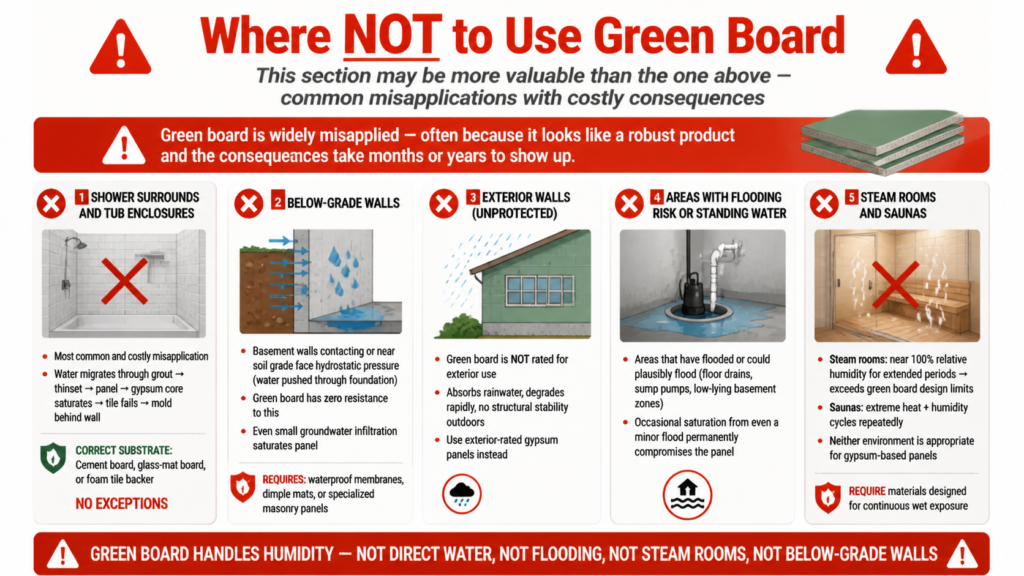
This section may be more valuable than the one above. Green board is widely misapplied — often because it looks like a robust product and the consequences of misuse take months or years to show up.
Shower surrounds and tub enclosures
This is the most common and costly misapplication of green board. Any wall surface inside a shower or tub enclosure — whether tiled or not — will eventually be penetrated by water if green board is used as the substrate. Water migrates through tile grout, through the thinset mortar layer, and ultimately into the panel. Once the gypsum core is saturated, the tile installation fails and mold establishes itself behind the wall.
The correct substrate for a shower surround is cement board, glass-mat board, or a foam tile backer. No exceptions.
Below-grade walls
Basement walls that contact or are near the soil grade face hydrostatic pressure — water being pushed through the foundation from outside. Green board has no resistance to this. Even a small amount of groundwater infiltration will saturate a panel installed on a below-grade wall. These applications require waterproof membranes, dimple mats, or specialized masonry panels depending on the severity of the moisture condition.
Exterior walls (unprotected)
Green board is not rated for exterior use. It will absorb rainwater, degrade rapidly, and provide no structural stability in an outdoor environment. If you’re building an outdoor structure that requires a gypsum-type panel, products specifically rated for exterior use are available — green board is not one of them.
Areas with flooding risk or standing water
Any area that has flooded in the past, or that could plausibly flood — near a floor drain, adjacent to a sump pump, or in a low-lying basement zone — should not have green board installed. The occasional saturation from a flooding event, even a minor one, is enough to compromise the panel permanently.
Steam rooms and saunas
Steam rooms operate at or near 100% relative humidity for extended periods. This sustained saturation exceeds the design limits of green board, regardless of how well it is installed. Saunas cycle through extreme heat and humidity repeatedly. Neither environment is appropriate for gypsum-based panels. These spaces require materials specifically designed for continuous wet exposure.
Green Board vs. Alternatives: Which Should You Choose?
Green board vs. cement board
Cement board (sold as Durock, HardieBacker, and similar brands) is an entirely different class of material. It is made from Portland cement reinforced with fiberglass mesh, and it is genuinely waterproof. Water does not degrade it. The trade-off is that it is heavier, harder to cut, and more expensive than green board.
The decision rule is simple: if the surface will have direct water contact — a shower wall, tub surround, or steam room — use cement board. If the surface will have elevated humidity but no direct water contact, green board is appropriate and more cost-effective.
Green board vs. purple board
Purple board (USG’s Sheetrock brand is the most well-known) adds mold and mildew resistance on top of the moisture resistance found in green board. The gypsum core is treated with an antimicrobial agent that inhibits mold growth even if the panel gets damp.
Purple board is worth the modest price premium in spaces where you want added insurance — a master bathroom, a finished basement, or anywhere that has had mold issues in the past. It is installed exactly like green board and accepts the same finishing materials.
Green board vs. DensShield and glass-mat boards
Glass-mat boards like DensShield use a fiberglass mat facing instead of paper, which eliminates the organic material that mold needs to colonize. They are significantly more moisture-resistant than green board — some are rated as a tile backer for shower applications — while being easier to work with than cement board.
These are a middle tier worth considering when cement board feels like overkill but green board feels insufficient. They cost more than green board but less than full cement board installation, and they accept tile directly.
Decision table: room type → recommended product
Location
Condition
Recommended product
Bathroom walls (outside shower)
Humid
Green board or purple board
Shower surround / tub enclosure
Direct water
Cement board or glass-mat backer
Kitchen backsplash wall
Splash / humid
Green board
Kitchen sink surround
Direct splash
Cement board
Laundry room walls
Humid
Green board
Laundry room sink surround
Direct splash
Cement board
Basement walls (above grade)
Humid
Green board or purple board
Basement walls (below grade)
Hydrostatic
Waterproof membrane + masonry panel
Garage (interior walls)
Condensation
Green board
Steam room / sauna
Continuous wet
Specialty wet-area board
Installation Tips for Green Board
Green board installs like standard drywall in most respects, but a few details matter more because of the moisture environment it operates in.
Correct fasteners and spacing
Use corrosion-resistant screws — coated or galvanized — rather than standard drywall screws, which can rust and stain in humid environments. Space fasteners at 8 inches in the field and 6 inches along edges, consistent with standard drywall practice.
Sealing cut edges and joints
This is the step most often skipped, and the one that matters most. The cut edges of green board expose the untreated gypsum core. Any cut — along the top, bottom, or where panels are trimmed around fixtures — should be sealed with a waterproof compound or silicone caulk before the panel is installed. Unsealed edges are the primary point of moisture entry.
Joint compound and tape at seams should also be applied with care. Some manufacturers recommend a moisture-resistant joint compound for green board installations.
Keeping it off the floor
Green board should never rest directly on the subfloor or concrete slab. Maintain a minimum ½-inch clearance at the bottom of every panel. This gap prevents the panel from wicking moisture up from the floor — a slow but reliable way to saturate a gypsum core over time. The gap will be covered by baseboard trim.
Painting and finishing
Green board requires a high-quality primer before painting, particularly in humid applications. A moisture-resistant or vapor-barrier primer helps slow the movement of water vapor through the finished wall. Latex paints formulated for bathroom and kitchen use are appropriate; avoid flat finishes in high-humidity areas, as they absorb moisture and are difficult to clean.
Building code considerations
The International Residential Code (IRC) specifies that water-resistant gypsum backing board is required in bathrooms and similar areas where surface materials are attached. However, codes in many jurisdictions have been updated to exclude green board from the shower surround — requiring cement board or equivalent instead. Always check your local amendments to the IRC before specifying materials. A building inspector who finds green board inside a shower surround during a rough inspection will flag it.
Frequently Asked Questions
Is green board the same as water-resistant drywall?
Yes — “green board” and “moisture-resistant drywall” refer to the same product. The green color comes from the moisture-resistant paper facing and helps contractors identify it on site.
Can green board get wet during construction?
Brief exposure to rain during framing is generally acceptable, but prolonged saturation is not. If green board gets significantly wet during the build, allow it to dry completely before covering it. Panels that have swelled or show surface damage should be replaced.
Does green board prevent mold?
Not reliably. Green board resists moisture absorption but does not contain antimicrobial agents. If the panel becomes saturated — due to a leak, flooding, or misapplication — mold can and will grow. Purple board, which includes mold inhibitors, is a better choice if mold prevention is a priority.
How long does green board last in a bathroom?
Properly installed in a humid-only application (not a shower surround), green board should last the life of the building — decades. Problems arise when it’s used in direct-water zones or when installation details like edge sealing and floor clearance are neglected.
Do I need a vapor barrier behind green board?
This depends on your climate zone and wall assembly. In cold climates, a vapor retarder on the warm side of the wall (between the insulation and the drywall) is often required by code. In mixed or hot climates, vapor retarders can cause moisture to accumulate rather than escape. Consult your local building code and a building science resource specific to your region.
Can I use green board on the ceiling of a bathroom?
Yes, with the right product. Standard green board is not rated for ceiling use at standard joist spacing because of sag resistance requirements. Look for moisture-resistant drywall specifically rated for ceilings, typically ½-inch panels rated for 12-inch on-center framing. USG and Georgia-Pacific both make ceiling-rated moisture-resistant panels.
Is green board required by code in bathrooms?
Many jurisdictions require water-resistant backing in bathrooms and similar humid areas. However, requirements vary significantly by location, and some codes now require cement board specifically for tile installations in wet zones. Check your local code before specifying materials — and remember that code compliance is the floor, not the ceiling, of good practice.
The Bottom Line
Green board is a reliable, cost-effective upgrade for humid rooms — as long as it stays in the humid zone and out of the wet zone. The line between those two zones runs along the edge of your shower surround and the bottom of your tub enclosure. Everything on the humid side of that line is a good application for green board. Everything on the wet side requires cement board, glass-mat backer, or another material designed for direct water contact.
Get that distinction right, and green board will serve you well for decades. Get it wrong, and you’ll be doing the job twice.
Elena Hart is the founder and lead writer of Better Home Pro.
She writes about drywall, home repair, and practical DIY home improvement topics, focusing on clear, useful information that helps homeowners make better decisions.
Her work combines firsthand experience, manufacturer documentation, industry resources, and careful research to create content that is accurate, practical, and easy to understand.
Through Better Home Pro, Elena aims to simplify complex home improvement topics and provide guidance that is genuinely helpful to homeowners and DIYers.








No Comments