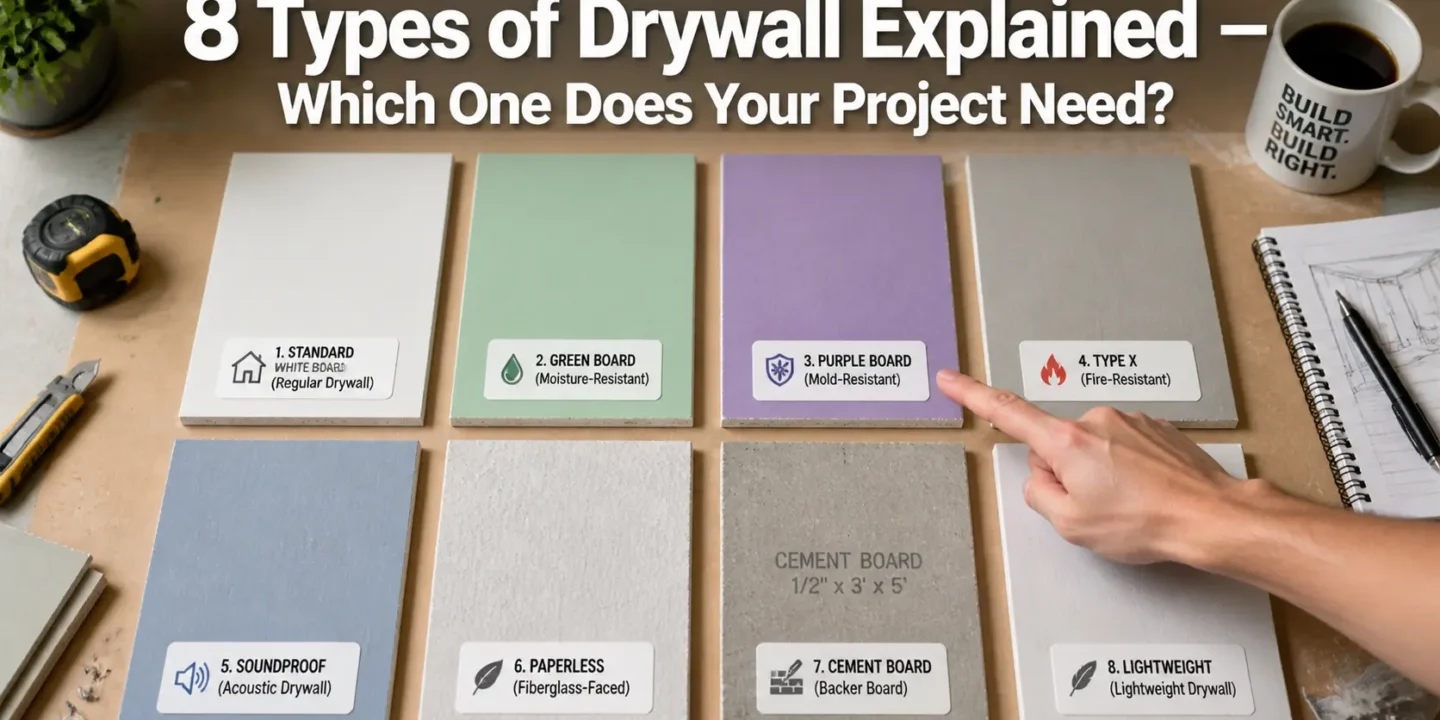



Walk into any hardware store and you’ll find green board, purple board, Type X, Type C, cement board, and paperless drywall all stacked side by side — with zero explanation of what goes where. Most homeowners grab the cheapest option and hope for the best. That’s how you end up with mold in your bathroom wall or a failed garage inspection.
This guide covers all 8 types of drywall you’ll encounter, explains exactly where each one belongs, and — just as importantly — tells you what goes wrong when you pick the wrong one. By the end, you’ll know precisely which types of drywall to buy for every room in your home, without guessing.
What is Drywall?
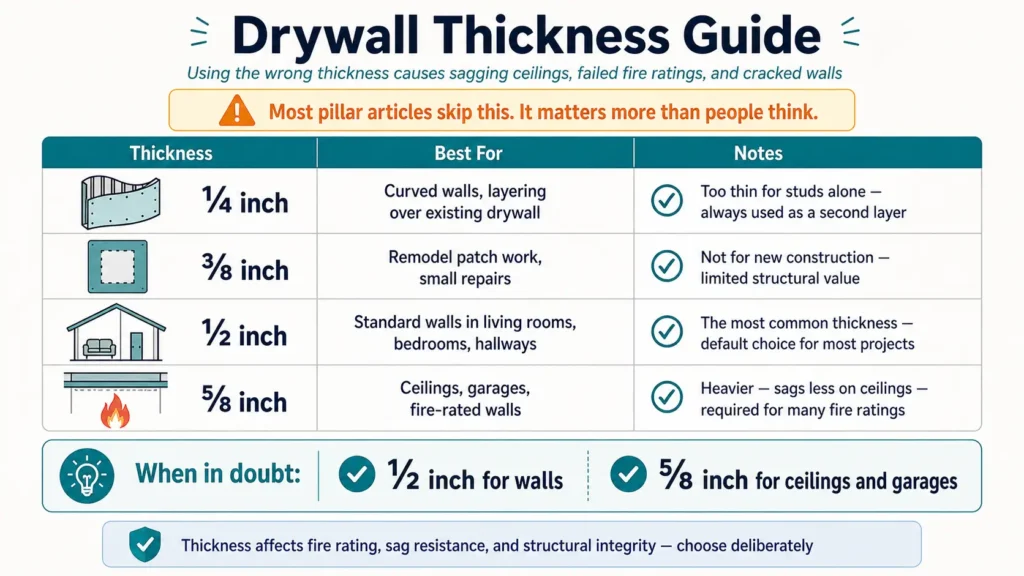
Drywall is a panel made from a gypsum plaster core pressed between two layers of paper — one smooth (the face) and one rougher (the back). It’s manufactured in large sheets, screwed to wall studs, taped at the seams, and finished with joint compound before painting.
You’ll also hear it called gypsum board, sheetrock (a brand name, like Kleenex), or wallboard. It replaced traditional plaster walls in the mid-20th century because it’s dramatically faster to install, cheaper to produce, and easier to repair.
Standard sheets come in 4×8 ft panels, though 4×12 ft sheets are available for fewer seams. Thickness ranges from ¼ inch to 1 inch depending on the application.
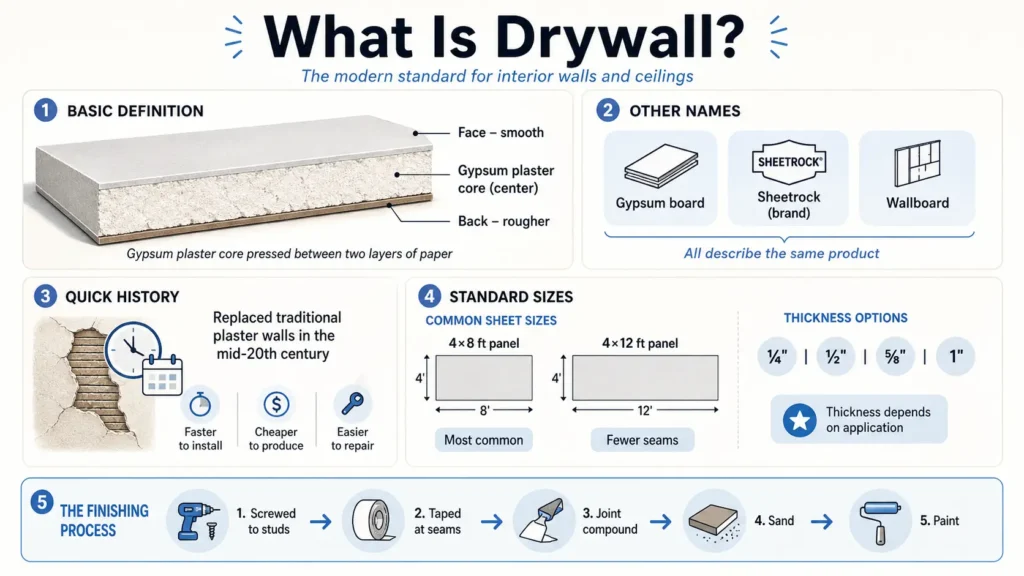
Drywall Thickness Guide
Most pillar articles skip this. It matters more than people think — using the wrong thickness causes sagging ceilings, failed fire ratings, and cracked walls.
| Thickness | Best For | Notes |
| ¼ inch | Curved walls, layering over existing drywall | Too thin for studs alone; always used as a second layer |
| ⅜ inch | Remodel patch work, small repairs | Not for new construction; limited structural value |
| ½ inch | Standard walls in living rooms, bedrooms, hallways | The most common thickness — default choice for most projects |
| ⅝ inch | Ceilings, garages, fire-rated walls | Heavier, sags less on ceilings; required for many fire ratings |
Quick rule: When in doubt, use ½ inch for walls and ⅝ inch for ceilings and garages.
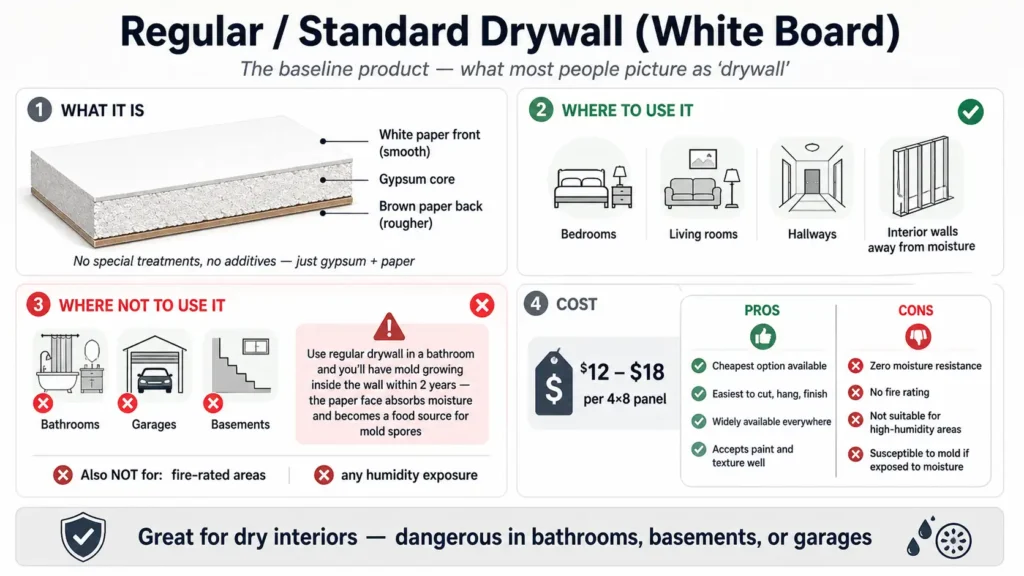
1. Regular / Standard Drywall (White Board)
What it is: This is the baseline product — a gypsum core sandwiched between white paper on the front and brown paper on the back. No special treatments, no additives. It’s what most people picture when they hear the word “drywall.”
Unlike specialty products used as a base for veneer plaster, standard drywall is designed specifically for taping, mudding, sanding, and painting
Where to use it:
- Bedrooms
- Living rooms
- Hallways
- Interior walls away from moisture
Where NOT to use it: Bathrooms, garages, basements, or anywhere with humidity or fire-rating requirements. Use regular drywall in a bathroom and you’ll have mold growing inside the wall within 2 years — the paper face absorbs moisture and becomes a food source for mold spores.
Average cost: $12–$18 per 4×8 panel
Pros:
- Cheapest option available
- Easiest to cut, hang, and finish
- Widely available at every hardware store
- Accepts paint and texture well
Cons:
- Zero moisture resistance
- No fire rating
- Not suitable for high-humidity areas
- Susceptible to mold if exposed to any moisture
2. Moisture-Resistant Drywall (Green Board)
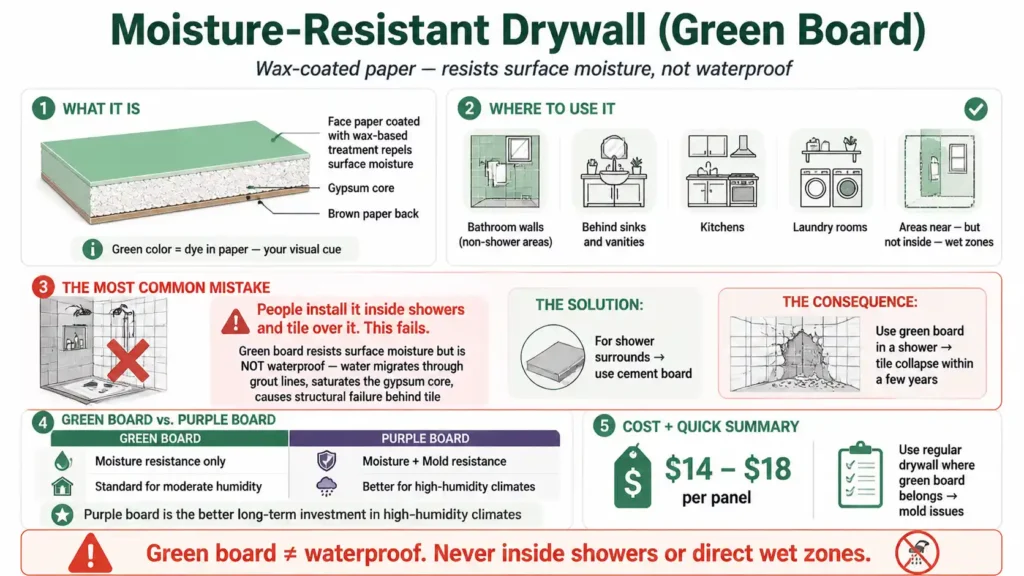
What it is: Green board looks like standard drywall but its face paper is coated with a wax-based treatment that repels surface moisture. The green color is simply the dye used in the paper — it’s your visual cue that you’re dealing with a moisture-resistant product.
Where to use it:
- Bathroom walls (non-shower areas)
- Behind sinks and vanities
- Kitchens
- Laundry rooms
- Areas near — but not inside — wet zones
The most common mistake with green board: people install it inside showers and tile over it — and it fails. As This Old House tile contractor Joe Ferrante explains in their guide on why green board fails in shower surrounds even when tiled over, green board is moisture-resistant but is not waterproof — water migrates through grout lines, saturates the gypsum core, and causes structural failure behind the tile. For shower surrounds, cement board is the only correct choice.
Use regular drywall where green board belongs and you’ll have mold issues; use green board in a shower and you’ll have a tile collapse within a few years.
Green board vs. purple board: Green board handles moisture only. Purple board handles both moisture and mold. If you’re in a high-humidity climate, purple board is the better long-term investment.
Average cost: $14–$18 per panel
Check out our head-to-head analysis of purple board vs. green board drywall for a full breakdown of their cost differences and core treatments
3. Fire-Resistant Drywall (Type X and Type C)
This is the highest-traffic spoke topic in the drywall category — and for good reason. Fire-resistant drywall is required by building code in many applications, and choosing the wrong product (or skipping it entirely) can result in failed inspections and real safety hazards.
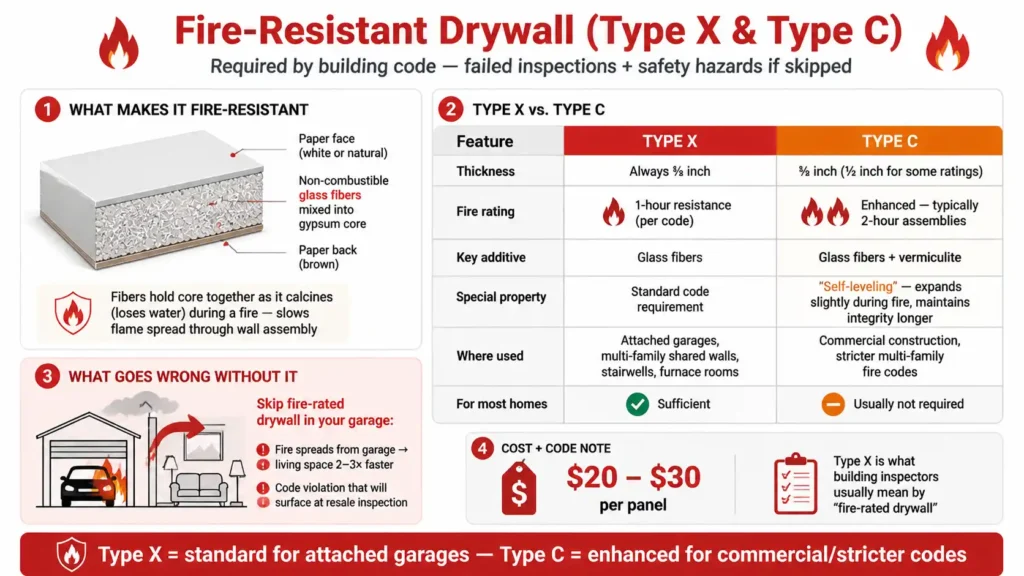
What makes it fire-resistant: Unlike standard drywall, fire-rated panels contain non-combustible glass fibers mixed into the gypsum core. These fibers hold the core together as it calcines (loses water) during a fire, slowing the spread of flames through the wall assembly.
Type X Drywall
- Thickness: Always ⅝ inch
- Fire rating: 1-hour fire resistance when installed per code
- Where required: Attached garages (the wall between garage and living space), shared walls in multi-family homes, stairwells, furnace rooms
Type X is the standard code-required product. If your building inspector asks for fire-rated drywall, this is almost certainly what they mean.
Type C Drywall
- Thickness: ⅝ inch (also available in ½ inch for some ratings)
- Fire rating: Enhanced — typically 2-hour rated assemblies
- Key difference: Type C contains additional vermiculite or other materials that make it “self-leveling.” When the gypsum core calcines in a fire, it expands slightly, maintaining integrity longer than Type X.
Type C is used in commercial construction and multi-family residential projects with stricter fire code requirements. For most single-family homeowners, Type X is sufficient.
What goes wrong without it: Skip fire-rated drywall in your garage and a house fire spreads from the garage into the living space 2–3× faster. It’s also a code violation that will surface at resale inspection.
Average cost: $20–$30 per panel
4. Soundproof / Acoustic Drywall
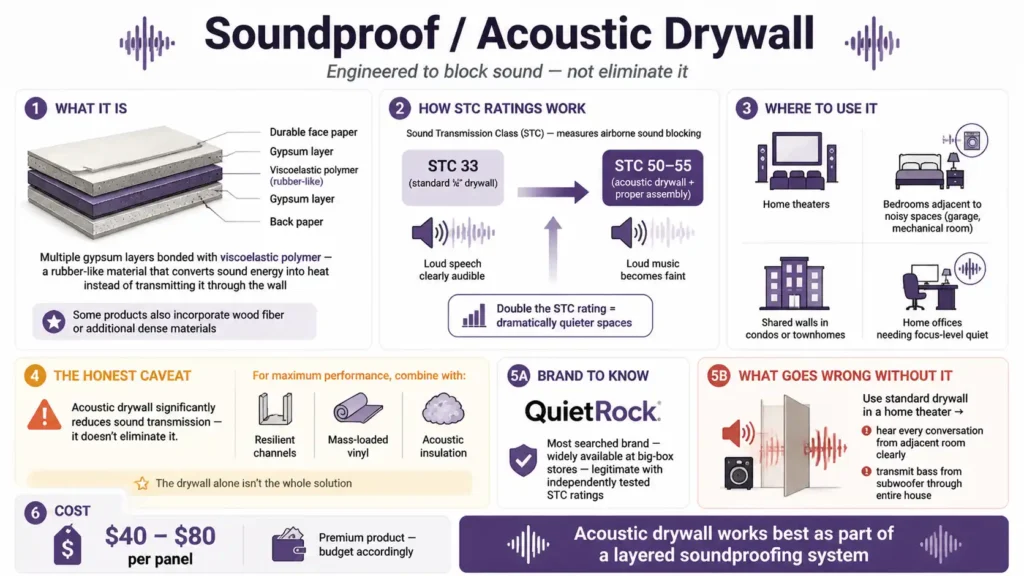
What it is: Acoustic drywall is engineered with multiple layers of gypsum bonded with a viscoelastic polymer — a rubber-like material that converts sound energy into heat rather than transmitting it through the wall. Some products also incorporate wood fiber or additional dense materials.
How STC ratings work: Sound Transmission Class (STC) measures how well a wall assembly blocks airborne sound. A standard ½-inch drywall wall assembly scores roughly STC 33 — meaning loud speech is clearly audible. Double it with acoustic drywall and proper assembly and you can reach STC 50–55, where loud music becomes faint.
Where to use it:
- Home theaters
- Bedrooms adjacent to noisy spaces (garage, mechanical room)
- Shared walls in condos or townhomes
- Home offices needing focus-level quiet
The honest caveat: Acoustic drywall significantly reduces sound transmission — it doesn’t eliminate it. For maximum performance, combine it with resilient channels, mass-loaded vinyl, and acoustic insulation. The drywall alone isn’t the whole solution.
Brand to know: QuietRock is the most searched brand in this category and widely available at big-box stores. It’s a legitimate product with independently tested STC ratings. For a complete look at how to properly insulate your space and select the right STC levels, read our deep dive into soundproof drywall options
What goes wrong without it: Use standard drywall in a home theater and you’ll hear every conversation from the adjacent room clearly. Worse, you’ll transmit bass from your subwoofer through the entire house.
Average cost: $40–$80 per panel (premium product — budget accordingly)
5. Mold-Resistant Drywall (Purple Board)
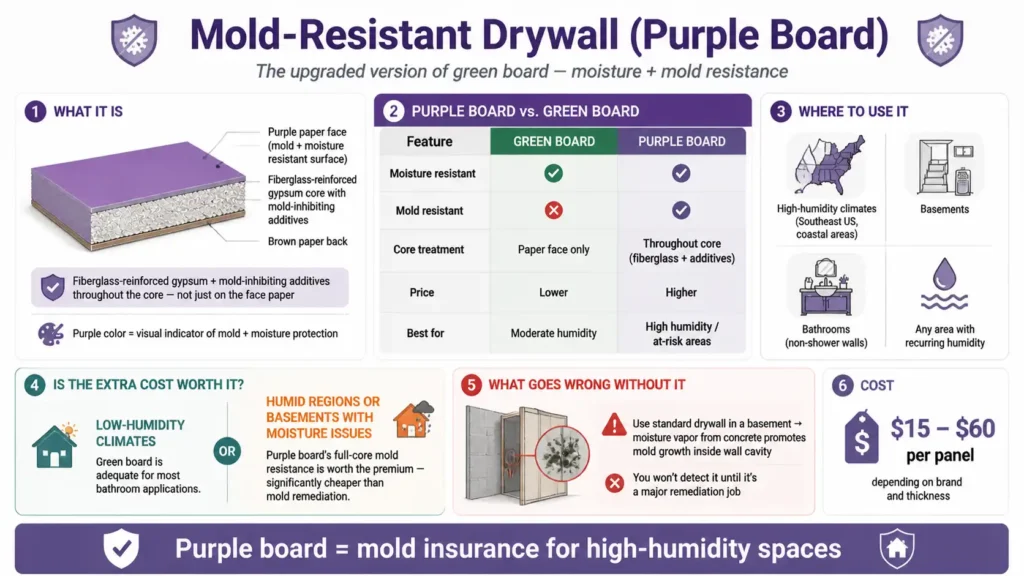
What it is: Purple board is the upgraded version of green board. The purple color indicates a product that has been treated to resist both moisture and mold — the two often go together, but the treatments are different. Purple board typically uses fiberglass-reinforced gypsum and mold-inhibiting additives throughout the core, not just on the face.
Purple board vs. green board — the real difference:
| Feature | Green Board | Purple Board |
| Moisture resistant | ✓ | ✓ |
| Mold resistant | ✗ | ✓ |
| Core treatment | Paper face only | Throughout core |
| Price | Lower | Higher |
Where to use it:
- High-humidity climates (Southeast US, coastal areas)
- Basements
- Bathrooms (non-shower walls)
- Any area with recurring humidity
Is the extra cost worth it? In low-humidity climates, green board is adequate for most bathroom applications. In humid regions or basements with known moisture issues, purple board’s full-core mold resistance is worth the premium — it’s significantly cheaper than mold remediation.
What goes wrong without it: Use standard drywall in a basement and moisture vapor from concrete will promote mold growth inside the wall cavity, which you won’t detect until it’s a major remediation job.
Average cost: $15–$60 per panel depending on brand and thickness
6. Paperless Drywall (Fiberglass-Faced)
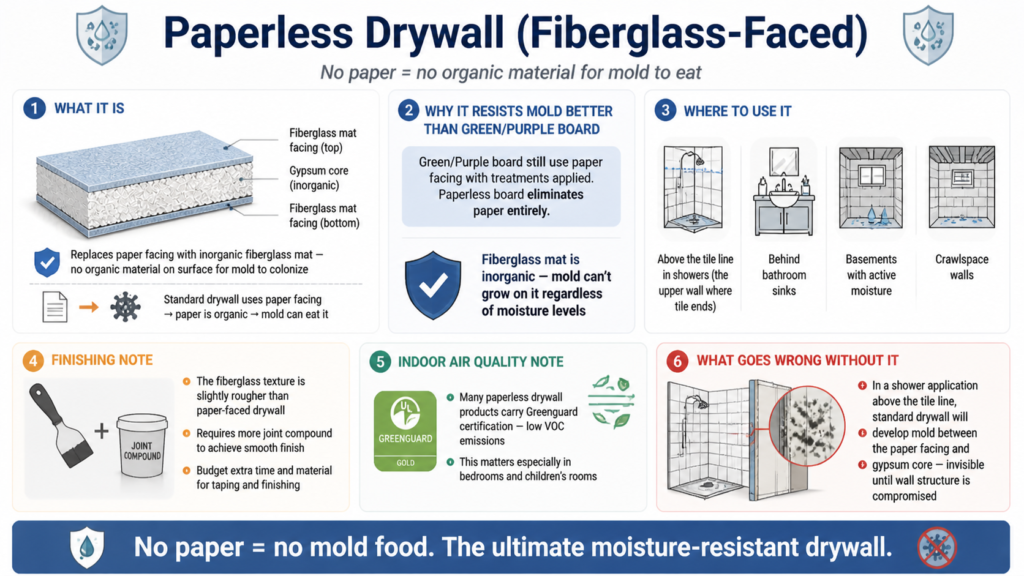
What it is: Standard drywall uses paper facing — and paper is ultimately organic, which means mold can eat it. Paperless drywall solves this by replacing the paper facing with a fiberglass mat. There’s no organic material on the surface for mold to colonize.
Why it resists mold better than green or purple board: Green and purple board still use paper facing with treatments applied. Paperless board eliminates the paper entirely. The fiberglass mat is inorganic — mold can’t grow on it regardless of moisture levels.
Where to use it:
- Above the tile line in showers (the upper wall where tile ends)
- Behind bathroom sinks
- Basements with active moisture
- Crawlspace walls
One finishing note: The fiberglass texture is slightly rougher than paper-faced drywall. It requires more joint compound to achieve a smooth finish — budget extra time and material for taping and finishing.
Indoor air quality note: Many paperless drywall products carry Greenguard certification, meaning they meet strict VOC emission standards. This matters especially in bedrooms and children’s rooms.
What goes wrong without it: In a shower application above the tile line, standard drywall will develop mold between the paper facing and the gypsum core — invisible from the outside until the wall structure is compromised.
7. Cement Board (Backer Board)
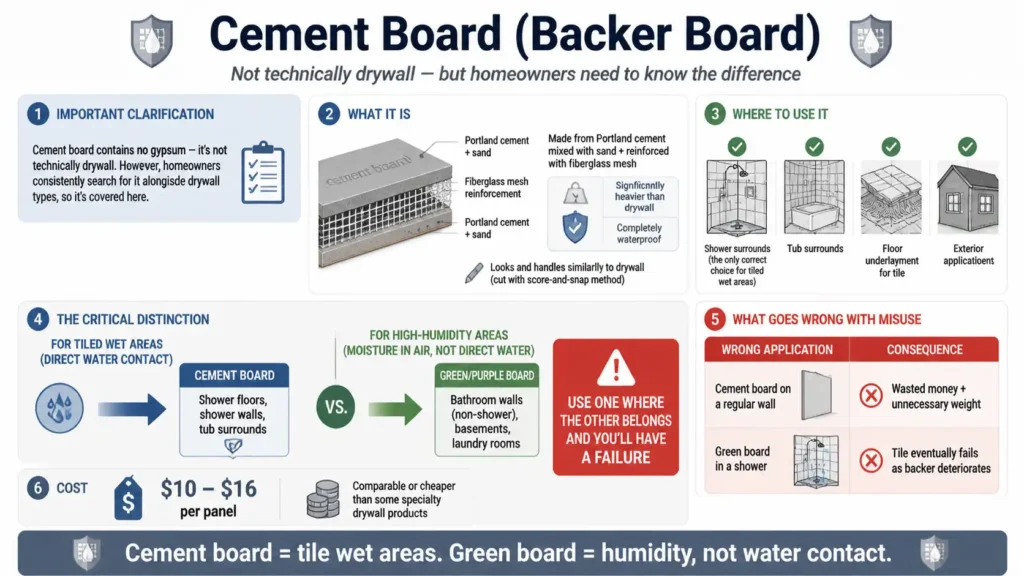
Important clarification: Cement board is not technically drywall — it contains no gypsum. However, homeowners consistently search for it alongside drywall types, so it’s covered here.
What it is: Cement board is made from Portland cement mixed with sand and reinforced with fiberglass mesh. It looks and handles similarly to drywall (cut with a score-and-snap method) but is significantly heavier and completely waterproof.
Where to use it:
- Shower surrounds (the only correct choice for tiled wet areas)
- Tub surrounds
- Floor underlayment for tile
- Exterior applications
The key distinction: Cement board is for tiled wet areas — places where water will directly contact the surface. Green board and purple board are for high-humidity areas — places with moisture in the air but not direct water contact. Use one where the other belongs and you’ll have a failure.
Put cement board on a regular wall and you’ve wasted money and added unnecessary weight. Use green board in a shower and your tile will eventually fail as the backer deteriorates.
Average cost: $10–$16 per panel
If you’re still undecided on which material fits your layout, look over our direct comparison of cement board vs. drywall to map out your project accurately.
8. Lightweight Drywall
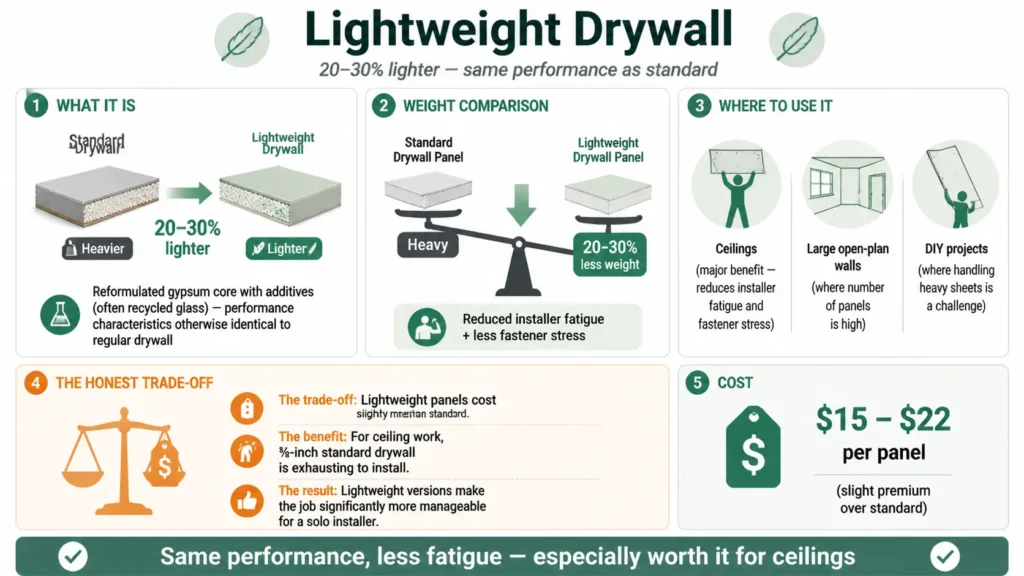
What it is: Lightweight drywall uses a reformulated gypsum core with additives (often recycled glass) that reduce panel weight by 20–30% compared to standard panels. The performance characteristics are otherwise identical to regular drywall.
Where to use it:
- Ceilings (major benefit — reduces installer fatigue and fastener stress)
- Large open-plan walls where the number of panels is high
- DIY projects where handling heavy sheets is a challenge
The honest trade-off: Lightweight panels cost slightly more than standard. The benefit is real for ceiling work — ⅝-inch standard drywall on a ceiling is exhausting to install. Lightweight versions make the job significantly more manageable for a solo installer.
Average cost: $15–$22 per panel (slight premium over standard)
Quick-Pick Comparison Table
| Type | Color | Best For | Avoid Using In | Avg. Cost/Panel |
| Regular (Standard) | White/brown | Bedrooms, living rooms, hallways | Bathrooms, garages, basements | $12–$18 |
| Moisture-Resistant (Green Board) | Green | Bathroom walls, kitchens, laundry | Shower surrounds, basements | $14–$18 |
| Fire-Resistant Type X | Gray/white | Garages, shared walls, stairwells | Low-priority interior walls (overkill) | $20–$30 |
| Fire-Resistant Type C | Gray/white | Commercial, 2-hr rated assemblies | Residential where Type X suffices | $22–$35 |
| Soundproof / Acoustic | White | Home theaters, shared walls, offices | Small budget projects | $40–$80 |
| Mold-Resistant (Purple Board) | Purple | Humid climates, basements, bathrooms | Dry interior rooms (overkill) | $15–$60 |
| Paperless (Fiberglass-Faced) | White/gray | Wet areas above tile line, basements | Standard rooms (finishing is harder) | $18–$28 |
| Cement Board | Gray | Shower surrounds, tile floors | Any non-tiled area | $10–$16 |
How to Choose the Right Drywall: Room by Room
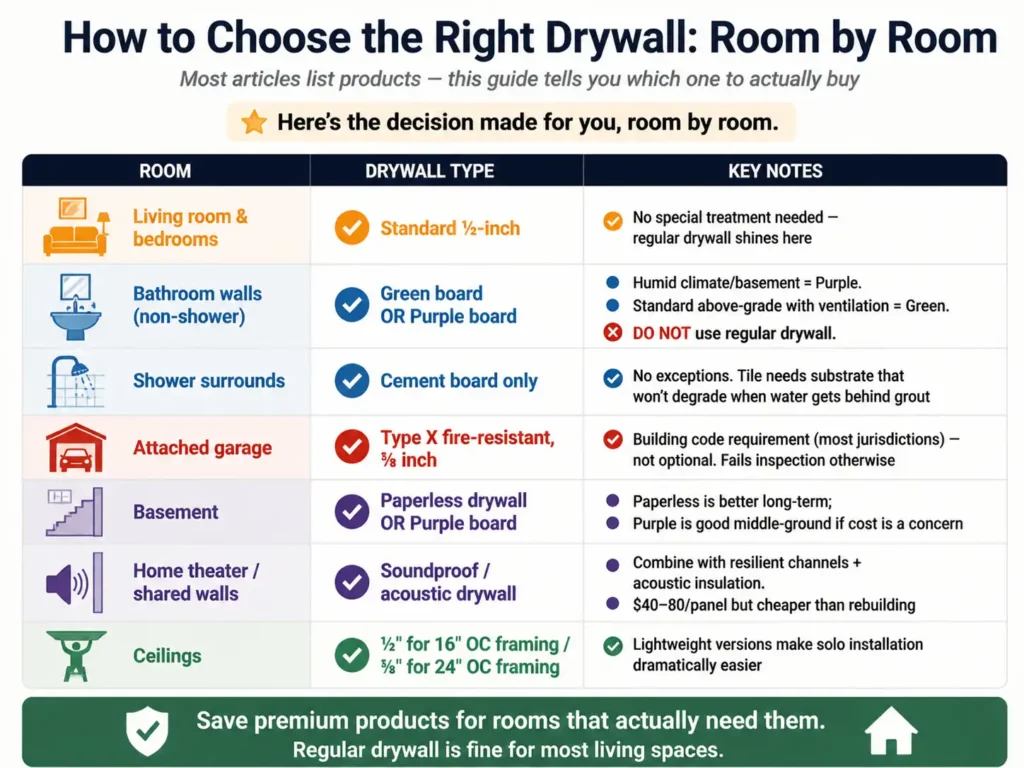
This is where most “types of drywall” articles fall short — they list the products but don’t tell you which one to actually buy. Here’s the decision made for you, room by room.
Living room and bedrooms: Standard ½-inch drywall. No special treatment needed. This is the most common application and where regular drywall shines. Save the premium products for rooms that actually need them.
Bathroom walls (non-shower): Green board or purple board. If you’re in a humid climate or the bathroom is in a basement, choose purple board. If it’s a standard above-grade bathroom with good ventilation, green board is sufficient. Either way, do not use regular drywall — the paper face will absorb steam and humidity over time.
Shower surrounds: Cement board only. No exceptions. This is the one non-negotiable in the list — tile needs a substrate that won’t degrade when water gets behind the grout lines, and only cement board provides that.
Attached garage: Type X fire-resistant drywall, ⅝ inch, on all walls and ceilings that connect to the living space. This is a building code requirement in most jurisdictions, not optional. Use standard drywall here and you’ll fail inspection.
Basement: Paperless drywall or purple board. Basements have chronic humidity from concrete off-gassing, and any paper-faced product will eventually develop mold. Paperless is the better long-term choice; purple board is a good middle-ground if cost is a concern.
Home theater or shared walls: Soundproof / acoustic drywall. Combine with resilient channels and acoustic insulation for maximum performance. Budget for it — at $40–$80 per panel, it adds up, but it’s far cheaper than rebuilding the wall later.
Ceilings: ½-inch drywall for standard 16-inch on-center framing. Use ⅝-inch for 24-inch on-center framing or in garages. Lightweight versions of either make ceiling installation dramatically easier, especially for solo DIYers.
FAQ
What is the most common type of drywall? Standard ½-inch regular drywall is by far the most widely used. It’s the default for interior walls in bedrooms, living rooms, dining rooms, and hallways. The ½-inch thickness hits the sweet spot between strength, weight, and cost.
What type of drywall is used in bathrooms? For bathroom walls that don’t get direct water contact, moisture-resistant green board or mold-resistant purple board are the correct choices. For shower surrounds and tub surrounds where tile will be applied, cement board (backer board) is required — not green board, not purple board.
Is Type X drywall required in garages? Yes, in most jurisdictions. The International Residential Code (IRC) requires ½-inch drywall minimum (or ⅝-inch Type X for better ratings) on the garage-to-dwelling separation wall. Most local codes specifically require Type X. Always verify with your local building department before starting.
What is the difference between green board and purple board? Both resist moisture, but they do it differently. Green board has a wax-coated paper face that repels surface moisture — the core itself is standard gypsum. Purple board has mold-inhibiting additives throughout the gypsum core and is rated for both moisture and mold resistance. Purple board outperforms green board in high-humidity applications.
Can you use regular drywall in a basement? You can — but you shouldn’t. Basements have persistent moisture from concrete off-gassing and groundwater vapor. Standard paper-faced drywall will absorb that moisture over time, leading to mold growth inside the wall cavity. Paperless drywall or purple board are the correct choices for below-grade applications.
What is the difference between drywall and Sheetrock? Nothing — Sheetrock is a brand name owned by USG Corporation, just as Kleenex is a brand name for facial tissue. “Drywall,” “gypsum board,” and “wallboard” are the generic terms. Sheetrock-brand products are widely respected for quality, but many other manufacturers produce equivalent panels.
What thickness of drywall should I use for ceilings? Use ½-inch drywall for ceilings with 16-inch on-center framing. Use ⅝-inch for 24-inch on-center framing to prevent sagging between joists. In garages with fire-rating requirements, ⅝-inch Type X is typically required regardless of framing spacing.
Does soundproof drywall actually work? Yes — but with realistic expectations. Acoustic drywall meaningfully reduces sound transmission compared to standard panels. It won’t make a room completely silent, but combined with resilient channels, acoustic insulation, and proper sealing of gaps (outlets, switches, penetrations), it can make conversations in the adjacent room inaudible.
Conclusion
The right drywall decision always comes down to one question: what does this room actually need? Match the product to the environment — moisture, fire risk, sound, or wet contact — and you’ll never overpay or underbuild.
The decision framework in summary: regular drywall for dry interior rooms, green or purple board for humid areas, cement board for tiled wet areas, Type X for garage and fire-rated assemblies, paperless for basements, and acoustic drywall for sound-sensitive spaces.


Elena Hart is the founder and lead writer of Better Home Pro. She writes about drywall, home repair, and practical DIY home improvement topics, focusing on clear, useful information that helps homeowners make better decisions. Her work combines firsthand experience, manufacturer documentation, industry resources, and careful research to create content that is accurate, practical, and easy to understand. Through Better Home Pro, Elena aims to simplify complex home improvement topics and provide guidance that is genuinely helpful to homeowners and DIYers.








No Comments