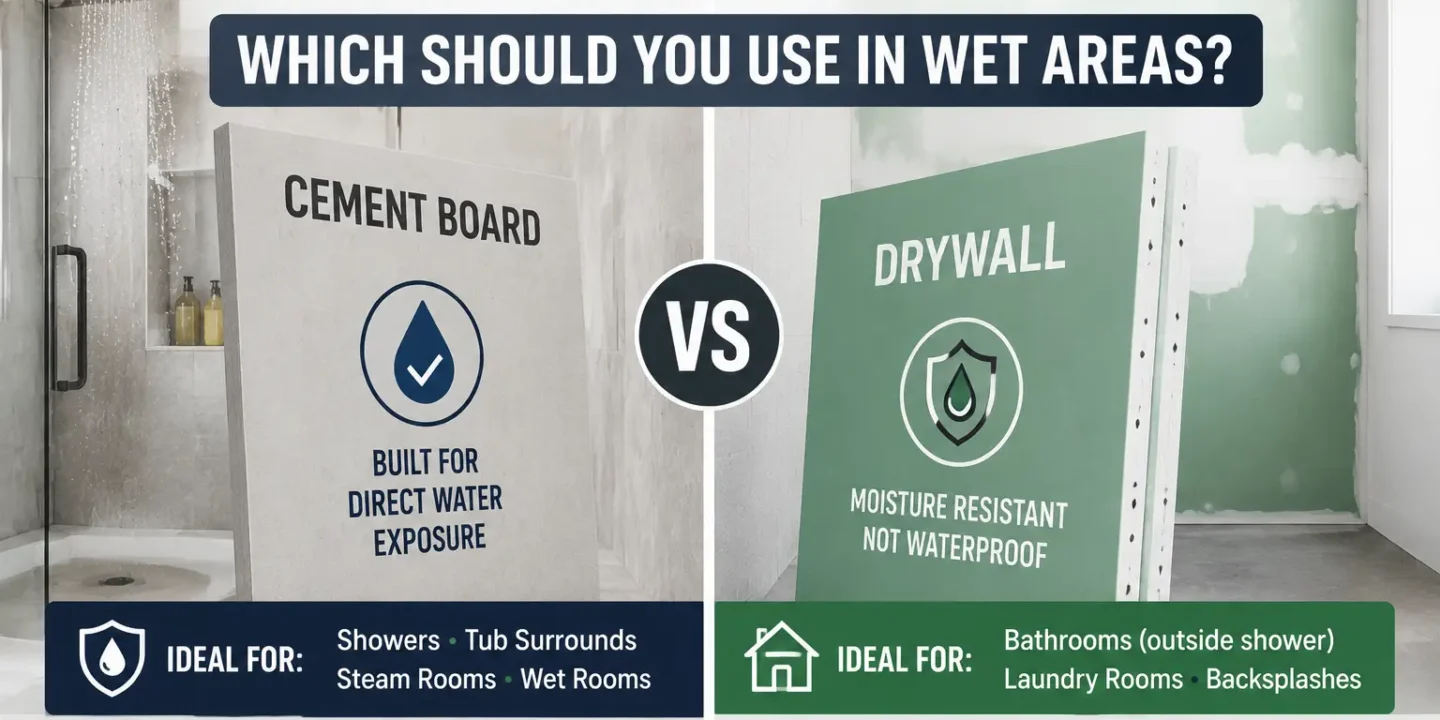



Every year, thousands of homeowners tile over drywall in their shower — and pay for it two years later when the wall starts crumbling behind the tiles. The mold follows. Then the demo. Then the bill.
Cement board and drywall are not interchangeable — and the difference isn’t just about performance. In many cases, it’s about building code. Using the wrong material in a wet area can mean a failed inspection, voided tile warranty, and a full wall tear-out.
By the end of this article, you’ll know exactly which material belongs in every room of your home — including the grey zones like kitchens, half-baths, and laundry rooms where most guides leave you guessing.
At-a-Glance Comparison Table
| Feature | Drywall | Cement Board |
| Material composition | Gypsum + paper | Cement + sand + fiberglass mesh |
| Moisture resistance | Low (absorbs water) | High (inorganic, won’t degrade) |
| Mold resistance | Poor | Excellent (no organic material to feed mold) |
| Tile substrate | Not suitable in wet areas | Yes — primary use case |
| Weight (4×8 panel) | ~55 lbs | ~90–110 lbs |
| Cost per panel | $12–$20 | $15–$35 |
| Paintable / finished surface | Yes | No (must be tiled or covered) |
| Building code approved for showers | No (drywall/green board) | Yes |
| DIY friendliness | Easy | Moderate (heavier, harder to cut) |
That building code row is the one that matters most when a permit is pulled. Under IRC Section R702.4 green board and standard drywall are not approved as tile backers for shower or tub surrounds in most US jurisdictions. A building inspector who finds drywall inside a shower surround during a rough inspection will flag it.
What Is Cement Board?
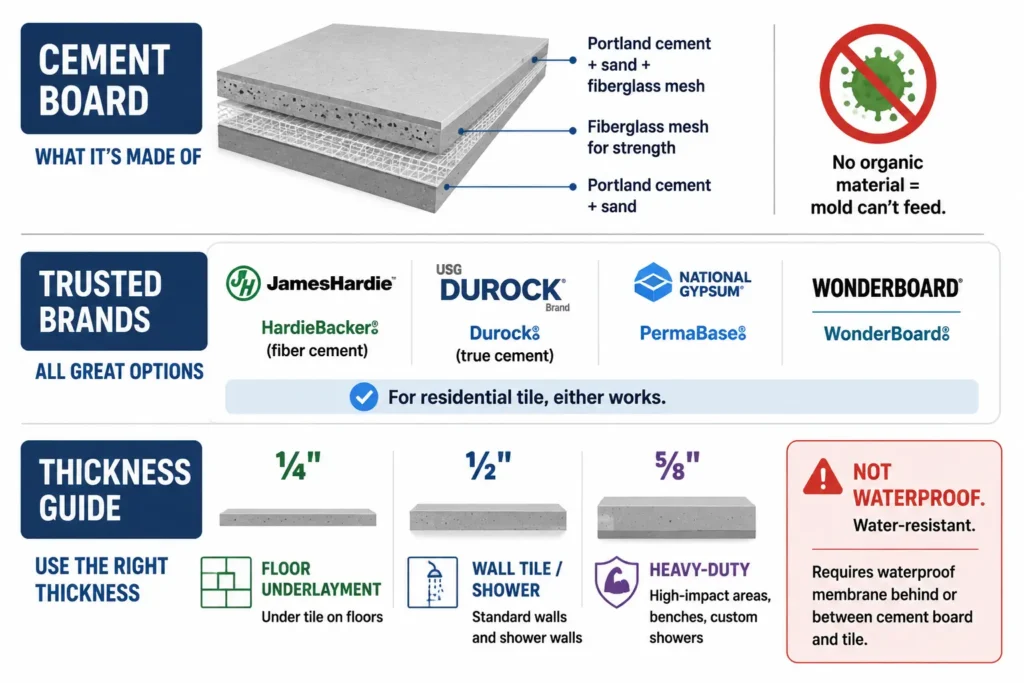
Cement board is made from Portland cement, sand, and fiberglass mesh reinforcement—a fully inorganic combination. Unlike the options found in our guide to standard types of drywall, there is no paper, no wood pulp, and no organic material of any kind. That matters because mold needs organic material to feed on. Cement board gives it nothing.
Common brand names you’ll see on shelves:
- HardieBacker — technically a fiber cement board (cement + cellulose fibers); slightly lighter, very popular
- Durock — a true cement board; one of the original products in this category
- PermaBase — Portland cement-based with fiberglass mesh reinforcement
- WonderBoard — another true cement board; widely available at big-box stores
Fiber cement and true cement board are often used interchangeably in conversation. For most residential tile applications, either works.
Available thicknesses:
- ¼” — floor underlayment over plywood subfloor
- ½” — standard wall tile applications (showers, tub surrounds)
- ⅝” — heavier-duty applications
One critical clarification: cement board is not waterproof. It is water-resistant. Water can still pass through it — it just won’t rot, swell, or degrade the way drywall does. In a true shower application, you still need a waterproof membrane behind the cement board or between it and the tile. More on that in the installation section.
Cement board costs $15–$35 per panel depending on brand, thickness, and panel size (common sizes: 3×5 and 4×8).
What Is Drywall?
You know what standard drywall is. Let’s focus on the moisture-resistant variants — because those are the ones homeowners actually compare to cement board.
Standard drywall: Gypsum core wrapped in paper. Absorbs water readily, degrades quickly, and becomes a mold buffet in any sustained wet environment. Never use in wet areas.
Green board (moisture-resistant drywall): While this product uses a wax-coated paper facing to resist moisture, it is not a substitute for a true waterproof backer. As we detail in our guide to using green board correctly, it is not code-approved for shower surrounds in most US jurisdictions under the modern International Residential Code (IRC). It is still frequently sold and used in these areas, but it remains a leading cause of moisture failure in showers.
Purple board: Mold and moisture-resistant core — a genuine step up from green board. Better performance, but still contains gypsum. Appropriate for damp areas. Not appropriate for direct water contact or shower surrounds.
Paperless / glass mat drywall: Fiberglass facing replaces the paper, significantly improving moisture resistance. Some products in this category — like DensShield — are specifically approved as tile backers above the tile line in certain shower applications. These occupy a legitimate middle ground.
The key distinction: even the best moisture-resistant drywall has a gypsum core that will eventually fail under sustained water exposure. Cement board’s fully inorganic composition is a fundamentally different material, not just a better version of the same thing.
The Wetness Spectrum: Right Material for Every Room
This is where most comparison guides fail you. “Use cement board in wet areas” isn’t enough — not when you’re standing in a laundry room or a kitchen trying to decide what to hang.
Here’s a precise breakdown from driest to wettest.
Zone 1 — Dry Areas (No Moisture Concern)
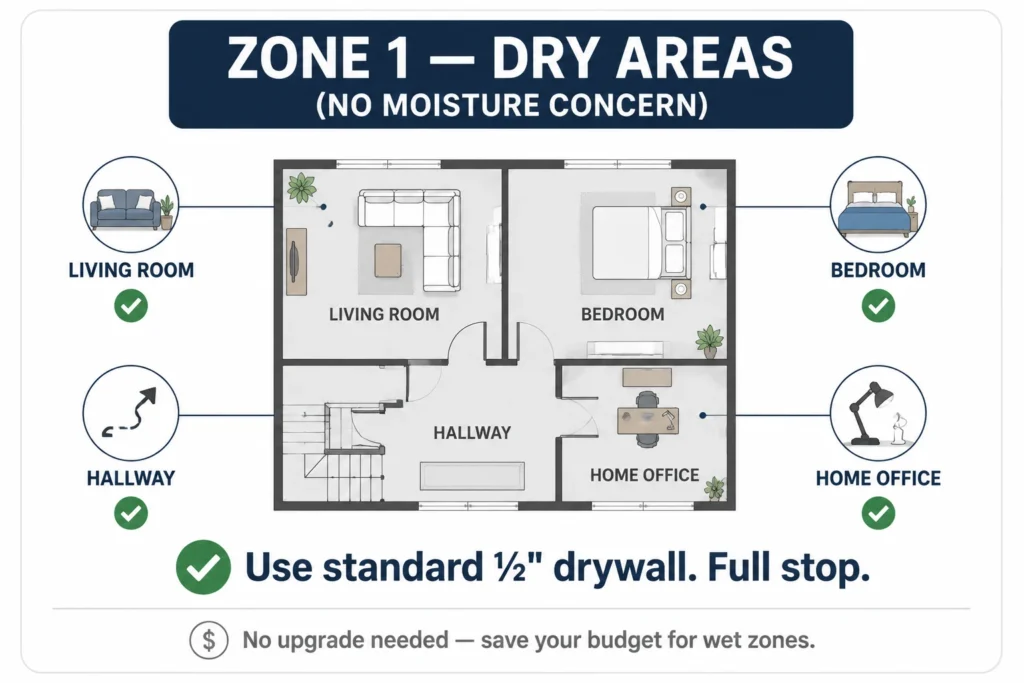
Rooms: Living rooms, bedrooms, hallways, home offices
Use standard ½” drywall. Full stop. No upgrade needed, no moisture-resistant board required.
Zone 2 — Damp Areas (Humidity, Occasional Splashes)
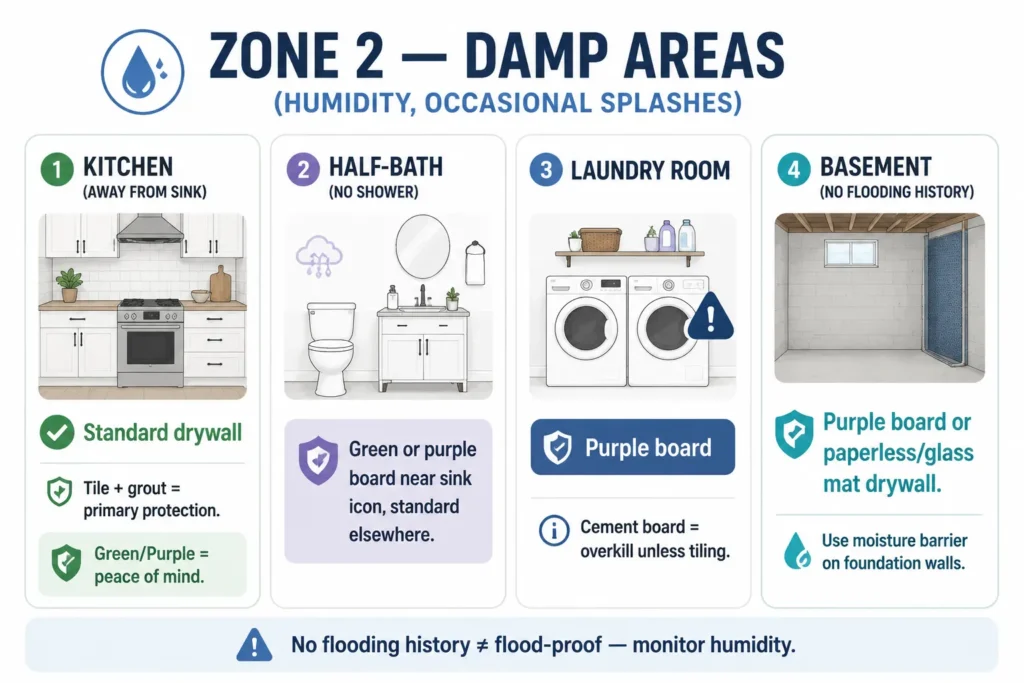
Kitchen walls (away from sink): Standard drywall is fine. If you’re running tile for a backsplash near the sink, standard drywall is actually acceptable here — the splash zone is limited and the tile + grout provides primary protection. Green board or purple board works too if you want extra peace of mind.
Half-bath (toilet + sink, no shower): Green or purple board for walls near the sink. Standard drywall works fine everywhere else in the room. A toilet generates humidity but not direct water contact — moisture-resistant drywall is more than adequate.
Laundry room: Use purple board throughout. Appliance leaks are common, and you want a wall that can handle an unexpected flood without immediately growing mold. Cement board is overkill here unless you’re tiling — and if you are tiling, use cement board.
Basement walls (no flooding history): Purple board or paperless/glass mat drywall. Better moisture resistance than standard drywall without the weight and cost of cement board.
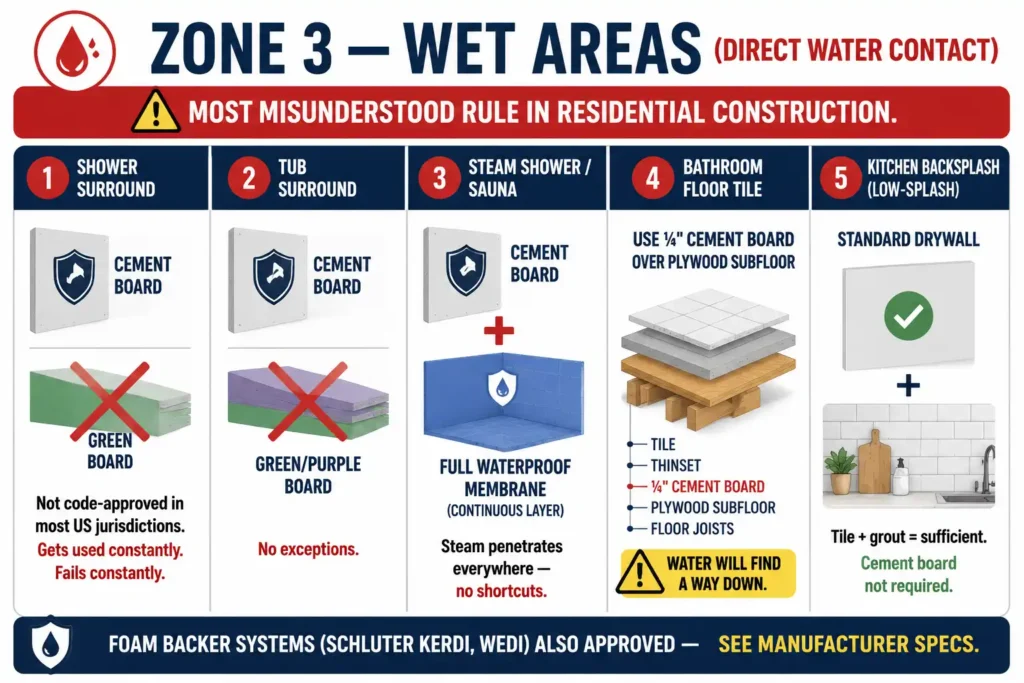
Zone 3 — Wet Areas (Direct Water Contact, Tiling Required)
Shower surround walls: Cement board only — or an approved foam backer board system like Schluter Kerdi or Wedi. This is the most misunderstood rule in residential construction. Green board is not building-code approved in shower wet areas in most US jurisdictions. It gets used constantly. It fails constantly.
Tub surround: Same rule as shower. Cement board. No exceptions.
Steam shower / sauna: Cement board plus a full continuous waterproof membrane. The steam penetrates everywhere. There is no room for shortcuts.
Bathroom floor tile underlayment: ¼” cement board over your plywood subfloor before setting tile.
Kitchen backsplash tile (low-splash zone): Standard drywall is acceptable here if the tile and grout are properly applied. The splash exposure is minimal compared to a shower. Cement board is not required, though it doesn’t hurt.
The Building Code Reality
Warning: This is the section that could save you from a failed inspection and a full wall tear-out. Read it before you buy materials.
The International Residential Code (IRC), Section R702.4 governs tile backer materials in wet areas. Under the modern IRC, the following materials are approved for shower and tub surround tile backing:
- Cement board (Durock, PermaBase, WonderBoard, etc.)
- Fiber cement board (HardieBacker)
- Glass-mat gypsum board (specific products like DensShield — verify product approval)
- Foam board waterproofing systems (Schluter Kerdi, Wedi)
Green board is not on this list. This has been the case since the 2006 IRC revision — confirmed by Walls & Ceilings industry reporting at the time of the code change. Most of the internet just hasn’t caught up.
The real-world consequence: if you pull a permit for a bathroom remodel and a building inspector visits, using green board in a shower surround can result in a failed inspection and a requirement to redo the work entirely — at your expense.
Some older jurisdictions still allow green board, and local codes do vary. Always verify with your local building department before starting work. But the national trend across the US is firmly against green board in shower wet areas, and it has been for years. Most of the internet just hasn’t caught up.
This isn’t a technicality. It’s the difference between a wall that lasts 30 years and one that needs to be demolished in five.
Real Cost Comparison
Most articles give you per-panel prices and stop. That doesn’t help you budget a real project. Here’s what the numbers actually look like.
Material cost for a standard 5×8 shower surround:
- Drywall: $12–$20/panel × ~6 panels = $72–$120
- Cement board: $15–$35/panel × ~6 panels = $90–$210
- Difference: roughly $50–$90 in material
That’s the gap. In the context of a bathroom remodel that typically costs $5,000–$15,000+, this is a rounding error.
Labor cost difference: Cement board is heavier (90–110 lbs per sheet) and harder to cut than drywall. Expect to add roughly $100–$200 in labor for a typical shower surround. Still minor.
The long-term cost of getting it wrong: Drywall failure in a shower doesn’t just mean replacing the wall. It means: demolition, mold testing, potential mold remediation ($500–$6,000+ depending on spread), substructure repair if studs are affected, and full retiling. A single failed shower wall can easily cost $3,000–$8,000 to fix correctly.
The verdict: Spending an extra $150 on cement board over drywall in a shower surround is one of the best investments in any bathroom renovation. There is no financial argument for using drywall in a shower.
Installation Differences
Drywall Installation
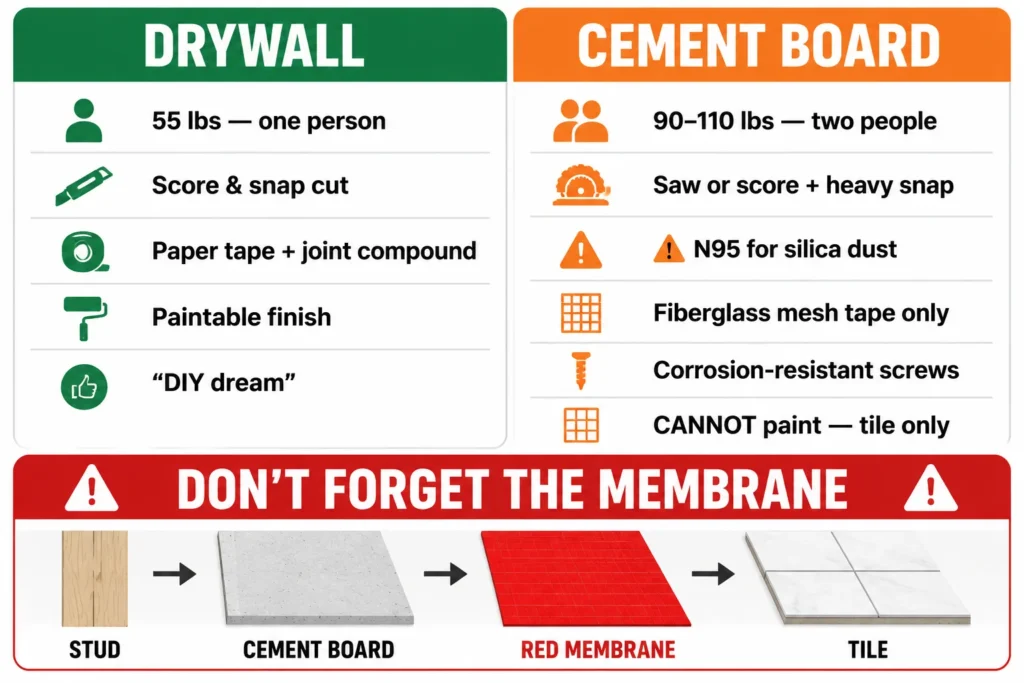
Score the face with a utility knife, snap along the score line, then cut through the back paper. At roughly 55 lbs per sheet, one person can handle a full 4×8 panel. Finish with joint compound, tape, sand, and paint. Highly DIY-friendly — the most forgiving material in residential construction.
Cement Board Installation
Cutting: Score-and-snap works but requires more force due to the density. A circular saw with a fiber cement blade is faster for complex cuts. Important: cutting cement board generates silica dust, which is a serious respiratory hazard. Wear an N95 respirator — not a dust mask — any time you’re cutting cement board.
Weight: At 90–110 lbs per sheet, cement board is a two-person job for large panels. Factor this into your plan before you start.
Fasteners: Use corrosion-resistant screws specifically rated for cement board. Standard drywall screws will rust in wet conditions, which defeats the purpose.
Seams: Tape with fiberglass mesh tape, not paper tape. Paper tape will fail in moisture.
The waterproof membrane step everyone skips: Even after correctly installing cement board, you need a waterproof membrane in a shower application. Products like RedGard (a painted-on membrane), Schluter Kerdi (a sheet membrane), or similar systems go over the cement board before tile. Cement board won’t rot — but water still passes through it and can reach your stud cavity, causing structural rot over years. The membrane is what actually stops the water.
Finished surface: Cement board cannot be painted, skim-coated, or left exposed. It must be tiled, covered with a specific surface treatment, or protected behind another material. This is why you won’t see it anywhere but wet-area applications.
3 Myths That Get Homeowners Into Trouble
Myth 1: “Green board is fine for showers”
The truth: Green board is not code-approved for shower surrounds or tub surrounds in most US jurisdictions under the modern IRC. It resists moisture better than standard drywall, but it still has a gypsum core that fails under sustained water exposure. It will degrade behind your tile. Using it in a shower also voids most tile manufacturer warranties.
Myth 2: “Cement board is waterproof”
The truth: Cement board is water-resistant, not waterproof. Water passes through it — it just doesn’t cause the board to degrade. Without a waterproof membrane between the cement board and your tile (or behind the board), water reaches your wall framing. Over years, this causes stud rot, even with cement board installed. The membrane is not optional.
Myth 3: “You can tile over regular drywall if you seal it”
The truth: Drywall — even sealed drywall — expands and contracts with changes in humidity and moisture. Over time, this movement causes grout cracks, and eventually tile pops. The sealer delays the problem; it doesn’t eliminate it. Never tile over standard drywall in any wet area. Not in a shower, not in a tub surround, not on a bathroom floor.
FAQs
Can I use drywall instead of cement board in a bathroom? It depends on the application. In a half-bath or on bathroom walls away from direct water contact, moisture-resistant drywall (green or purple board) is fine. In a shower surround or tub surround, no — building codes in most US jurisdictions require cement board or an approved equivalent. Standard drywall in a shower will fail.
Is cement board waterproof? No. Cement board is water-resistant — it won’t swell, rot, or degrade when exposed to water. But water does pass through it. In shower applications, you still need a waterproof membrane (RedGard, Schluter Kerdi, etc.) applied over or behind the cement board to prevent water from reaching your wall framing.
Do I need cement board behind shower tile? Yes, in virtually all cases. Approved alternatives include fiber cement board (HardieBacker), glass-mat gypsum board (DensShield), and foam waterproofing board systems (Schluter Kerdi, Wedi). What you cannot use is standard drywall or green board — both are code violations for shower wet areas in most jurisdictions.
Can you use green board in a shower? Not legally in most US jurisdictions. Green board is moisture-resistant but not code-approved as a tile backer for shower surrounds under the modern IRC. It was commonly used in older construction and still appears in stores, but using it in a shower today risks a failed inspection and eventual wall failure. Use cement board instead.
What is the difference between cement board and drywall? Drywall is made from a gypsum core wrapped in paper — an organic composition that absorbs water, degrades, and grows mold. Cement board is made from Portland cement, sand, and fiberglass mesh — fully inorganic, unaffected by water, and incapable of supporting mold growth. They are fundamentally different materials suited to different environments.
Is cement board harder to install than drywall? Yes, moderately. Cement board is roughly twice the weight of drywall (90–110 lbs vs. ~55 lbs per sheet), harder to cut cleanly, and requires corrosion-resistant fasteners and fiberglass mesh tape instead of paper tape. It’s manageable for a capable DIYer but is a two-person job and requires an N95 respirator when cutting. Drywall is significantly more forgiving.
What is HardieBacker used for? HardieBacker is a fiber cement board made by James Hardie, primarily used as a tile substrate in wet areas: shower surrounds, tub surrounds, bathroom floors, and kitchen floors. It’s one of the most popular cement board products on the market and is widely available at home improvement stores. It performs the same function as Durock or PermaBase — the brand differences are minor for most residential applications.
The Bottom Line
The decision isn’t complicated once you know the rules:
- Shower surrounds, tub surrounds, steam rooms, floor tile underlayment: Cement board. No exceptions. Building code requires it.
- Laundry rooms, basements, half-baths, kitchens: Moisture-resistant drywall (purple or green board) — appropriate for damp conditions without direct water contact.
- Everything else: Standard drywall.
The material cost difference between cement board and drywall in a typical shower is less than $100. The cost of getting it wrong — mold remediation, demolition, retiling, failed inspections — can run into the thousands. There’s only one right answer for wet areas.


Elena Hart is the founder and lead writer of Better Home Pro. She writes about drywall, home repair, and practical DIY home improvement topics, focusing on clear, useful information that helps homeowners make better decisions. Her work combines firsthand experience, manufacturer documentation, industry resources, and careful research to create content that is accurate, practical, and easy to understand. Through Better Home Pro, Elena aims to simplify complex home improvement topics and provide guidance that is genuinely helpful to homeowners and DIYers.







No Comments