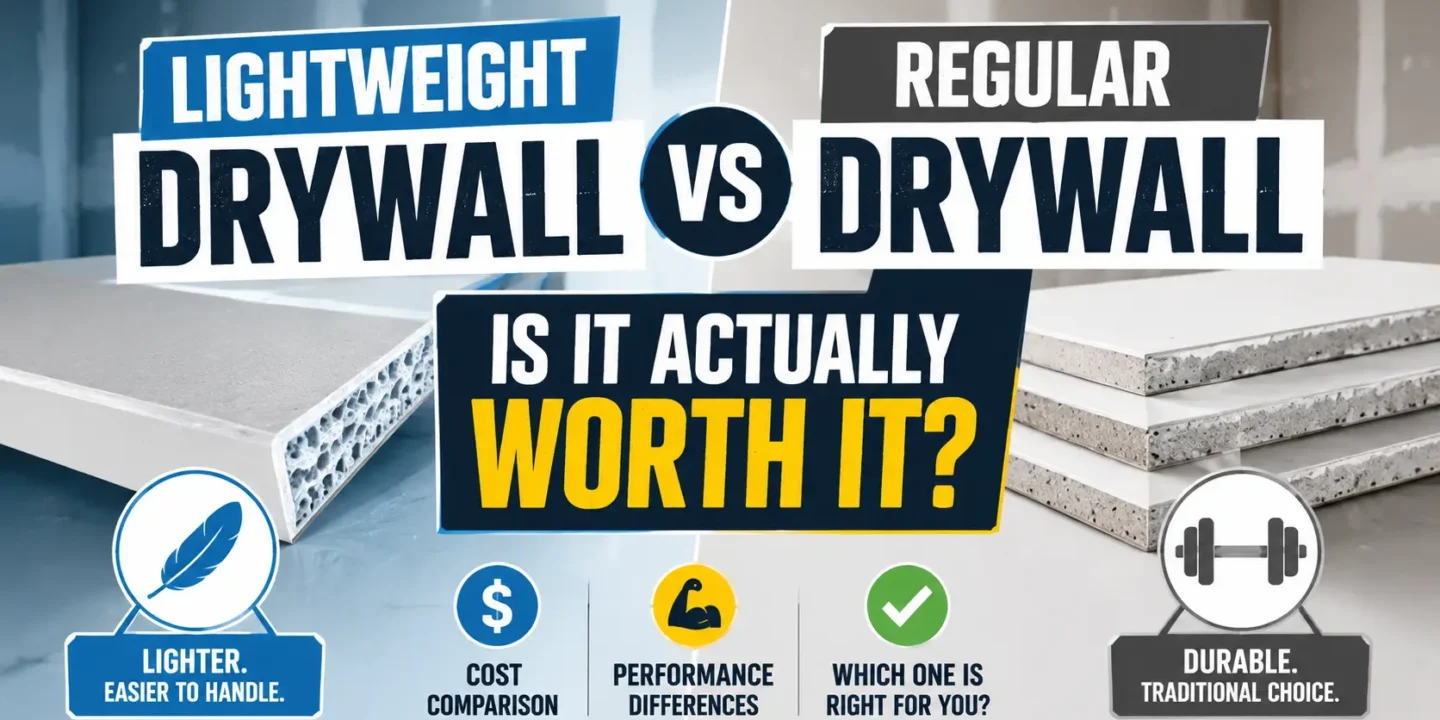



A standard 4×8 sheet of drywall weighs 51–57 pounds. Now imagine lifting 25 of them overhead into a ceiling. That’s nearly 1,400 pounds of material above your head in a single room.
Lightweight drywall, sometimes called ultralight drywall, solves that problem directly. It reduces panel weight by about 25%, turning a two-person overhead nightmare into a manageable solo job. However, there are various types of drywall to consider, as this version costs more and has trade-offs most articles never mention. These include reduced screw-holding strength, slightly worse sound performance, and a handling advantage that mostly disappears on professional job sites.
This article gives you a clear verdict by project type — not a feature list, not a “it depends.” By the end, you’ll know exactly which product makes sense for your ceiling, your walls, your situation.
Key Takeaways
- Lightweight drywall is made by injecting gaseous foaming agents into the gypsum slurry. This creates microscopic air pockets that reduce total weight by 25–30% (approx. 15 lbs per sheet) without changing the panel’s exterior dimensions or installation process.
- Because mass is a primary factor in sound dampening, the lower-density core of lightweight drywall offers marginally less sound blocking than standard drywall. For walls shared with noisy rooms (like home theaters or nurseries), standard drywall remains the superior acoustic choice.
- Lightweight drywall is the industry-standard recommendation for ceilings. Its reduced weight minimizes physical fatigue during overhead work and offers superior sag resistance, as there is less gravity load pulling the panel away from the fasteners.
- Standard drywall features a denser mineral core, providing better resistance to dents and scuffs in high-traffic areas (hallways, kids’ rooms). It also offers more “grip” for wall anchors; lightweight panels are less forgiving if heavy items like TVs or cabinets are not mounted directly to studs.
- The most professional approach to a room renovation is to mix drywall types: use lightweight panels for the ceiling (to save your back) and standard panels for the walls (for durability and sound mass). Since both products finish identically with the same mud and tape, there is no downside to mixing them.
What Is Lightweight Drywall and How Is It Made?
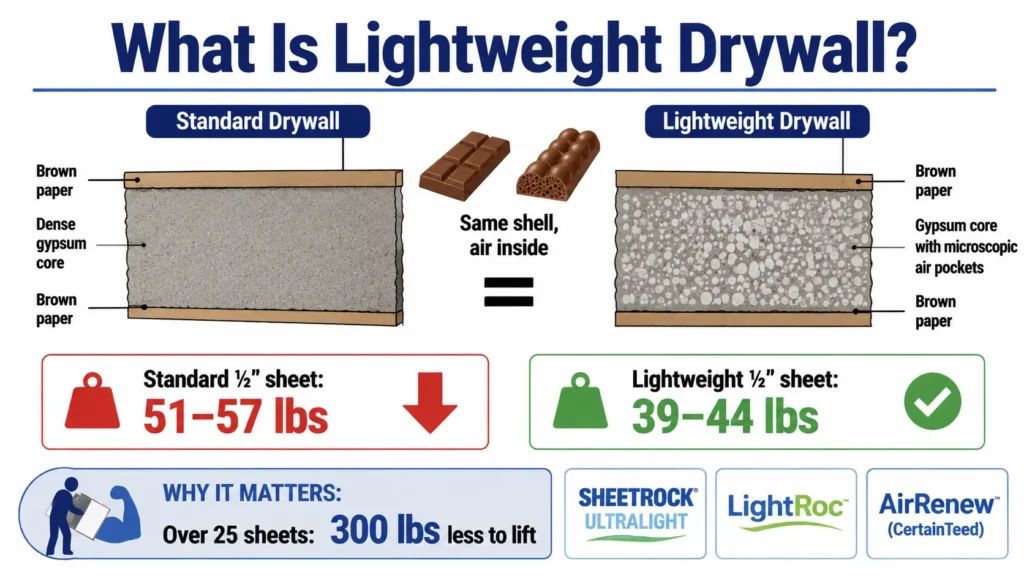
Both lightweight and standard drywall share the same basic construction: a gypsum core sandwiched between two layers of paper facing. Same structure, same dimensions, same installation process.
The difference is in the core. During manufacturing, producers inject gaseous foaming agents into the gypsum slurry before it sets. This creates microscopic air pockets distributed throughout the core — displacing mineral content without breaking the structural matrix of the panel.
Think of it like the difference between a solid chocolate bar and an Aero bar: same outer shell, same shape, air inside reduces the weight without changing what it looks like from the outside.
The weight numbers that matter:
- Standard ½” 4×8 sheet: 51–57 lbs
- Lightweight ½” 4×8 sheet: 39–44 lbs
- Reduction per sheet: ~25–30%
- Over 25 sheets: roughly 300 lbs less total material to move
On a whole-room project, that difference is felt in your back, your shoulders, and your install time — especially overhead.
Brand names you’ll see:
- Sheetrock UltraLight (USG) — first to market, most widely recognized
- LightRoc (National Gypsum)
- AirRenew (CertainTeed) — also includes air-purifying additives
Side-by-Side Comparison Table
| Feature | Standard Drywall | Lightweight Drywall |
| Weight (½” 4×8) | 51–57 lbs | 39–44 lbs |
| Cost per sheet | $12–$20 | $13–$22 (~$0.02/sq ft more) |
| DIY handling | Difficult solo | Manageable solo |
| Ceiling sag resistance | Good | Slightly better (less gravity load) |
| Impact / dent resistance | Better | Slightly lower |
| Sound dampening | Better (denser core) | Marginally lower |
| Screw / anchor holding | Better | Slightly lower density |
| Fire rating (Type X) | Available | Available (some products) |
| Availability | Everywhere | Most major retailers |
| Best for | Walls, high-traffic, pro install | Ceilings, DIY, solo install |
The sound dampening and screw-holding rows are the ones most guides leave out — and they’re the ones that matter most if you’re planning to mount a TV or sleep next to a noisy room.
When to Choose Each: Project-by-Project Verdict
This is what most comparison articles never give you. Here’s a direct recommendation by scenario — no hedging.
Choose Lightweight Drywall When:
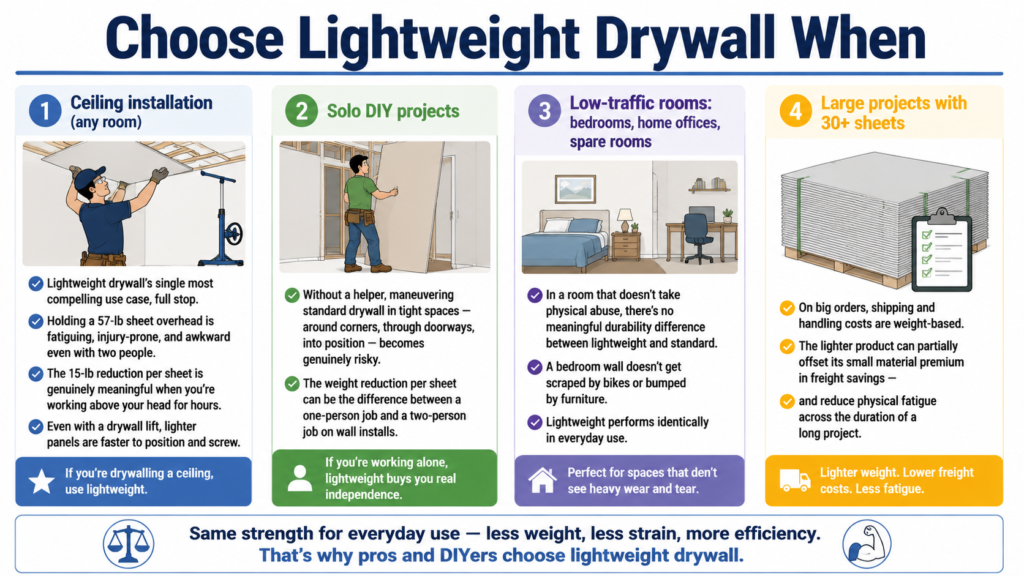
Ceiling installation (any room) Lightweight drywall’s single most compelling use case, full stop. Holding a 57-lb sheet overhead is fatiguing, injury-prone, and awkward even with two people. The 15-lb reduction per sheet is genuinely meaningful when you’re working above your head for hours. Even with a drywall lift, lighter panels are faster to position and screw. If you’re drywalling a ceiling, use lightweight.
Solo DIY projects Without a helper, maneuvering standard drywall in tight spaces — around corners, through doorways, into position — becomes genuinely risky. The weight reduction per sheet can be the difference between a one-person job and a two-person job on wall installs. If you’re working alone, lightweight buys you real independence.
Low-traffic rooms: bedrooms, home offices, spare rooms In a room that doesn’t take physical abuse, there’s no meaningful durability difference between lightweight and standard. A bedroom wall doesn’t get scraped by bikes or bumped by furniture. Lightweight performs identically in everyday use.
Large projects with 30+ sheets On big orders, shipping and handling costs are weight-based. The lighter product can partially offset its small material premium in freight savings — and reduce physical fatigue across the duration of a long project.
Choose Standard Drywall When:
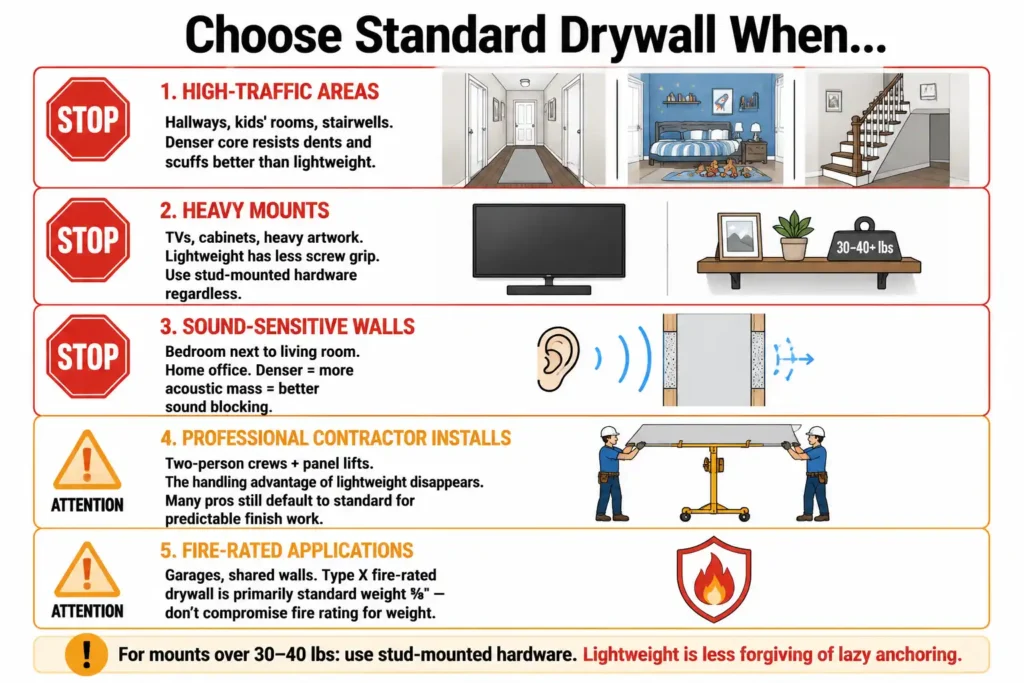
High-traffic areas: hallways, kids’ rooms, stairwells Denser core equals better resistance to dents, scuffs, and the daily physical reality of active rooms. Standard drywall is measurably more durable in areas that see constant movement and contact. This is where its extra mass earns its keep.
Rooms where you’ll mount heavy items TVs, large floating shelves, kitchen cabinets, heavy artwork. Lightweight’s lower-density core provides less material for screws to grip. For anything over 30–40 lbs mounted to the wall, use standard drywall — or use proper stud-mounted hardware regardless of drywall type. Lightweight is less forgiving of lazy anchoring.
Sound-sensitive walls If noise is a genuine priority for a bedroom adjacent to a living room or a home office on a busy street, standard drywall provides more performance at no extra cost. Denser material equals more acoustic mass, which leads to better sound blocking. While the difference between standard and lightweight is helpful, those looking for maximum silence should explore our full guide on soundproof drywall for more specialized, high-decibel reduction options.
Professional contractor installs Contractors have two-person crews, panel lifts, and body mechanics refined over thousands of installations. The handling advantage of lightweight largely disappears with the right equipment and team. Many experienced drywallers still default to standard for its predictable, consistent behavior — especially on high-end finish work where surface uniformity is critical.
Fire-rated applications: garages, shared walls Type X fire-rated drywall is primarily available in standard weight 5/8″ format. While lightweight Type X options exist, they are less common and more expensive. When deciding on the right protection for garages or shared walls, it is helpful to review the technical differences in fire-resistant drywall: Type X vs. Type C. Never compromise a fire rating for a weight advantage—that rating exists for a critical safety reason
Real Cost Breakdown: Is the Price Premium Justified?
Most articles give you per-sheet prices and stop. Here’s what it actually looks like at project scale.
Per sheet:
- Standard drywall: $12–$20 ($0.30–$0.50/sq ft)
- Lightweight drywall: $13–$22 (~$0.02/sq ft more on average)
For a typical 12×12 bedroom (~20 sheets):
- Premium: $20–$40 total — essentially negligible
For a full home renovation (~200 sheets):
- Premium: $200–$400 total — more significant, but still modest relative to a full renovation budget
Where the math flips in lightweight’s favor: If your ceiling project requires two workers instead of one because standard drywall can’t be safely handled solo overhead, the labor savings from a solo-workable lightweight install easily offset the material premium. One extra hour of a drywall helper’s time costs more than the entire per-sheet premium across a typical room.
Honest bottom line: The cost difference is rarely a meaningful deciding factor. Choose based on your project type, your working situation, and the room’s use — not the price tag. The premium is small enough to ignore in both directions.
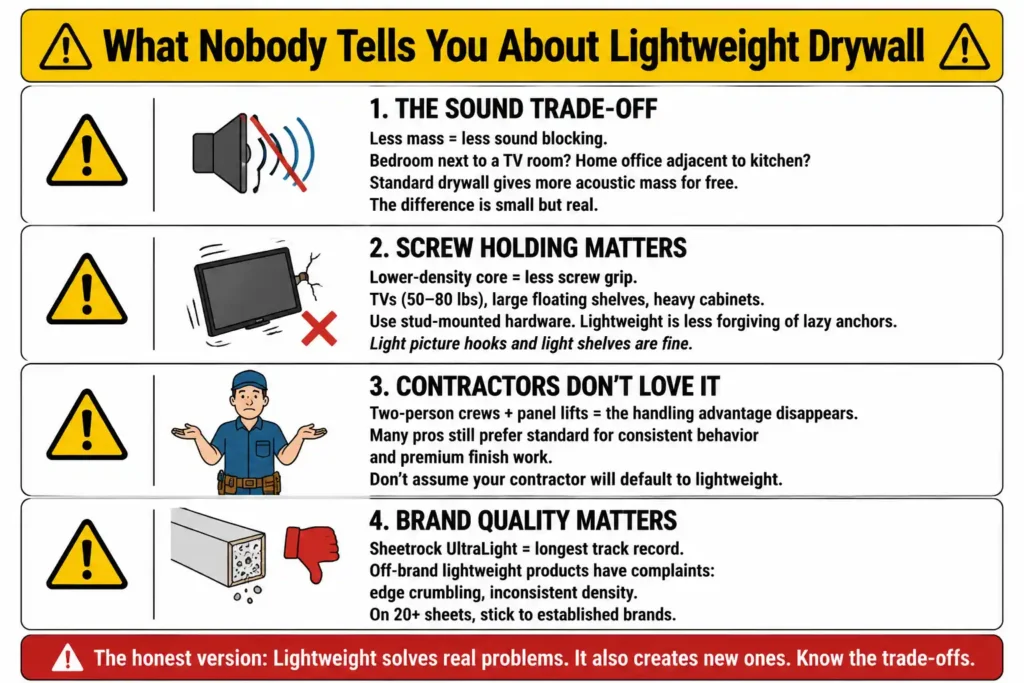
What Nobody Tells You About Lightweight Drywall
This is where most articles get vague. Here’s the honest version.
The Sound Trade-off Is Real, If Small
Mass equals sound blocking. Lightweight drywall’s air pockets reduce density, which reduces its natural ability to dampen sound compared to standard drywall. In most rooms, this difference won’t affect your daily life. But in a bedroom that shares a wall with a TV room, or a home office adjacent to a kitchen, standard drywall gives you more acoustic mass for free. If sound is a genuine priority, standard wins — or consider dedicated acoustic drywall for those specific walls.
Screw Holding Matters More Than It Seems
Lower-density core means less material for screws to grip. For standard picture hooks and lightweight shelving, this is completely irrelevant. For wall-mounted TVs (typically 50–80 lbs), large floating shelves, or full kitchen cabinet runs, this matters. Use stud-mounted hardware regardless of drywall type — but be aware that lightweight drywall is even less forgiving if you’re relying on drywall anchors alone for a heavy load.
Contractors Don’t Love It as Much as You’d Expect
Professionals have panel lifts, two-person crews, and years of developed technique for maneuvering heavy panels. The handling advantage that makes lightweight drywall so compelling for a solo DIYer is largely irrelevant to a two-person professional team. Many experienced drywallers still prefer standard for its consistent, predictable behavior — particularly on premium finish work where any surface variation shows. If a contractor is quoting your job, don’t assume they’ll default to lightweight.
Brand Quality Matters
Not all lightweight drywall performs equally. Sheetrock UltraLight has the longest track record and the most consistent field reviews. Some off-brand lightweight products have attracted complaints about edge crumbling and inconsistent density across panels. On a project where you’re buying 20+ sheets, stick to an established brand — the per-sheet savings on a cheaper product aren’t worth a wall full of crumbling edges.
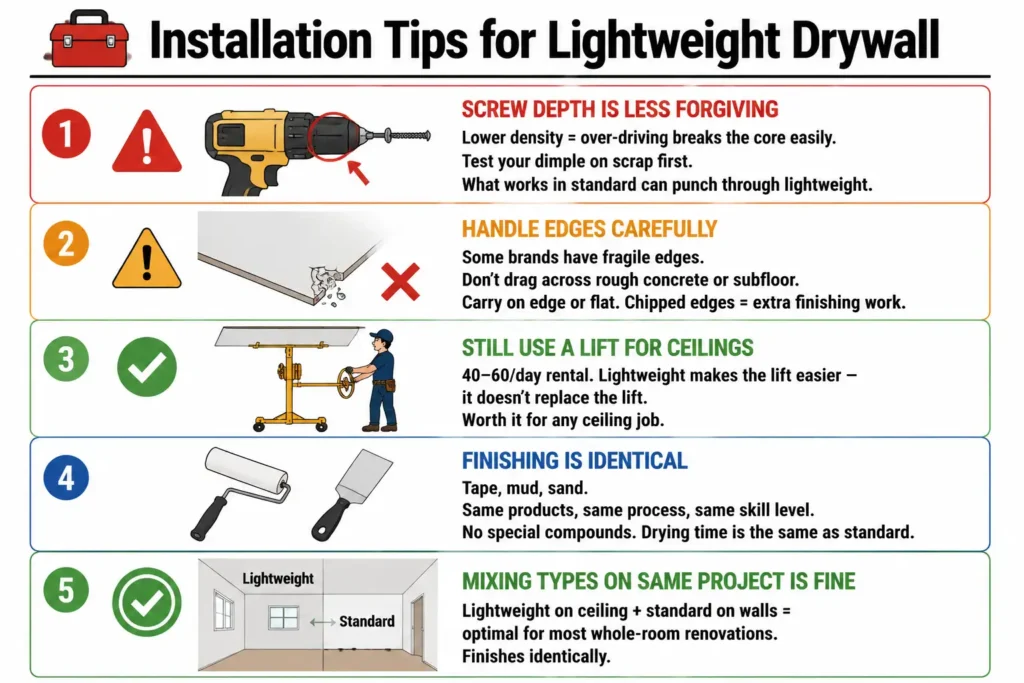
Installation Tips for Lightweight Drywall
The process is the same as standard drywall — with a few specifics worth knowing before you start.
Screw depth is less forgiving. Lightweight’s lower density means over-driving screws breaks the core more easily than standard. Set your screw gun’s depth clutch carefully and test your dimple on a scrap piece before starting. A dimple that works fine in standard drywall can punch through the core of a lightweight panel.
Handle edges carefully. Some lightweight brands have slightly more fragile edges than standard drywall. Don’t drag sheets across rough concrete or subfloor — carry them on edge or flat. Chipped edges create extra finishing work.
Still use a lift for ceilings. The weight reduction is significant, but holding any drywall panel overhead while simultaneously driving screws is fatiguing and produces poor fastener placement. A rented drywall lift ($40–$60/day) is worth it for any ceiling job regardless of drywall type. Lightweight makes the lift easier to operate — it doesn’t replace the lift.
Finishing is identical. Tape, mud, sand — same products, same process, same skill level required as standard drywall. No special compounds, no different technique. Joint compound drying time is the same.
Mixing types on the same project is completely fine. Lightweight on the ceiling, standard on the walls finishes identically and is actually the optimal approach for most whole-room renovations. More on this below.
The Smartest Approach: Use Both
Here’s the insight that most home improvement guides never say out loud — and it’s the one that makes the most practical sense for almost every full-room renovation.
Use lightweight drywall on ceilings. Use standard drywall on walls.
Ceilings are where the handling difficulty is greatest (overhead work is where weight matters most), where sag resistance is an advantage (less panel weight pulling against its own fasteners), and where durability from impact is least relevant (nobody is bumping into your ceiling). Lightweight is the right call here — unambiguously.
Walls are where durability matters (foot traffic, furniture, kids, daily contact), where sound performance counts (shared walls between rooms), and where screw-holding strength affects real decisions (mounted TVs, shelving, cabinets). Standard drywall earns its place here.
The cost premium on the ceiling panels is minimal. The finishing process is identical — you tape and mud both products exactly the same way. There’s no complexity in mixing them on the same project.
This is what experienced DIYers and some contractors already do instinctively. They just don’t always say it explicitly. Now you know.
FAQ
Is lightweight drywall as strong as regular drywall? For most residential applications, yes — with two exceptions. Lightweight drywall has slightly lower impact and dent resistance than standard, which matters in high-traffic areas like hallways and kids’ rooms. It also has marginally lower screw-holding strength in the core, which matters when mounting heavy items. For walls in low-traffic rooms and for all ceiling applications, the strength difference is not meaningful.
What are the disadvantages of lightweight drywall? Three honest ones: slightly lower dent resistance (matters in high-traffic rooms), marginally reduced sound dampening (matters in noise-sensitive walls), and lower screw-holding density (matters for heavy wall-mounted items). It’s also slightly more expensive and less universally available than standard drywall. None of these are deal-breakers in the right application — but they’re real.
Is lightweight drywall good for ceilings? It’s the best standard drywall choice for ceilings. The weight reduction makes overhead installation significantly safer and less fatiguing, and lighter panels put less stress on ceiling fasteners over time (reducing long-term sag risk). This is the single most compelling use case for lightweight drywall.
Does lightweight drywall hold screws as well? Slightly less well than standard, due to the lower-density core. For typical picture hooks and light shelving, the difference is irrelevant. For heavy wall-mounted items — TVs, large shelving systems, kitchen cabinets — always use stud-mounted hardware regardless of drywall type. Lightweight drywall is less forgiving if you’re relying on drywall anchors for significant loads.
What is Sheetrock UltraLight? Sheetrock UltraLight is USG’s lightweight drywall product — the first lightweight panel to reach the residential market and still the most widely recognized brand. It uses a foamed gypsum core to achieve a roughly 25% weight reduction vs. standard Sheetrock panels, at a modest price premium. Available at most major home improvement retailers and widely considered the benchmark product in this category.
Is lightweight drywall more expensive? Marginally — roughly $0.02 per square foot more than standard, which works out to about $1–$2 extra per sheet. For a typical 12×12 bedroom, the total premium is $20–$40. For a full home renovation, it’s $200–$400. The cost difference is rarely the deciding factor — choose based on project type and working situation, not price.
The Bottom Line
The smartest move for most homeowners: lightweight drywall on ceilings, standard drywall on walls.
Lightweight wins clearly for: solo DIY ceiling installs, any overhead work, large projects where handling fatigue accumulates, and low-traffic rooms where durability isn’t a concern.
Standard wins clearly for: high-traffic walls, sound-sensitive rooms, anywhere you’re mounting heavy items, and professional installs where the handling advantage largely disappears.
The price difference is too small to be the deciding factor. Let your project type and working situation make the call — then use both products where each one earns its place.


Elena Hart is the founder and lead writer of Better Home Pro. She writes about drywall, home repair, and practical DIY home improvement topics, focusing on clear, useful information that helps homeowners make better decisions. Her work combines firsthand experience, manufacturer documentation, industry resources, and careful research to create content that is accurate, practical, and easy to understand. Through Better Home Pro, Elena aims to simplify complex home improvement topics and provide guidance that is genuinely helpful to homeowners and DIYers.










No Comments