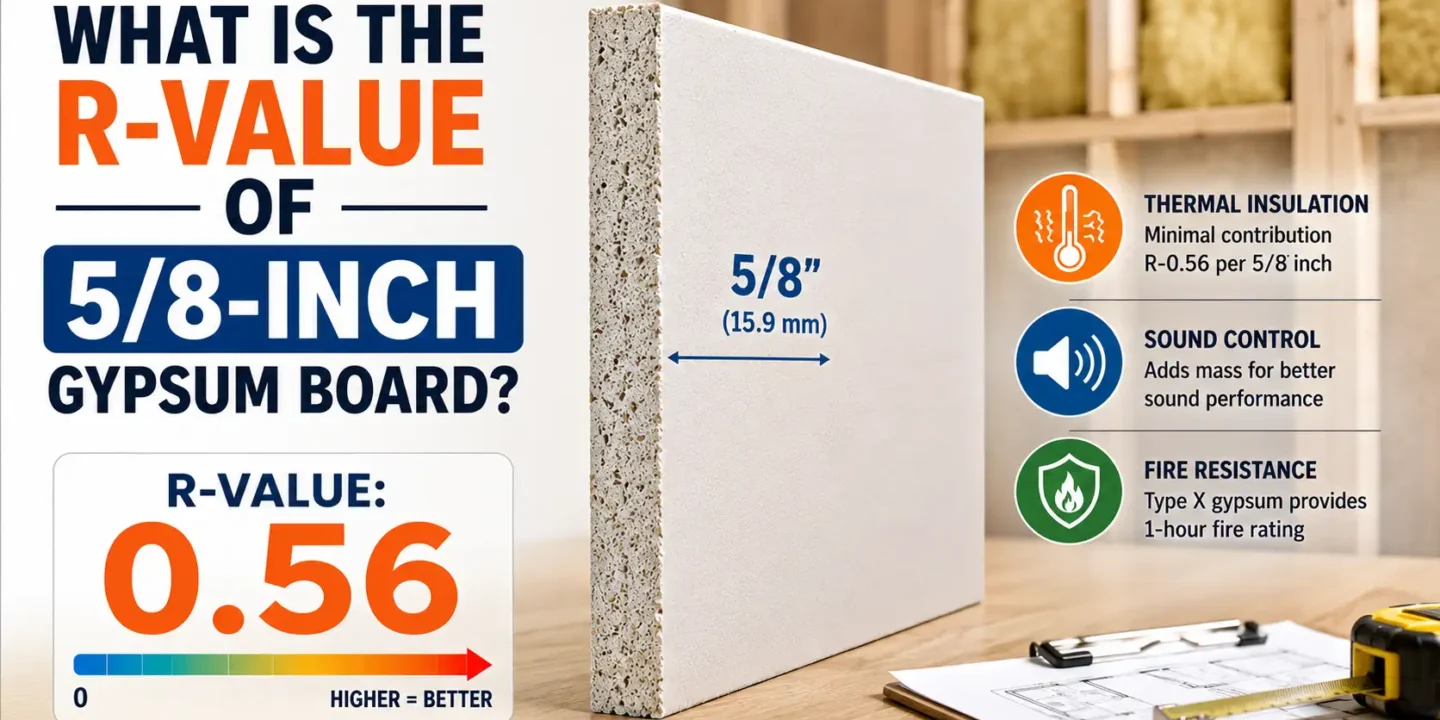



5/8-inch gypsum board has an R-value of approximately 0.56. That number places it in the category of materials that contribute very little to a wall’s thermal performance on their own. Drywall is not insulation, and that distinction matters whether you are finishing a garage, framing a basement, or reviewing wall assembly specifications.
Builders choose 5/8 drywall for fire resistance, code compliance, and structural rigidity, not to provide thermal insulation. The small thermal contribution it does make becomes relevant only in highly optimized assemblies or unusually constrained spaces.
Key Takeaways:
- Standard 5/8-inch drywall provides a modest R-value of 0.56, making its thermal contribution negligible compared to cavity insulation.
- Switching from 1/2-inch to 5/8-inch board adds only 0.11 to the R-value, which has no measurable impact on heating or cooling costs.
- Builders specify 5/8-inch gypsum for its one-hour fire rating and structural rigidity, not for its ability to insulate a room.
- The added mass of 5/8-inch panels helps reduce noise transfer between rooms, though it cannot replace dedicated soundproofing materials.
- Assuming a wall is insulated based on drywall thickness is a mistake; only cavity or exterior insulation creates a functional thermal barrier.
What Is the R-Value of 5/8 Gypsum Board?
R-value measures a material’s resistance to heat flow. The higher the number, the harder it is for heat to pass through. For 5/8-inch gypsum board, the tested R-value typically falls between 0.50 and 0.56 depending on the manufacturer and product type. Most published values are approximately 0.56.
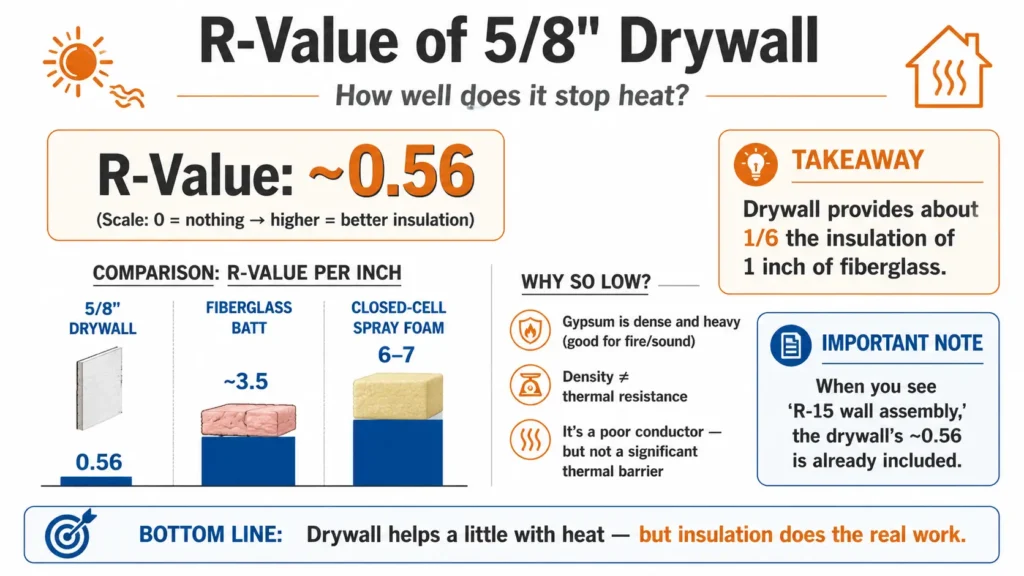
A single inch of fiberglass batt insulation delivers roughly R-3.5. One inch of closed-cell spray foam reaches R-6 to R-7. A 5/8-inch sheet of drywall contributes about one-sixth of the thermal resistance provided by a single inch of fiberglass.
The R-value of gypsum is determined by its mass and mineral composition, primarily calcium sulfate dihydrate, which is a poor conductor of heat but not a significant thermal barrier. Dense and relatively heavy, it performs well for fire resistance and sound control—properties covered in our guide to drywall types—but that same density does not result in strong thermal resistance.
Manufacturers sometimes publish R-values for complete wall assemblies, including framing, insulation, air barriers, and drywall, rather than drywall in isolation. When a wall system is rated at R-15 or R-21, the drywall contribution of approximately 0.56 is already included. It is a measurable value, but it remains minor.
Does 5/8 Drywall Insulate a Room?
Not in a significant way on its own.
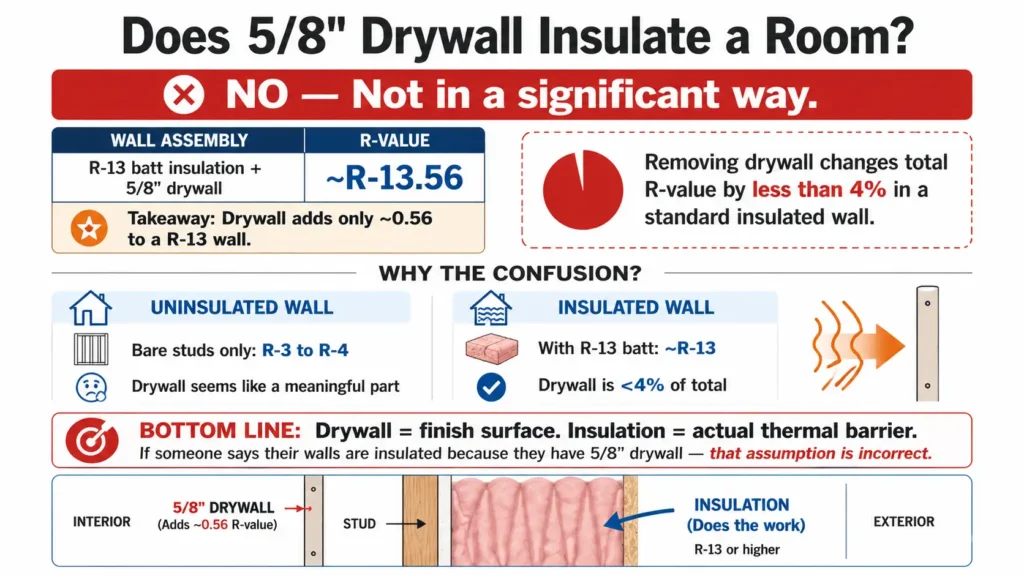
When heat moves through a wall, each layer resists transfer in sequence: exterior sheathing, air barrier, cavity insulation, framing, and drywall. Each layer contributes some resistance. Drywall is the final layer, and its contribution is so minor that removing it changes the wall’s total R-value by less than 4 percent in a standard insulated assembly.
This is why builders and energy auditors treat drywall as thermally negligible. If a wall contains R-13 batt insulation in a 2×4 cavity, adding 5/8 drywall increases the assembly to approximately R-13.56. That increase is not a significant design factor.
Confusion results from comparing drywall to an uninsulated wall. A bare framed wall with no cavity insulation has a total R-value around R-3 to R-4 when accounting for framing, sheathing, drywall, and air films. In that context, drywall appears to be a measurable contributor. Once cavity insulation is added, the drywall’s relative contribution declines sharply.
The conclusion is simple: drywall is the finish surface, while insulation is the material inside the cavity or wrapped around the exterior. If someone says their walls are insulated because they have 5/8 drywall, that assumption is incorrect.
Why Builders Still Use 5/8 Gypsum Board
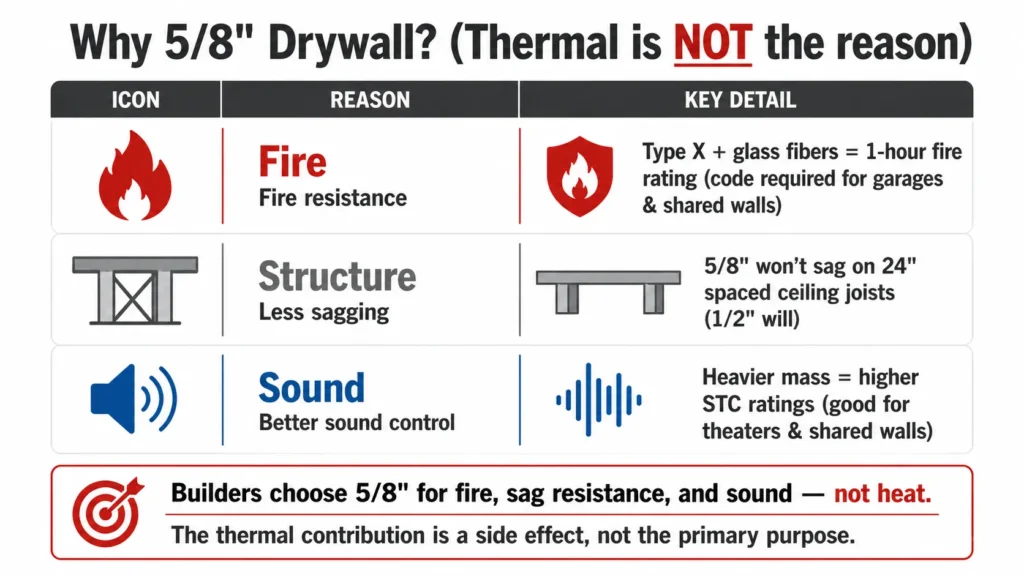
If 5/8 drywall provides little thermal resistance, why specify it over lighter 1/2-inch drywall? The reason is unrelated to insulation performance.
Fire Resistance
Fire resistance is the primary driver. 5/8-inch Type X gypsum board contains glass fibers and additional gypsum mass that slow the spread of fire. Most building codes require Type X drywall on attached garage walls and ceilings, between dwelling units in multifamily buildings, and in certain commercial applications. To understand the full range of fire-resistant drywall options and their specifications, refer to our fire resistant drywall guide, which details how Type X and Type C products meet code requirements.
Properly installed 5/8-inch Type X assemblies commonly achieve one-hour fire ratings. These assemblies also require careful attention to fastening specifications because screw length must account for the combined drywall thickness.
Structural Rigidity
Structural rigidity matters on long ceiling spans. The additional weight of 5/8-inch panels also increases installation difficulty and labor requirements compared to standard half-inch drywall. 1/2-inch drywall tends to sag over time when installed on ceiling joists spaced 24 inches on center. 5/8-inch board resists sagging better and is the standard recommendation for those framing layouts, especially when installing drywall on ceilings with wider joist spacing.
Sound Control
Sound control benefits from additional mass. Because 5/8 drywall is heavier per square foot, it improves sound transmission class (STC) ratings within wall assemblies. This matters in multifamily buildings, home theaters, and bedroom walls where acoustic separation is important. For a comprehensive overview of how drywall thickness and type affect acoustic performance, our soundproof drywall guide explores this topic in greater depth
These properties, including fire resistance, rigidity, and acoustic performance, explain why builders specify 5/8 drywall even when thermal performance is irrelevant. The thermal contribution is a side effect rather than the primary purpose.
5/8 Gypsum Board vs. Other Building Materials
| Material | R-Value per Inch | Typical R-Value as Used |
| 5/8-inch gypsum board | ~0.90/inch | ~0.56 |
| 1/2-inch gypsum board | ~0.90/inch | ~0.45 |
| Fiberglass batt (3.5″) | ~3.2–3.8/inch | ~R-13 |
| Mineral wool batt (3.5″) | ~3.7–4.2/inch | ~R-15 |
| EPS rigid foam (1″) | ~3.6–4.2/inch | ~R-4 |
| Closed-cell spray foam (1″) | ~6.0–7.0/inch | ~R-7 |
The gap between drywall and insulation materials is substantial. The difference between 1/2-inch drywall and 5/8-inch drywall is only about 0.11 R-value, which has no practical impact on room heating, cooling, or energy performance.
Foam board, mineral wool, and fiberglass batts provide most thermal resistance in modern walls. Drywall serves as the interior finish layer that protects the assembly and satisfies fire and finish requirements.
When the R-Value of Drywall Matters
Most of the time, the drywall R-value is too small to matter enough for design calculations. However, there are situations where even fractional R-values become relevant.
Passive House and High-Performance Structures
Tiny homes and Passive House assemblies optimize every fraction of thermal resistance. In these systems, drywall, sheathing, framing, and air films are all included because performance targets are stringent and require a holistic view of the building envelope to achieve extreme energy efficiency.
Uninsulated or Minimally Insulated Spaces
Older garages and unfinished basements sometimes receive drywall without cavity insulation. In below-grade environments, selecting the appropriate drywall product becomes just as important as improving thermal performance.
In those situations, drywall’s R-0.56 becomes a modest but measurable addition to the assembly.
Layered Wall Assemblies
Wall systems with continuous exterior insulation occasionally document every assembly layer, including drywall, for LEED certification or energy-code compliance. In these high-performance projects, even a 0.56 R-value contribution is tallied to ensure the structure meets specific sustainability and thermal envelope thresholds.
Dual-Layer Fire and Sound Assemblies
Assemblies using two layers of 5/8-inch drywall exceed R-1.0 cumulatively. That value remains modest but becomes slightly more relevant in uninsulated partition walls.
Common Misunderstandings About Drywall and Insulation
“Thicker drywall means better insulation.”
This is true only in a theoretical sense. Switching from 1/2-inch to 5/8-inch drywall adds approximately 0.11 R-value. That increase will not measurably affect heating bills, comfort levels, or energy-audit results.
“Fire-rated drywall improves energy efficiency.”
Fire resistance and thermal resistance are separate properties. Type X drywall contains glass fibers that help maintain structural integrity during fire exposure, but those fibers do not increase meaningful thermal resistance.
“Drywall can substitute for insulation in mild climates.”
It cannot. Even in moderate climates, the difference between R-0.56 and R-13 is the difference between a functional thermal envelope and an uninsulated shell. Drywall alone will not prevent condensation, energy loss, or comfort complaints.
“My walls must be insulated because they have thick drywall.”
Drywall thickness does not indicate whether insulation exists inside the wall cavity. A wall may contain multiple layers of 5/8-inch Type X drywall and still have no insulation between studs. Confirming insulation requires direct inspection, thermal imaging, or construction documentation.
The Bottom Line
The R-value of 5/8-inch gypsum board is approximately 0.56. It is measurable, documented, and part of the total thermal resistance of a wall assembly, but only as a minor component. Drywall is selected for fire resistance, code compliance, structural performance, and acoustic mass. Insulation provides the primary thermal performance in a wall system, and that function occurs inside the cavity or around the exterior assembly.
When evaluating wall performance, start with cavity insulation and continuous exterior insulation. Add the drywall’s R-0.56 afterward as a minor supplemental contribution rather than the primary thermal barrier.


Elena Hart is the founder and lead writer of Better Home Pro. She writes about drywall, home repair, and practical DIY home improvement topics, focusing on clear, useful information that helps homeowners make better decisions. Her work combines firsthand experience, manufacturer documentation, industry resources, and careful research to create content that is accurate, practical, and easy to understand. Through Better Home Pro, Elena aims to simplify complex home improvement topics and provide guidance that is genuinely helpful to homeowners and DIYers.









No Comments