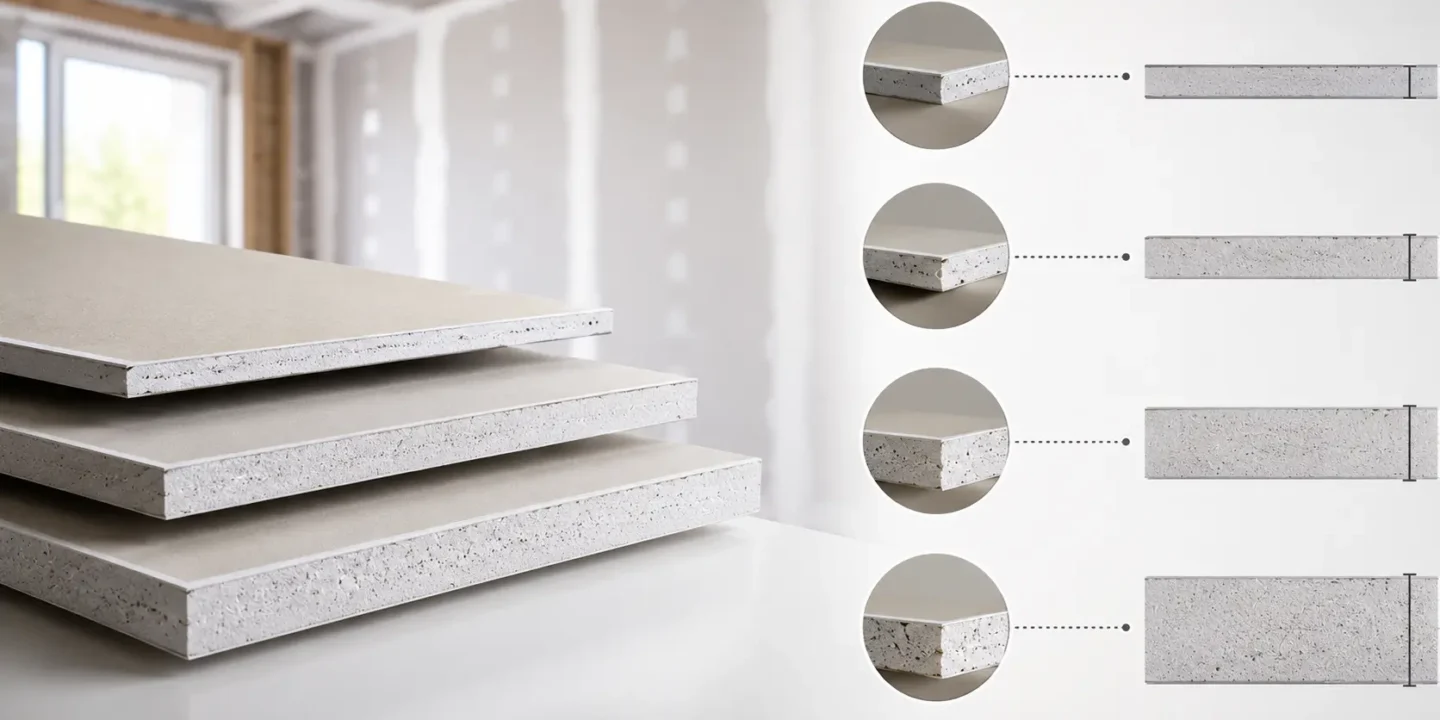



Walk into any home improvement store and you’ll find drywall in at least three thicknesses. Most people grab 1/2-inch without thinking about it, and for a lot of projects that’s perfectly fine. But use the wrong thickness on a ceiling with wide framing spacing, a fire-rated wall, or a curved surface, and you’ll end up with a real problem.
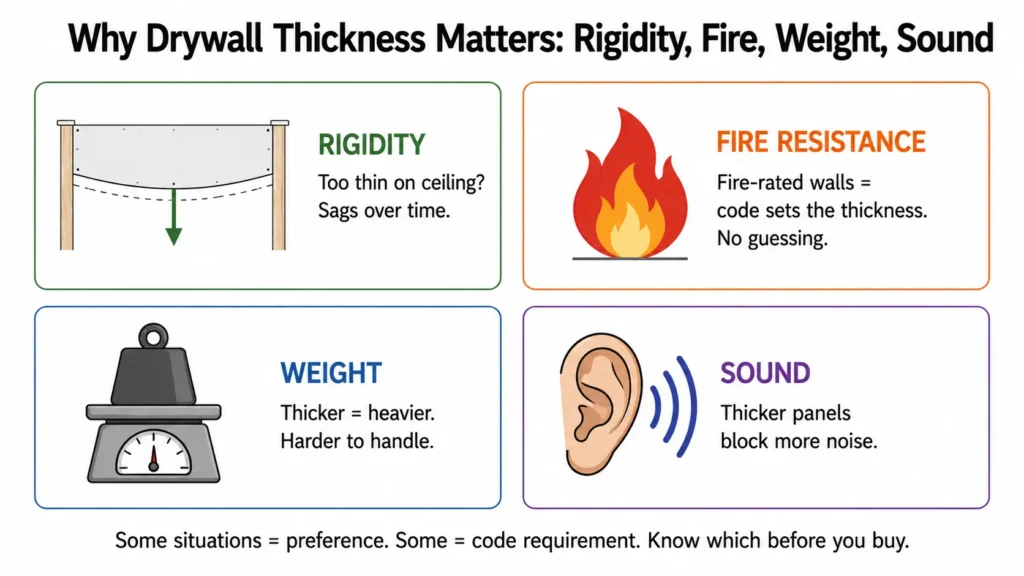
Thickness affects rigidity, fire resistance, weight, and sound performance. Get it wrong on a ceiling and you’ll see visible sagging within months. Get it wrong on a garage wall and you’re looking at a failed inspection and a tear-out. The good news is that once you understand what each option is actually designed for, the decision gets straightforward.
This article covers every thickness option in practical terms, including where each one works, where it doesn’t, what the code requires in common situations, and how to make the right call before you buy.
Key Takeaways
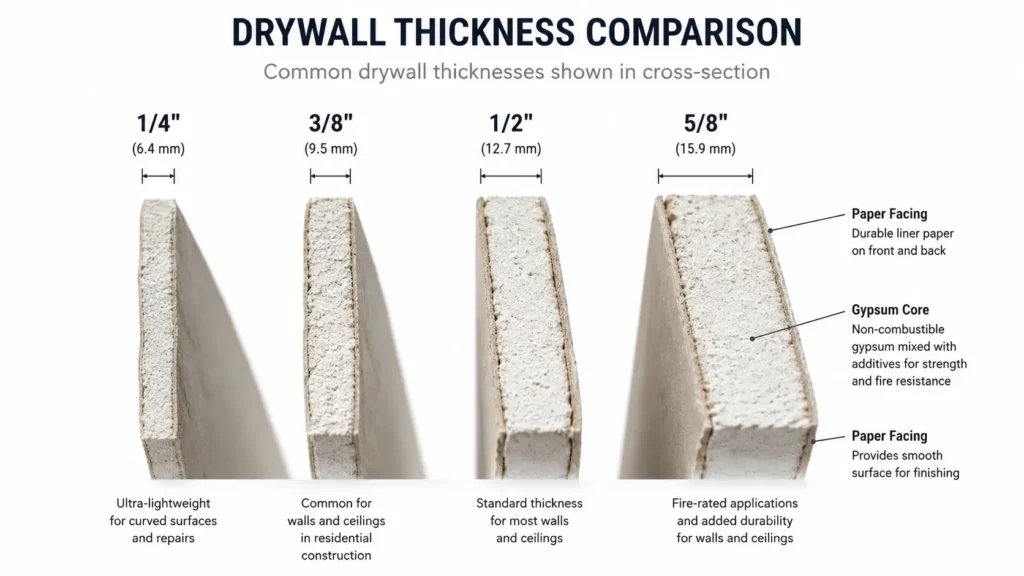
- Match Thickness to Use: Use 1/2-inch for standard walls, 5/8-inch for ceilings and fire-rated assemblies, and 1/4-inch for curves or laminating.
- Ceilings Need Rigidity: 5/8-inch drywall is recommended for most ceilings and required on 24-inch on-center framing to prevent sagging.
- Fire Ratings Matter: Attached garages, stairwells, and other rated assemblies typically require 5/8-inch Type X drywall.
- Thicker Means Better Performance: 5/8-inch panels improve sound control, impact resistance, and long-term durability compared to 1/2-inch.
- Lightweight Eases Installation: Lightweight drywall reduces handling strain by 20–30% while maintaining similar performance for most residential walls.
Why Drywall Thickness Matters
Thickness is not just a spec on a label. It directly affects four things: rigidity, fire resistance, weight, and sound attenuation. Each of those factors matters differently depending on where the panel is going.
On ceilings, rigidity is the most critical factor under ASTM C840 gypsum board application standards. A panel that’s too thin across wide framing spacing will sag over time, and ceiling repairs are among the most difficult and expensive drywall fixes to do cleanly, especially when trying to match existing drywall finish levels.
On fire-rated walls, the required thickness is set by code and tied to tested assembly specifications. In curved applications, thickness determines whether the panel will bend without cracking.
In some situations, thickness is a preference. In others, it’s a code requirement. Knowing which applies to your project saves money, rework, and headaches later.
1/4-Inch Drywall
What It Is
Quarter-inch drywall is the thinnest panel available for residential use. It’s not a structural product and isn’t designed to stand alone as a wall surface in most situations. It comes in standard 4×8 sheets, though specialty drywall sizes are harder to find at most retail locations. Its main advantages are flexibility and light weight, both of which make it useful in specific applications.
Where It’s Actually Used
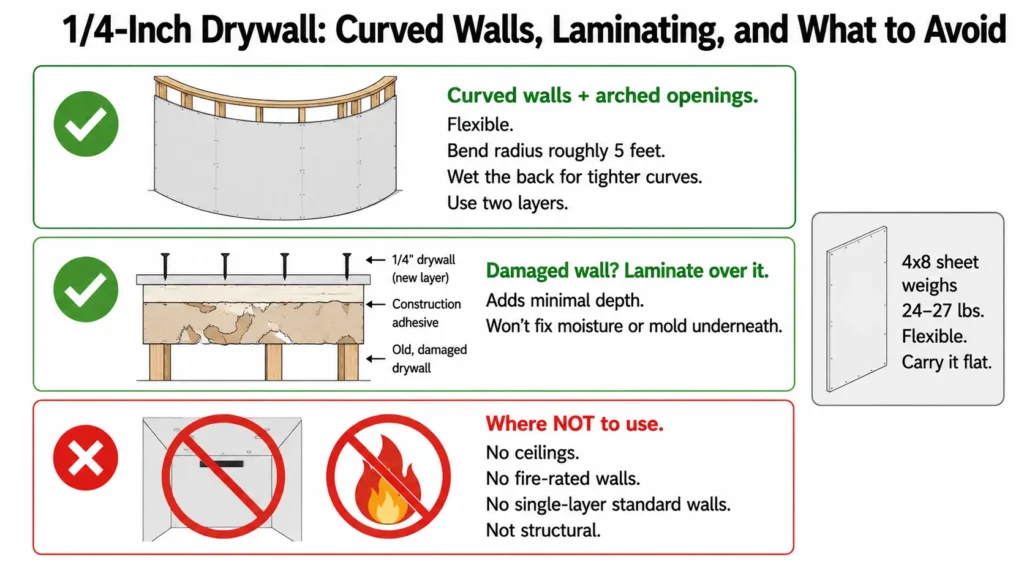
Curved walls and arched openings
This is where 1/4-inch earns its place. It’s the only standard drywall panel flexible enough to bend around curved framing without cracking , as demonstrated in CertainTeed’s curved drywall application guidelines. For dry panels, the minimum bend radius is roughly five feet when bending along the 8-foot length. If you wet the back face of the sheet lightly with water before bending, you can achieve tighter radii, which is useful for arched openings or decorative curved walls with a smaller radius.
For curved walls, 1/4-inch is typically applied in two layers. Two layers brings the total thickness to 1/2-inch, which matches standard wall depth and gives the surface adequate rigidity once installed. Going with a single layer of 1/4-inch leaves the wall too flexible and prone to damage.
Laminating over existing surfaces
The other common use is renovation work. When existing drywall or plaster is too damaged to finish cleanly but not bad enough to warrant full demo, 1/4-inch panels can be glued and screwed directly over the top. It adds minimal depth to the wall, which keeps the impact on door casings, window trim, and electrical boxes manageable.
One thing worth noting: laminating covers surface defects, it doesn’t fix structural or moisture problems underneath. If the existing wall has active moisture damage, mold, or underlying framing issues, laminating over it isn’t the right move. That needs to be addressed first.
Where It Shouldn’t Be Used
Don’t use 1/4-inch as a single-layer wall surface in standard applications. It doesn’t belong on ceilings. It contributes nothing to fire resistance and won’t pass inspection as the primary wall finish in any fire-rated or code-required location.
Weight
A standard 4×8 sheet runs 24 to 27 lbs. Easy enough to handle solo, but flexible enough that it needs to be carried flat or supported along its length to avoid accidental bending during transport.
3/8-Inch Drywall
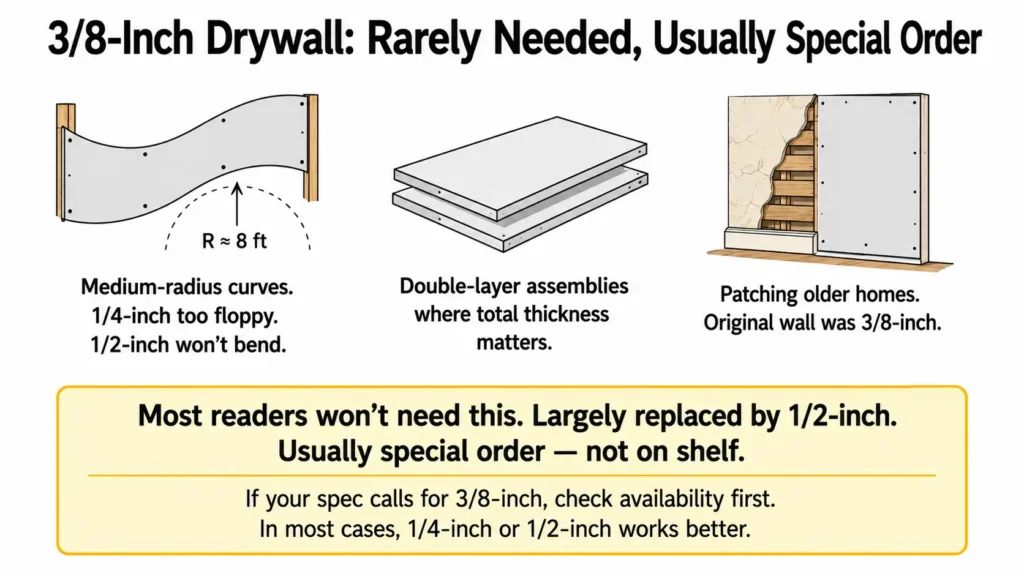
This is the least common thickness in modern residential work, and most readers won’t need it. It was more widely used decades ago as a standard wall thickness, but it’s largely been displaced by 1/2-inch in most applications.
Today, 3/8-inch is typically a special order item. You’ll rarely find it stocked on shelves at a big box store. It lands in a middle ground that’s stiffer than 1/4-inch but not as rigid or heavy as 1/2-inch.
Practical uses are limited: medium-radius curves where 1/4-inch is too flexible and 1/2-inch won’t bend, certain double-layer assemblies where controlling total thickness matters, and patching in older homes where 3/8-inch was the original wall thickness and matching the depth is necessary to avoid surface irregularities around existing trim.
If your project spec calls for 3/8-inch, confirm availability with your supplier before building your plan around it. In most cases where 3/8-inch seems like it might be the right call, either 1/4-inch or 1/2-inch will actually work better.
1/2-Inch Drywall
This is the product most people are buying, and for good reason. It’s the standard thickness for interior walls in residential construction. Every home improvement store and lumber yard carries it in multiple sheet lengths and several specialty formulations. It balances rigidity, weight, and cost better than any other thickness for standard wall applications.
Where It Works Well
Standard interior walls
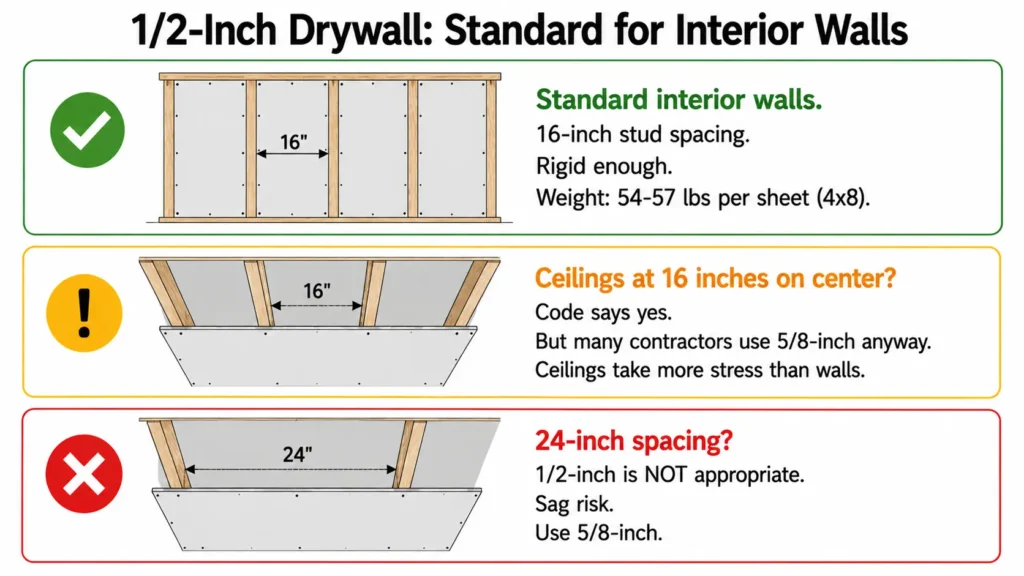
For partition walls in most residential settings, 1/2-inch is the correct choice. On framing spaced at 16 inches on center, it provides plenty of rigidity and handles the normal demands of a wall surface without issue. A standard 4×8 sheet weighs 54 to 57 lbs, which is manageable with two people. Lightweight 1/2-inch, discussed below, brings that down significantly.
Ceilings with 16-inch on-center framing
On ceiling framing at 16 inches on center, 1/2-inch is code-acceptable. It’ll hold. That said, a lot of contractors and builders default to 5/8-inch even on 16-inch framing as a standard practice. The reasoning is solid: ceilings are subject to seasonal wood movement, truss shifts, and vibration that walls aren’t, and 5/8-inch handles those stresses better over time. The upgrade is worth considering if you’re already pricing out the job.
At 24 inches on center, 1/2-inch is not appropriate for ceilings. That’s where sag becomes a real risk, and 5/8-inch becomes the minimum.
Specialty Versions
The 1/2-inch thickness is available in several drywall formulations beyond standard.
Moisture-resistant green board uses the same core as standard drywall but with a treated facing that resists humidity better. It’s a common choice for bathrooms and basements, though it’s worth understanding the limits of any moisture-resistant product before specifying it. For a detailed breakdown, see the green board moisture-resistant drywall guide.
Lightweight 1/2-inch is one of the more underrated options on the market. The weight difference between lightweight and regular drywall is significant: lightweight panels come in around 38 to 44 lbs per 4×8 sheet versus 54 to 57 lbs for standard. Performance is comparable for most residential wall applications. The cost per sheet is slightly higher, but the reduction in physical strain across a large project is real, especially on ceiling work.
Fire-rated 1/2-inch Type X exists but is less commonly specified than 5/8-inch Type X. Before planning around it, verify with your local building department that it satisfies the required assembly rating for your specific application.
Where 1/2-Inch Falls Short
It’s not the right product for ceilings on 24-inch framing. It doesn’t meet code for most fire-rated assemblies where 5/8-inch Type X is specified. It’s more susceptible to impact damage and denting than 5/8-inch. And because it’s less dense, it contributes less to sound blocking through the wall compared to the heavier panel.
5/8-Inch Drywall
If 1/2-inch is the workhorse for walls, 5/8-inch is the standard for ceilings, fire-rated assemblies, and any application where performance matters more than minimizing cost or weight.
Where It Works Well
Ceilings
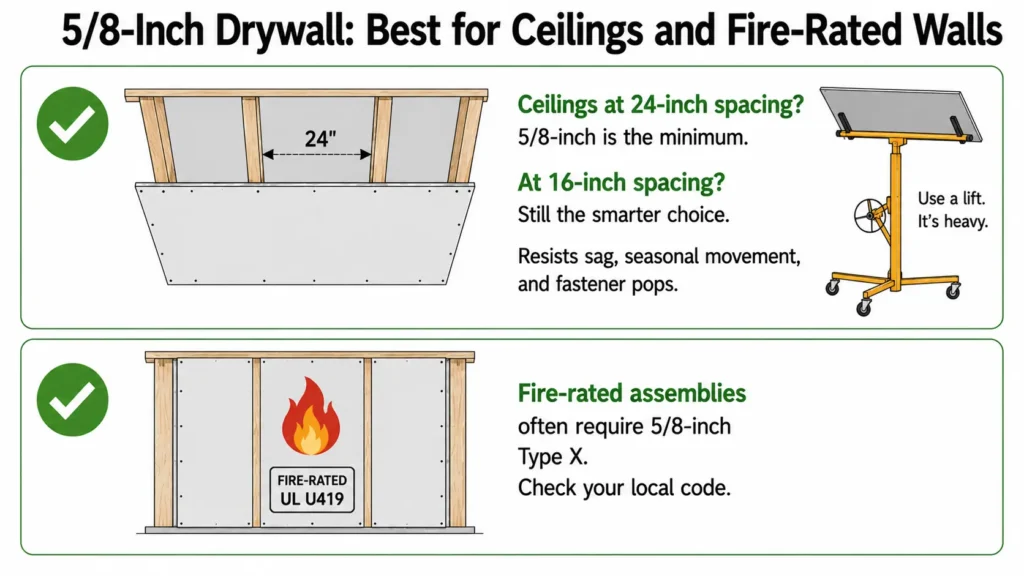
Five-eighths-inch is the preferred thickness for ceilings across the board. On framing at 24 inches on center, it’s the minimum acceptable option. On 16-inch framing, it’s still the smarter choice. The added rigidity resists the seasonal movement and vibration that cause fastener pops and surface cracking in thinner panels. If you’ve ever repaired a ceiling and know how difficult it is to blend a repair cleanly, you understand why specifying 5/8-inch upfront is cheap insurance.
For anyone planning a ceiling installation, using a drywall lift is essential at this weight. Check out the drywall lift guide for equipment options and rental considerations before the job starts.
Fire-rated assemblies
This is where 5/8-inch Type X becomes a code requirement rather than a preference. Type X panels contain glass fibers added to the gypsum core. Those fibers slow the spread of fire and help the panel maintain structural integrity under heat exposure longer than a standard panel would.
Five-eighths-inch Type X is the standard product for one-hour and two-hour fire-rated wall and ceiling assemblies. For a detailed comparison of fire-rated options, Type X vs Type C drywall breaks down the differences between the two and when each is appropriate.
One point that most content on this topic misses: the panel alone doesn’t create a rated assembly. The fire rating comes from the full tested and listed assembly specification, which includes fastener type, fastener spacing, framing requirements, and sometimes additional layers or materials. Installing Type X drywall on its own doesn’t automatically produce a rated assembly. You need to follow the complete specification for the assembly being used.
Locations where code requires it
In most jurisdictions, 5/8-inch Type X is required in several specific locations:
- Garage walls and ceilings adjacent to living space
- Stairwell enclosures
- Party walls in multi-family construction
- Certain mechanical room applications
The garage wall requirement catches people by surprise more than any other. It’s a fire separation requirement, not a structural one. The intent is to give occupants enough time to escape if a fire starts in the garage before it reaches the living area. Always verify the exact requirement with your local building department before buying materials. Requirements can vary by jurisdiction and project type.
Higher-performance walls
Some builders apply 5/8-inch across all walls and ceilings as a quality standard. Walls built with 5/8-inch feel noticeably more solid, resist denting better, and perform better acoustically without any additional treatment. In home theater spaces, recording rooms, or shared bedroom walls, the thickness upgrade provides a meaningful baseline improvement. For spaces where sound isolation is a serious concern, see the full breakdown of soundproof drywall options beyond just thickness.
Sound Performance
Mass is the primary mechanism for blocking sound through a wall assembly, and 5/8-inch drywall is denser and heavier than 1/2-inch. That weight difference translates directly to better sound attenuation. A wall built with 5/8-inch on each side will outperform the same framing assembly with 1/2-inch panels. It’s not a substitute for a dedicated acoustic assembly where serious isolation is the goal, but it’s a meaningful starting point.
Weight and Handling
A standard 5/8-inch 4×8 sheet weighs 70 to 74 lbs. A 4×12 sheet can exceed 100 lbs. Two people are necessary for wall installation. Ceiling work at this weight requires a lift without exception.
If you’re ordering 5/8-inch in volume, arrange delivery from your supplier. Transporting and unloading large quantities of 5/8-inch sheets adds significant physical strain to a project, and job site setup gets easier when material is delivered directly to the work area rather than hauled from a vehicle.
For screw selection on 5/8-inch panels, the right fastener length matters. Check the screw size recommendations for 5/8-inch drywall before fastening to make sure you’re getting proper penetration into the framing.
Where 5/8-Inch Is Overkill
Standard interior partition walls in low-traffic rooms where fire rating, sound, and impact resistance aren’t concerns. Patch repairs where matching the existing 1/2-inch depth is more practical. Any application where the added weight creates handling difficulty with no real performance benefit to show for it.
Code Requirements by Location
| Location | Required Thickness | Product Type | Notes |
| Standard interior walls | 1/2-inch minimum | Standard | Local codes vary |
| Ceilings (16″ OC) | 1/2-inch minimum | Standard | 5/8-inch recommended |
| Ceilings (24″ OC) | 5/8-inch | Standard or Type X | 1/2-inch will sag |
| Garage walls (attached) | 5/8-inch | Type X | Required in most jurisdictions |
| Garage ceiling (attached) | 5/8-inch | Type X | Required in most jurisdictions |
| Stairwell enclosures | 5/8-inch | Type X | Verify local code |
| Party walls (multi-family) | 5/8-inch | Type X | Assembly-specific |
| Curved walls | 1/4-inch | Standard | Two layers typical |
| Laminate over existing | 1/4-inch | Standard | Not a structural layer |
The table above reflects general construction practice in most U.S. jurisdictions. Local codes vary, and some municipalities have requirements that go beyond the IRC baseline. Before buying materials for any fire-rated or code-specific application, confirm the exact requirement with your local building department.
The fire assembly point deserves repeating: Type X drywall installed on its own doesn’t create a rated assembly. The rating comes from the full tested and listed assembly specification documented in UL fire-rated wall and ceiling assemblies. Use the correct panel and follow the full tested assembly to achieve the required rating.
Weight and Cost Comparison
| Thickness | 4×8 Sheet Weight | Relative Cost | Primary Use |
| 1/4-inch | 24 to 27 lbs | Low | Curves, laminating |
| 3/8-inch | 35 to 38 lbs | Low to moderate | Specialty only |
| 1/2-inch | 54 to 57 lbs | Moderate | Standard walls |
| 1/2-inch lightweight | 38 to 44 lbs | Moderate to high | Walls, easier handling |
| 5/8-inch | 70 to 74 lbs | Moderate to high | Ceilings, fire-rated |
The cost difference between 1/2-inch and 5/8-inch per sheet is modest, typically a dollar or two. On a small project, that’s negligible. On a full house or a large commercial job, it adds up. Factor that into your material budget when specifying 5/8-inch across a large area.
Lightweight drywall costs more per sheet than standard 1/2-inch but can reduce labor cost on large projects where handling time and physical fatigue are real factors. On ceiling installations in particular, the weight reduction matters for installer efficiency and safety.
The 3/8-inch and 1/4-inch options are typically priced similarly to or slightly below 1/2-inch per sheet where they’re stocked. The challenge is availability. Special ordering thin or niche thicknesses adds cost and lead time that should be factored in during the planning phase.
FAQ
What thickness drywall should I use for walls?
For most interior walls in residential construction, 1/2-inch is the right choice. It performs well on 16-inch on-center framing, is widely available, and handles the demands of a standard wall surface without issue. The exception is any wall that requires a fire rating, where 5/8-inch Type X is typically the code-required product.
What thickness drywall should I use for ceilings?
Five-eighths-inch is the better choice for ceilings in most situations. It’s required when framing is spaced at 24 inches on center and strongly recommended even at 16 inches on center. The added rigidity reduces sag risk, minimizes fastener pops, and produces a more stable surface over time. Before installation, review the ceiling drywall installation process to plan the job properly.
Is 5/8-inch drywall required for garage walls?
In most jurisdictions, yes. Attached garages require 5/8-inch Type X on walls and ceilings that separate the garage from the living space. This is a fire separation requirement designed to slow the spread of fire and give occupants time to evacuate. Always verify the specific requirement with your local building department before purchasing materials.
What is the difference between Type X and standard drywall?
Type X drywall contains glass fibers embedded in the gypsum core. Those fibers slow the spread of fire and help the panel hold together longer under heat exposure than a standard panel would. Type X is the product required for fire-rated wall and ceiling assemblies. Standard drywall carries no fire rating and cannot substitute for Type X in code-required locations.
Can I use 1/4-inch drywall on walls?
Not as a single layer in standard applications. Quarter-inch is too thin and flexible to work as a standalone wall surface. It’s used for curved walls, typically in two layers to reach 1/2-inch total thickness, and for laminating over existing surfaces during renovation. For standard walls, 1/2-inch is the minimum practical thickness.
Does thicker drywall improve soundproofing?
Yes, meaningfully. Mass is the primary driver of sound blocking through a wall, and 5/8-inch drywall is heavier and denser than 1/2-inch. A wall assembly using 5/8-inch on each side will outperform the same assembly with 1/2-inch panels. It’s not a replacement for a purpose-built acoustic assembly in spaces where serious sound isolation is needed, but it provides a real baseline improvement.
What is lightweight drywall and is it worth it?
Lightweight drywall uses a modified gypsum formulation that reduces sheet weight by roughly 20 to 30 percent compared to standard panels. Performance for most residential wall applications is comparable to standard. It costs slightly more per sheet but significantly reduces physical strain on large projects, particularly ceiling work where handling weight matters most. For most DIYers, the handling benefit justifies the small cost premium.
Conclusion
The decision comes down to application. For standard interior walls, 1/2-inch is the right product. For ceilings and fire-rated assemblies, 5/8-inch is either required or strongly recommended. For curved walls and laminating over existing surfaces, 1/4-inch is the specific tool for that job.
Before buying materials for any project involving a garage wall, ceiling, or fire-rated separation, verify the local code requirement with your building department. Requirements vary by jurisdiction, and an incorrect thickness choice in a code-required location means a failed inspection and a tear-out.
If you’re undecided between 1/2-inch and 5/8-inch for a ceiling, go with 5/8-inch. The weight difference is manageable with the right equipment, the cost difference is modest, and the performance advantage on ceilings is real and lasting.


Elena Hart is the founder and lead writer of Better Home Pro. She writes about drywall, home repair, and practical DIY home improvement topics, focusing on clear, useful information that helps homeowners make better decisions. Her work combines firsthand experience, manufacturer documentation, industry resources, and careful research to create content that is accurate, practical, and easy to understand. Through Better Home Pro, Elena aims to simplify complex home improvement topics and provide guidance that is genuinely helpful to homeowners and DIYers.









No Comments