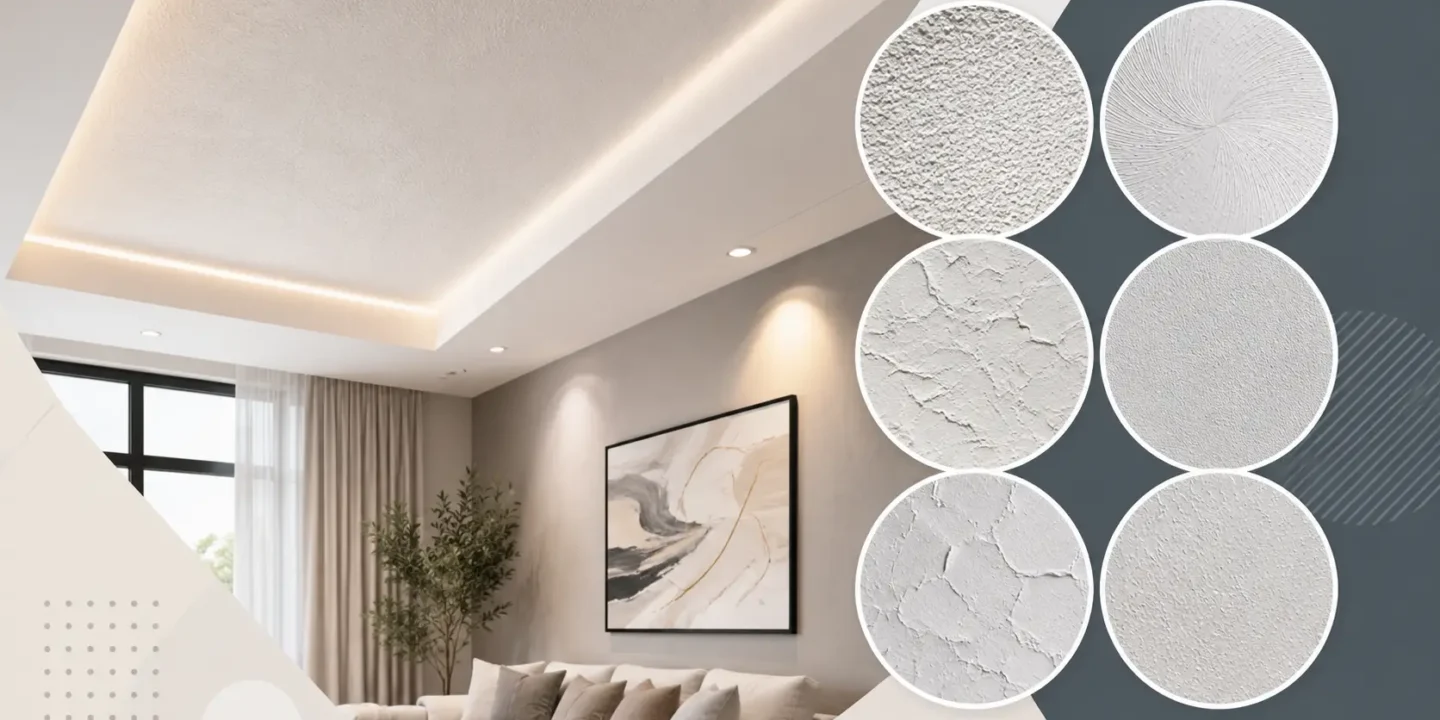



Most drywall texture guides show you eight options and leave you to choose. But the right texture for a north-facing bedroom with raking morning light is completely different from the right texture for a high-traffic hallway or a home theater ceiling. The texture choice isn’t just aesthetic. It affects how your room feels under different lighting, how forgiving the finish is for a first-time DIYer, and how difficult future repairs will be.
Before you pick a texture based on a photo you liked on Pinterest, there are four decisions worth mapping out: room type and lighting conditions, DIY difficulty, repair difficulty, and how the texture aligns with where interior design is heading in 2026. No single factor tells the whole story.
This guide covers all eight major texture types with every dimension rated, a room-by-room decision matrix, a section on raking light that most guides completely ignore, and the 2026 trends actually worth paying attention to.
Key Takeaways:
- Side windows and directional fixtures cast raking light that amplifies every imperfection on smooth walls, whereas knockdown or orange peel textures disguise them.
- Orange peel is the most practical choice for high-traffic rooms because matching spray cans make localized drywall repairs virtually invisible.
- Knockdown has become the standard 2026 ceiling texture for hiding substrate flaws, largely replacing dated popcorn textures in modern renovations.
- Hand-applied finishes like skip trowel and hawk-and-trowel look highly custom but are exceptionally difficult to patch without refinishing the entire wall.
- Skipping a dedicated primer coat over fresh texture causes uneven paint absorption, leaving a patchy and flat final finish across the wall surface.
The Raking Light Factor: Why Your Room’s Lighting Determines Your Texture Choice
This is the single most practically useful piece of knowledge for anyone choosing a drywall texture, and almost no guide covers it.
Raking light is light that hits a wall at a sharp, near-parallel angle. Morning sun coming through a side window, low-hanging pendant lights, directional spotlights, a floor lamp positioned near a wall. When light skims a surface at that angle, it casts long shadows across the wall, amplifying every bump, ridge, and imperfection that would otherwise be invisible under diffuse overhead lighting.
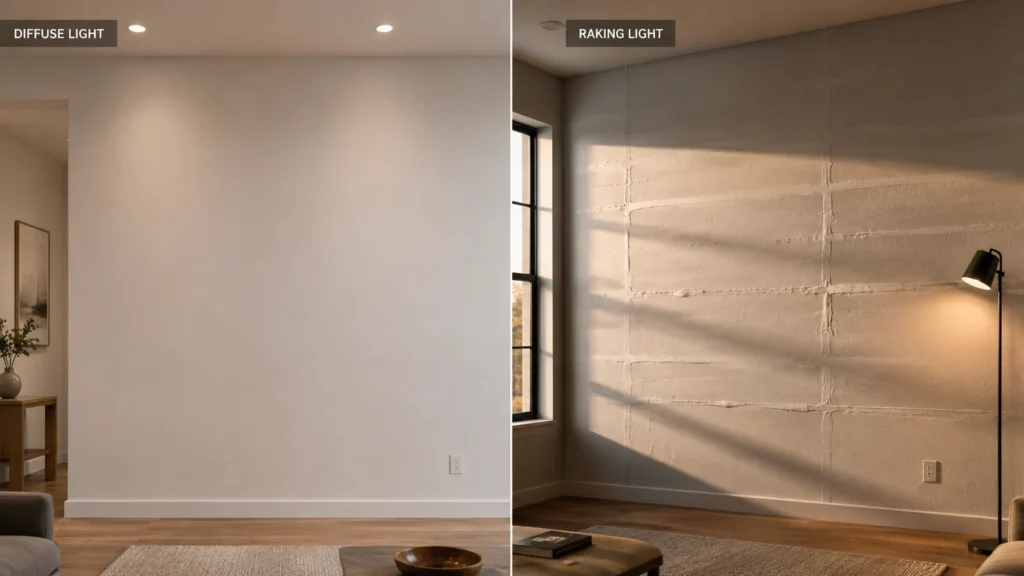
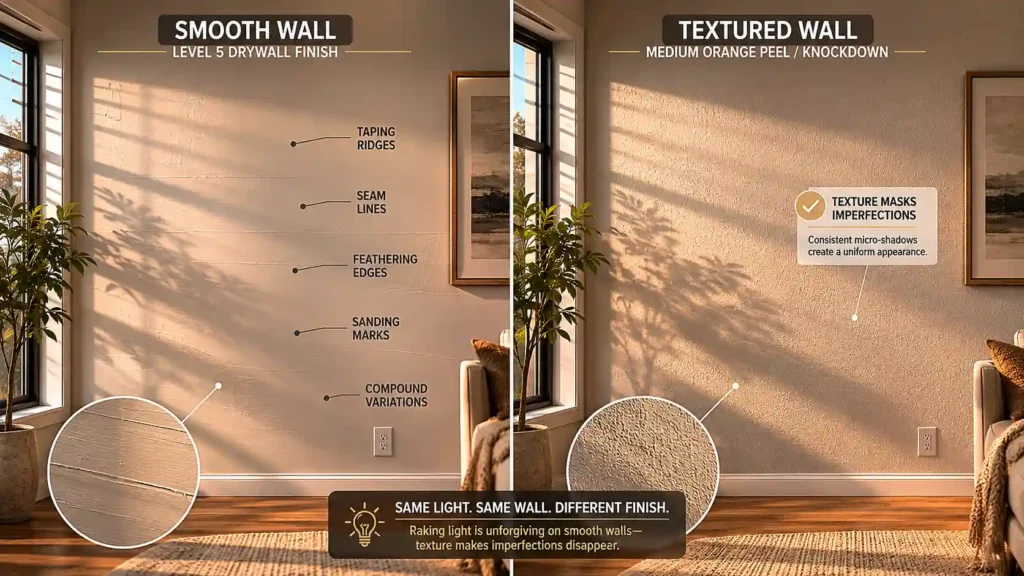
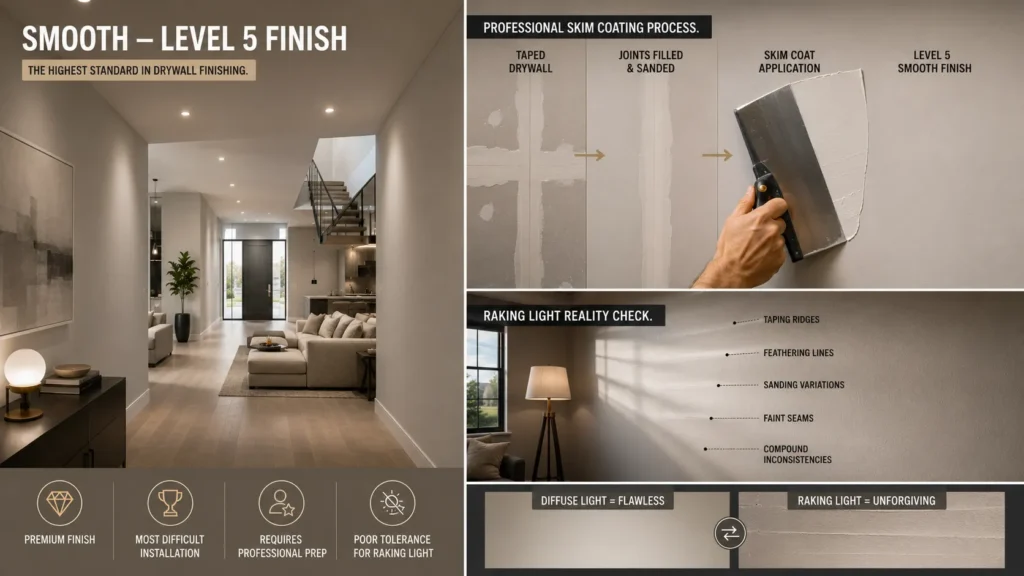
What this means for smooth walls: A Level 5 smooth finish can look stunning in a room with diffuse, overhead lighting. Put that same wall in a room with a low side window or directional fixtures and the situation changes completely. Every taping ridge, every slight variation in compound thickness, and every seam becomes visible once directional lighting starts exposing drywall surface ridges across the wall plane. Smooth walls are brutally unforgiving under raking light, which is why professional installers spend significantly more time on surface preparation when smooth is the specified finish. Skim coating, perfect feathering, and flawless substrate prep are mandatory because Level 5 finish quality depends entirely on eliminating visible transitions before paint.
What this means for textured walls: Medium textures like orange peel and knockdown work in the opposite way under raking light. The texture itself creates micro-shadows that overwhelm and conceal any substrate imperfections. Raking light actually makes these textures look better, adding dimension and visual interest. This is a big part of why knockdown and orange peel became the default residential textures in the first place.
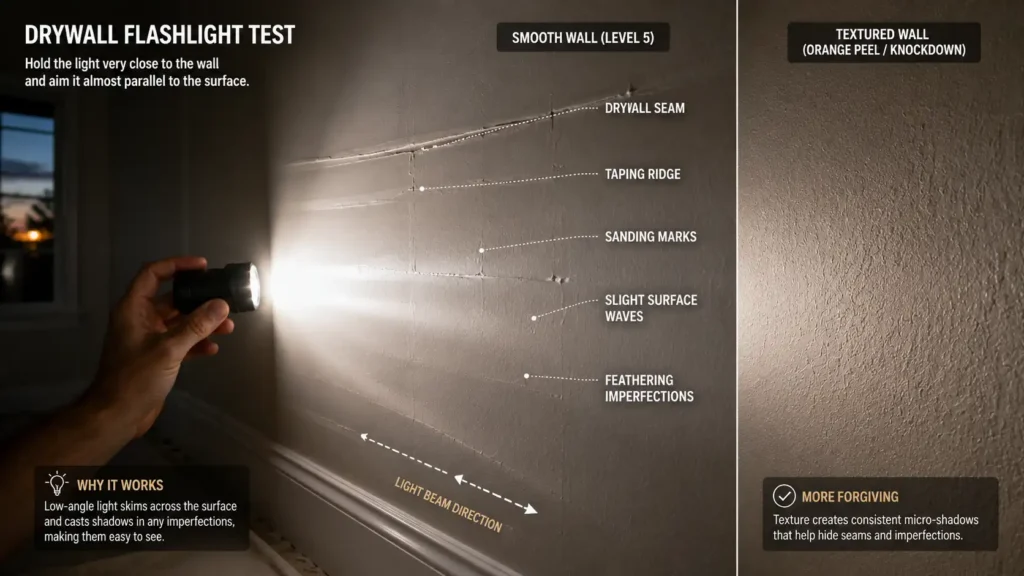
Before you commit to any texture, try this test: shine a work light or strong flashlight at a sharp angle across your existing wall surface. Hold it close to the wall and aim it so the beam travels nearly parallel to the surface. What you see is what raking light will reveal in that room. If the surface looks rough, uneven, or full of ridges under that test, a texture with enough relief to hide the substrate will save you significant prep work and deliver a better-looking result over time.
The 8 Texture Types: Complete Guide With DIY Rating, Repair Difficulty, and Room Fit
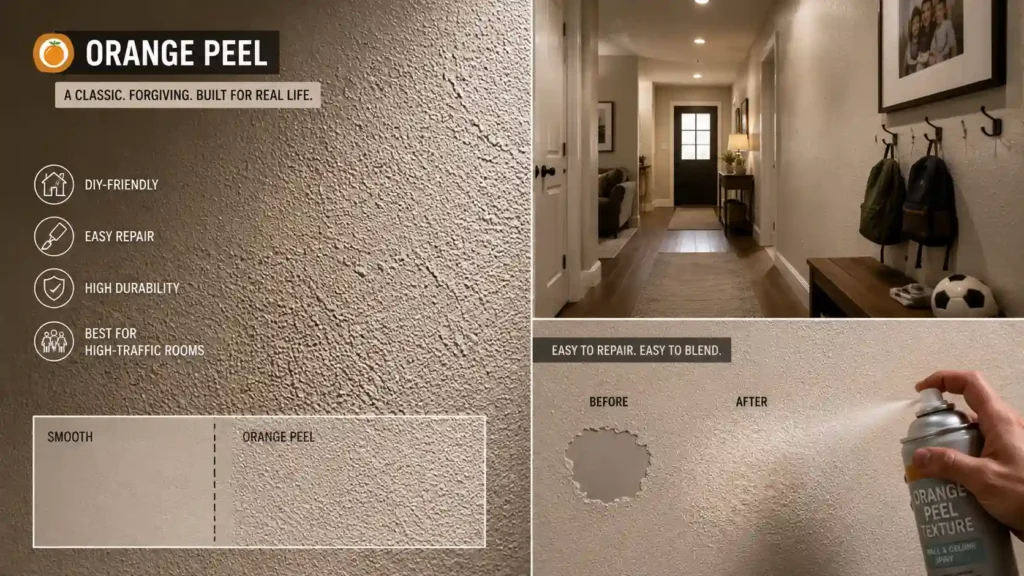
Orange Peel
DIY difficulty: ⭐⭐ 2/5 | Repair difficulty: ⭐ 1/5 | Hides imperfections: Good
The most widely used texture in new residential construction in the US. The surface resembles citrus skin: fine, slightly rounded bumps distributed evenly across the wall. It’s applied with a hopper gun or, for smaller areas, a spray can. The random, uniform pattern makes it forgiving to apply and extremely practical in high-traffic spaces where future drywall repairs are almost inevitable.
Orange peel is the practical choice where durability and repairability matter more than visual sophistication. Spray cans in multiple nozzle sizes are available at every hardware store, which means a small patch blends naturally into the surrounding texture with minimal effort.
That practicality is one reason orange peel is commonly recommended in finished basements, where uneven surfaces and long-term basement moisture exposure are both common remodeling concerns.
Best for: High-traffic areas, hallways, family rooms, bathrooms, kitchens, rental properties. Avoid for: Formal spaces or primary bedrooms where a more refined finish is expected.
Knockdown
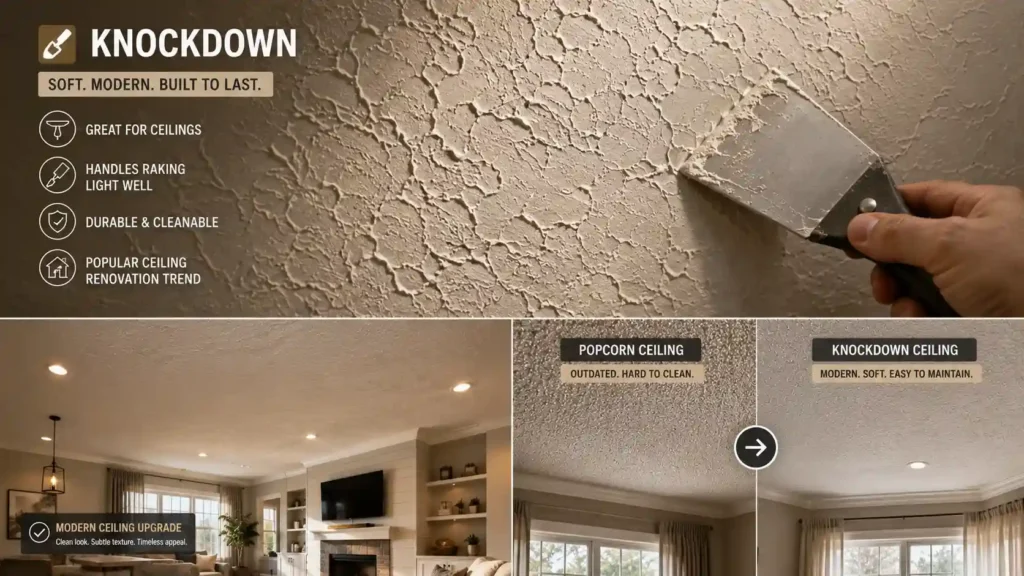
DIY difficulty: ⭐⭐⭐ 3/5 | Repair difficulty: ⭐⭐ 2/5 | Hides imperfections: Excellent
Compound is sprayed or rolled onto the wall and then lightly flattened with a knockdown knife before it fully sets. The result is a soft, organic surface with irregular flattened areas and slight texture between them. It resembles a gentle stucco and handles raking light well because the surface variation is substantial enough to create its own visual pattern.
Knockdown is the dominant ceiling texture in 2026. The overhead application suits the technique because a knockdown spreader is easier to use above your head than a spray rig, and the texture effectively hides any imperfections in the substrate. It’s also cleanable, durable, and repairable with reasonable effort.
Best for: Ceilings (the standard recommendation), living rooms, dining rooms, home offices in rooms with directional lighting. 2026 trend: Replacing popcorn ceilings with knockdown is currently the most popular ceiling renovation job in the US. Same imperfection coverage, far more contemporary appearance.
Skip Trowel
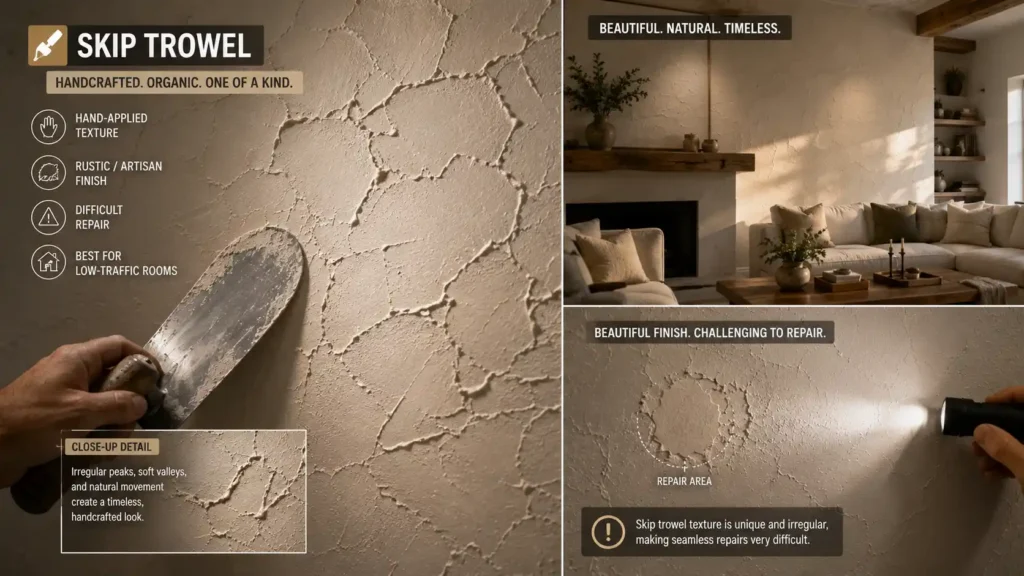
DIY difficulty: ⭐⭐⭐ 3/5 | Repair difficulty: ⭐⭐⭐⭐ 4/5 | Hides imperfections: Excellent
Skip trowel is applied by hand using a curved trowel. You apply compound in irregular patches, letting the trowel skip across the surface and leave gaps between the compound areas. The finished surface has a rustic, handcrafted quality with organic peaks and valleys. No two walls look identical, which is part of its appeal.
The tradeoff is repair difficulty. Because the pattern is applied by hand in an organic, irregular way, matching a patch to the surrounding texture later is genuinely hard. A skilled plasterer can get close, but in raking light, repairs are often visible. Choose skip trowel for rooms you expect to leave undisturbed.
Best for: Living rooms, dining rooms, primary bedrooms, feature walls, transitional and modern farmhouse interiors. Avoid for: Rooms with young children, high-traffic areas, or any space where dents, holes, or scuffs are likely.
Smooth — Level 5 Finish
DIY difficulty: ⭐⭐⭐⭐⭐ 5/5 | Repair difficulty: ⭐⭐⭐⭐⭐ 5/5 | Hides imperfections: Amplifies them
No texture at all. A Level 5 finish means the entire wall surface is skim coated to achieve a perfectly flat, paint-ready surface. It’s the most labor-intensive option and requires consistent compound application, thorough sanding, and flawless feathering.
The result, when done right and in the right lighting environment, is genuinely striking. Smooth walls have become a premium finish marker in high-end new construction. Buyers and designers recognize the additional cost and skill involved. In a room with soft, diffuse overhead lighting and no directional windows, Level 5 looks exceptional.
Under raking light, it’s the most unforgiving finish that exists. Any taping ridge, compound buildup, or uneven feathering becomes visible once angled light starts traveling across the finished surface. This is not a DIY project for most homeowners.
Best for: Contemporary and minimalist interiors, professional installs, rooms with overhead diffuse lighting. Not recommended for: First-time DIYers, rooms with directional side windows, or any wall that’s likely to need future patching.
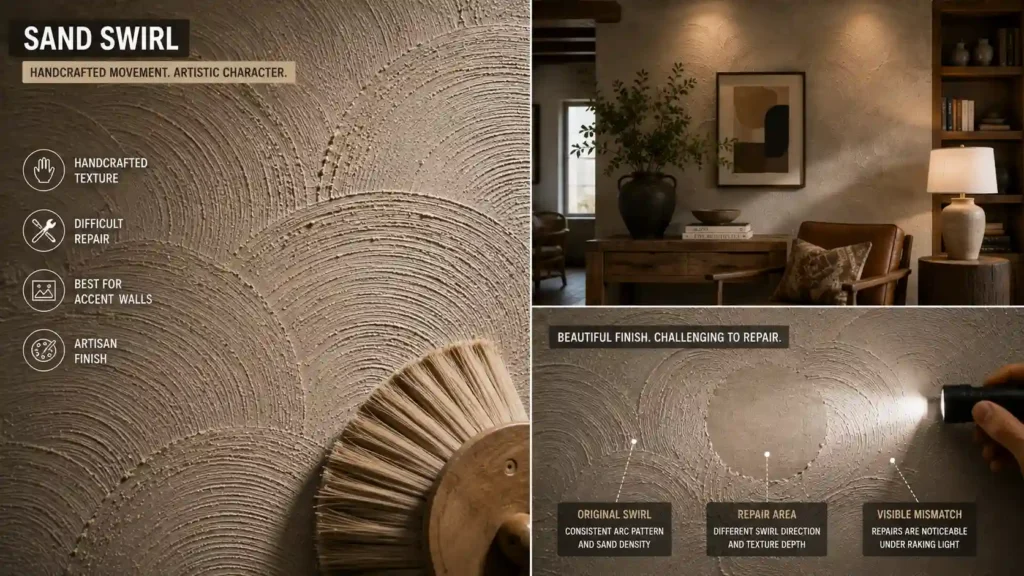
Sand Swirl
DIY difficulty: ⭐⭐⭐ 3/5 | Repair difficulty: ⭐⭐⭐⭐ 4/5 | Hides imperfections: Good
Fine sand is mixed directly into compound, then the mixture is applied to the wall and swept in overlapping arcs with a brush. Each wall is unique. The pattern is distinctive and overtly handmade, which some homeowners love and others find too busy for whole-room application.
Repair is difficult because recreating the exact arc pattern, sand density, and layering depth of the original application is nearly impossible. Best treated as a commitment.
Best for: Feature walls, accent ceilings, eclectic or artisan-influenced interiors. 2026 note: Too niche for whole-home use, but a compelling choice for a single statement wall.
Slap Brush / Stipple
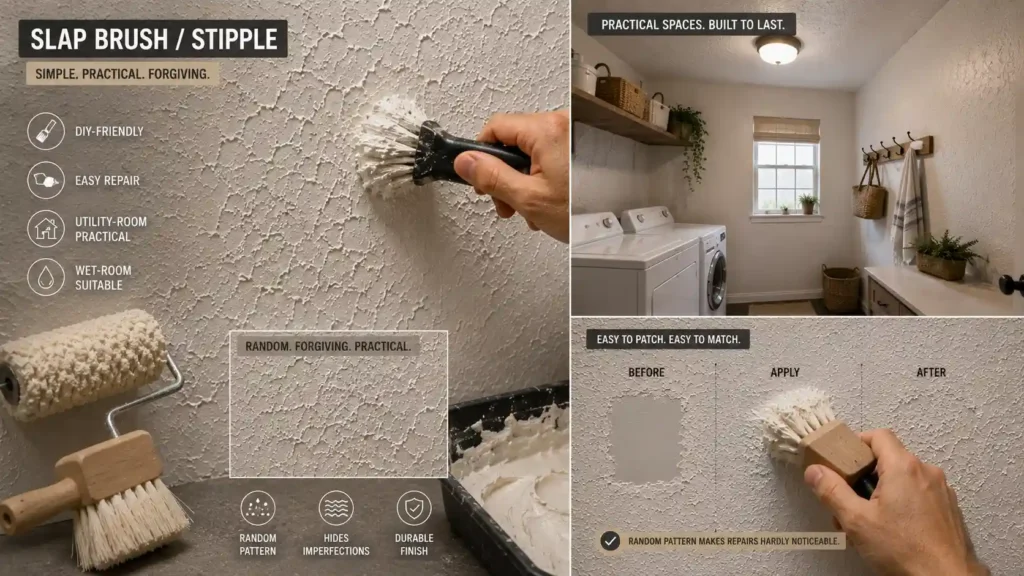
DIY difficulty: ⭐⭐ 2/5 | Repair difficulty: ⭐⭐ 2/5 | Hides imperfections: Good
A brush or texture roller is dabbed repeatedly into wet compound to create a random raised pattern. One of the most consistent DIY textures to produce because random texture patterns hide minor application inconsistencies surprisingly well.
Best for: Bathrooms, utility rooms, laundry areas, any space where ease of application matters more than visual refinement. 2026 note: Declining in main living areas but still the practical choice for utility spaces and wet rooms.
Comb Texture
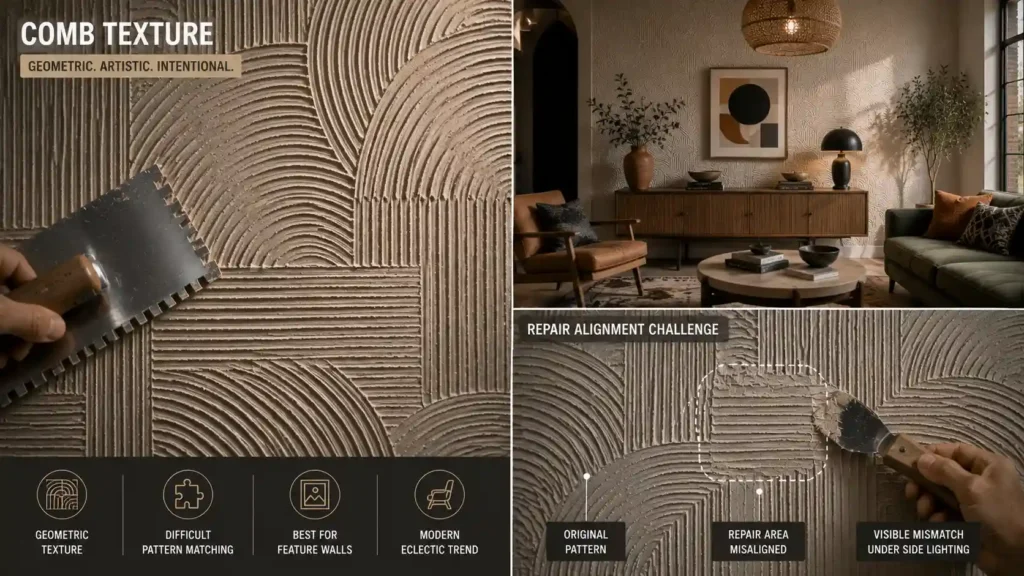
DIY difficulty: ⭐⭐ 2/5 | Repair difficulty: ⭐⭐⭐ 3/5 | Hides imperfections: Moderate
A notched trowel is dragged through wet compound in parallel lines, waves, or fan patterns. The result is precise and geometric, which makes it visually distinctive but also harder to repair than random textures. Pattern alignment on a patch is the main challenge.
Best for: Feature walls, accent applications, mid-century and eclectic interiors. 2026 trend: Comb texture is making a comeback in modern eclectic homes, particularly on single feature walls rather than whole rooms. The geometric quality pairs well with curated vintage-meets-contemporary aesthetics.
Hawk and Trowel (Venetian / Santa Fe)
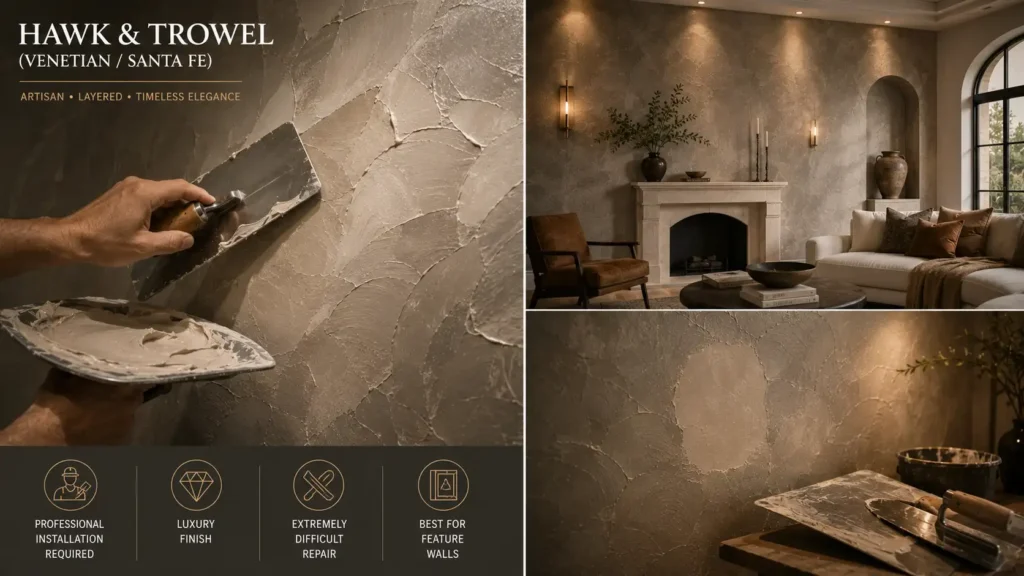
DIY difficulty: ⭐⭐⭐⭐⭐ 5/5 | Repair difficulty: ⭐⭐⭐⭐⭐ 5/5 | Hides imperfections: Excellent
Multiple layers of compound are hand-applied with a hawk and trowel, building up deep, organic patterns with visible layering and texture variation. The finished surface has a genuine sculptural quality that no sprayed or rolled texture can replicate.
This is not a DIY texture for most homeowners. The result is highly visible, intentional, and nearly impossible to extend or repair without refinishing the entire wall section. For high-end custom installations done by a skilled professional, the result is exceptional. For anyone else, the repair risk is too significant.
Best for: High-end custom installations, feature walls, professional application in formal spaces. Honest note: Budget for professional installation and accept that future repairs mean full-wall refinishing.
Room-by-Room Decision Matrix
| Room | Recommended Texture | Reason |
| Living room (open plan, mixed lighting) | Knockdown or skip trowel | Good imperfection coverage, raking light tolerance |
| Master bedroom (side window light) | Knockdown | Handles directional light far better than smooth |
| Contemporary/minimalist bedroom | Smooth Level 5 | Only if professional install and no directional windows |
| Bathroom walls | Orange peel | Easiest to clean, easiest to repair |
| Kitchen walls | Orange peel | Durable, cleanable, easy repair near cooking area |
| Hallway (high traffic) | Orange peel | Most repair-friendly option for high-wear areas |
| Home office (raking window light) | Knockdown | Handles raking light; smooth would show every imperfection |
| Basement finishing | Knockdown or orange peel | Forgiving over imperfect or uneven substrate |
| Any ceiling | Knockdown | Dominant ceiling texture in 2026 for good reason |
| Feature wall / accent wall | Skip trowel, sand swirl, or comb | Visual interest is the whole point |
| High-end formal space (pro install) | Smooth Level 5 or hawk and trowel | When the budget allows and professional applicators are involved |
The patterns in that table aren’t arbitrary. Rooms with raking light push toward knockdown. Rooms with daily wear push toward orange peel. Feature walls are where you can take risks. Rooms that will see patches and repairs in a few years are not the place for skip trowel or smooth.
Repair Difficulty Ranked: What to Know Before You Choose
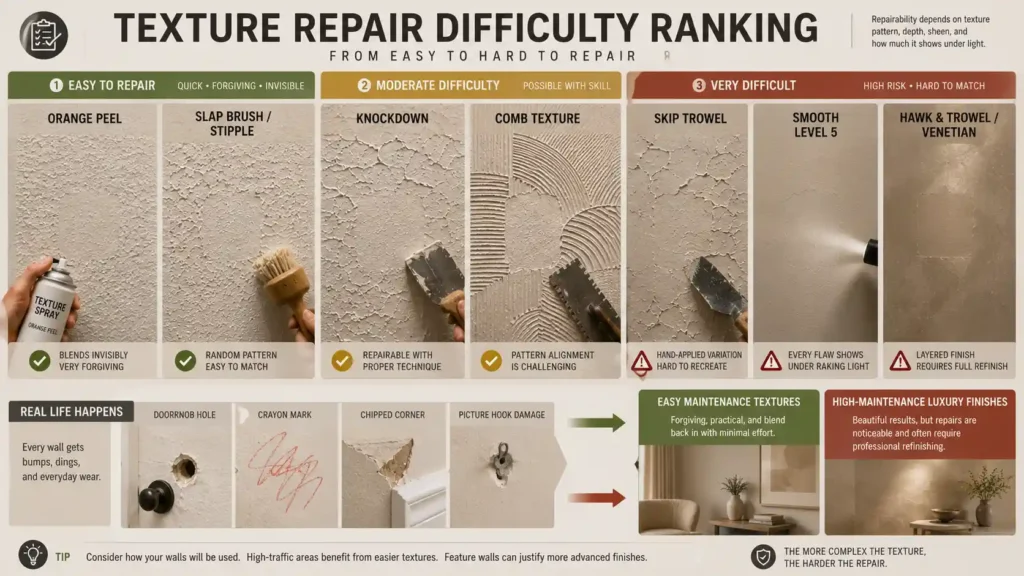
Most homeowners choose a texture based on how it looks on day one. The practical reality is that walls get damaged. A doorknob punches a hole, a crayon leaves a mark at toddler height, a picture falls and takes a chunk of plaster with it. What happens next depends entirely on which texture you chose.
Easy to repair
Orange peel is the most repair-friendly texture available. Spray cans match the pattern naturally because orange peel is inherently random and uniform. Three can sizes cover coarse, medium, and fine patterns. Most hardware stores stock all of them. A good repair is invisible.
Slap brush and stipple are also very forgiving. The random dab pattern tolerates variation in a repair without it standing out.
Moderate to repair
Knockdown can be matched with practice. Apply fresh compound, spread it thinly, then flatten with a knife to approximate the original pattern. Feather the edges wide. It typically takes two or three attempts to match well, but the result can be close to invisible.
Comb texture depends entirely on having the original tool. If you can match the notch width and spacing, alignment repairs are achievable. If the original tool is gone, matching is much harder.
Very difficult to repair
Skip trowel repairs are visible. The hand-applied organic pattern is essentially impossible to recreate with enough precision that a patch disappears, especially under raking light. A skilled plasterer can get close. Close is not invisible.
Smooth Level 5 patches are similarly problematic because even minor sanding scratches and sheen differences become visible under directional lighting. Any feathering seam becomes visible under directional light. Patching a smooth wall often means refinishing the entire wall plane.
Hawk and trowel is essentially impossible to repair without refinishing the whole section. The layered, hand-applied depth cannot be replicated in a localized patch.
The practical implication: For any room that sees daily use, has children, or is likely to need repairs over the next decade, orange peel or knockdown is the rational choice regardless of aesthetic preference. Save skip trowel and smooth for feature walls or rooms you genuinely intend to leave untouched.
2026 Texture Trends: What Is In, What Is Out, What Is Coming
Out: popcorn ceilings. The removal trend has been building for years and has not slowed down. Popcorn texture is consistently cited as a top buyer deterrent in real estate listings. Knockdown is the standard replacement because the texture hides ceiling imperfections effectively without creating the dated appearance associated with popcorn ceilings.
Rising: smooth Level 5 in premium builds. High-end new construction is increasingly specifying Level 5 as a deliberate premium finish marker. The cost of the additional skim coating work is a quality signal to buyers and design clients. Expect this to continue as a differentiator in the custom home market, though it will remain a professional-application item rather than a DIY standard.
Dominant: knockdown for ceilings. If there is one texture that defines 2026 residential renovation work, it is knockdown on ceilings. It handles overhead application well, hides imperfections effectively, cleans reasonably, and looks far more current than popcorn. The market for knockdown ceiling work is substantial right now.
Growing: the feature wall approach. Rather than texturing entire rooms, designers are increasingly applying bold textures — skip trowel, hawk and trowel, sand swirl — to a single feature wall while keeping adjacent surfaces smooth or in orange peel. The result has a higher design impact with lower repair risk, because the textured wall is typically one you would avoid hanging shelves or frames on anyway.
Emerging: textile and cotton plaster finishes. Products like Belka Cotton Plaster represent a genuinely different category. These create a continuous textile-like surface that feels warmer than painted drywall and has meaningful acoustic properties — softening room echo rather than just changing the wall’s visual appearance. For home theaters, offices, and bedrooms where acoustic quality matters, cotton plaster is a niche option worth knowing about.
Comeback: comb texture. Comb texture is reappearing in eclectic and mid-century-influenced interiors, particularly on single accent walls. The geometric quality feels deliberate and artisanal, which suits the broader trend toward curated, handcrafted interior details.
5 Texturing Mistakes That Produce Amateur Results
1. Skipping surface preparation. Texture applied over a dusty, unprimed, or unpainted surface bonds poorly. Within months, you will see cracking, peeling, or delamination. Always prime bare drywall paper before texturing. This is not optional prep — it is the foundation the texture depends on.
2. Using the wrong compound consistency for the technique. Orange peel and knockdown require thin, almost watery compound for a spray gun to atomize correctly. Skip trowel requires thicker, more workable compound that holds its shape when applied by hand. Using spray consistency for hand trowel work produces mud that slides rather than holds. Using hand consistency in a spray gun produces clogging and uneven output. Every technique has a target consistency, and matching them correctly is the most common variable separating good results from bad ones.
3. Not priming before painting over texture. Unprimed texture absorbs paint unevenly. High spots absorb differently than the recessed areas, producing a patchy, flat finish even with quality paint. Always apply a primer coat before your topcoat, particularly over new compound.
4. Applying texture in extreme temperatures. Compound dries too fast in hot conditions or low humidity, which affects how it behaves when knocked down or smoothed. It dries too slowly in cold conditions, which can affect adhesion and final texture appearance. Work in the 50 to 85°F range with moderate humidity whenever possible.
5. Texturing over existing texture without assessing compatibility. New texture applied directly over old texture doubles the surface relief. The result is often heavier than intended and harder to control visually. For most retexturing projects, skim coating the old texture flat before applying the new one produces a cleaner, more predictable result and dramatically improves the final wall appearance.
FAQ
What is the most popular drywall texture in 2026? Knockdown is the most-requested texture in 2026 renovation work, particularly for ceilings. Orange peel remains the default in new residential construction for walls due to its speed and repairability. For premium builds, smooth Level 5 is gaining ground as a luxury marker.
What drywall texture hides imperfections best? Knockdown and skip trowel are the strongest performers. Both create enough surface variation that substrate imperfections, taping ridges, and seams disappear visually. Hawk and trowel hides imperfections equally well but requires professional application. Orange peel hides moderate imperfections effectively and is a more practical choice when DIY is involved.
What is the easiest drywall texture to apply? Orange peel is the most accessible for first-time DIYers because the texture tolerates small application inconsistencies without making them visually obvious later. Slap brush and stipple are comparably easy and require only a texture roller and compound. Comb texture is also straightforward once you practice the dragging motion.
What drywall texture is easiest to repair? Orange peel, without question. Spray cans in matching patterns are available at every hardware store, and the random uniform pattern naturally disguises repairs. Slap brush is a close second. Both textures are forgiving enough that a careful repair is essentially invisible.
Is orange peel or knockdown better? They solve different problems. Orange peel is faster to apply, cheaper, and significantly easier to repair. Knockdown looks more refined, handles raking light better, and is the preferred choice for ceilings and living spaces where visual quality matters more than pure practicality. For high-traffic areas, orange peel wins on repairability. For living rooms and bedrooms, knockdown is usually the better result.
How do I match existing drywall texture? Start by identifying the texture type. For orange peel, take a chip of the existing texture to a hardware store to match the spray can size. For knockdown, apply fresh compound, flatten at a similar pressure and timing, and feather wide. For skip trowel or hand textures, matching is very difficult and often requires a professional. In all cases, prime the patch before painting to avoid sheen differences.
Can I texture over existing drywall texture? Technically yes, but the result is rarely clean. Layering texture on texture increases relief unpredictably and can look heavier than intended. For a better result, skim coat the existing texture flat first, let it cure, prime, and then apply the new texture. The extra step produces a more controlled and professional outcome.
Conclusion
The four-dimension framework holds up across every room in the house. Room type and lighting tells you which textures are realistic. DIY skill level sets the ceiling on what’s achievable. Repair difficulty determines what you will live with long term. Style alignment confirms whether the choice makes sense for where design is heading.
The raking light rule is worth committing to memory: if your room has a side window, directional spotlights, or floor lamps near the walls, smooth will amplify every imperfection and knockdown will hide them. That single insight eliminates a lot of bad decisions before they become expensive ones.
Repair difficulty is the most underrated dimension of this entire decision. It is easy to choose skip trowel because it looks beautiful. It is much harder to accept, three years later, that a doorknob hole in your skip trowel wall will never be invisible. For rooms that see real daily life, orange peel or knockdown is not a compromise. It is the correct professional answer.


Elena Hart is the founder and lead writer of Better Home Pro. She writes about drywall, home repair, and practical DIY home improvement topics, focusing on clear, useful information that helps homeowners make better decisions. Her work combines firsthand experience, manufacturer documentation, industry resources, and careful research to create content that is accurate, practical, and easy to understand. Through Better Home Pro, Elena aims to simplify complex home improvement topics and provide guidance that is genuinely helpful to homeowners and DIYers.






No Comments