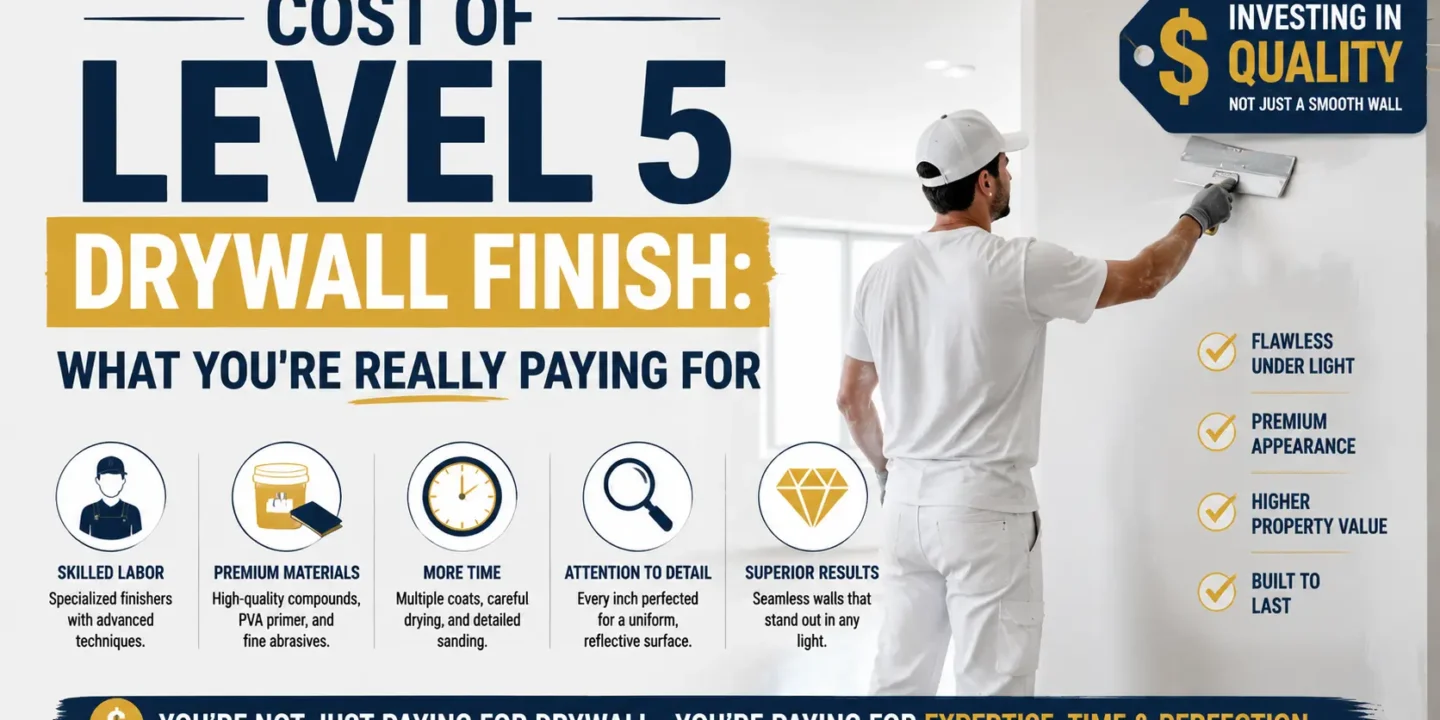



A Level 5 drywall finish typically costs between $2.00 and $5.00 per square foot, depending on the project size, wall condition, ceiling complexity, and local labor rates.
In high-end homes or remodels with difficult lighting conditions, costs can go even higher. As the highest drywall finish level, Level 5 includes a full skim coat over the entire surface, extensive sanding, and extra detail work designed to minimize visible imperfections under paint.
What surprises many homeowners is that the added cost usually has very little to do with drywall mud itself. The real expense comes from the labor required to create walls that appear smooth under natural light, glossy paint, or large open spaces.
Achieving that level of surface perfection takes time, experience, and precision especially on ceilings and modern smooth-wall interiors where flaws become highly visible after painting.
Key Takeaways
- Level 5 costs $3–$5 per square foot — labor alone eats 60–70% of that, not materials, because skilled skim-coat applicators are rare and slow.
- It’s not always the right choice — Level 5 is specifically engineered for gloss/semi-gloss paints and raking light conditions. For flat or matte paint in normal lighting, a Level 4 finish is virtually identical to the naked eye.
- The board you start with matters — not all drywall panels accept a Level 5 skim coat equally well, so your panel choice affects both the finish quality and the final cost.
- Ridging is the #1 enemy of a Level 5 finish — taped joints that raise above the surface must be caught and corrected before the skim coat goes on, or they’ll show through even the finest paint job.
- Where you live can shift the price by 40–60% — a Level 5 finish in NYC or LA can cost nearly double what the same job runs in Dallas or Charlotte, purely due to local labor rates.
What Is a Level 5 Drywall Finish?
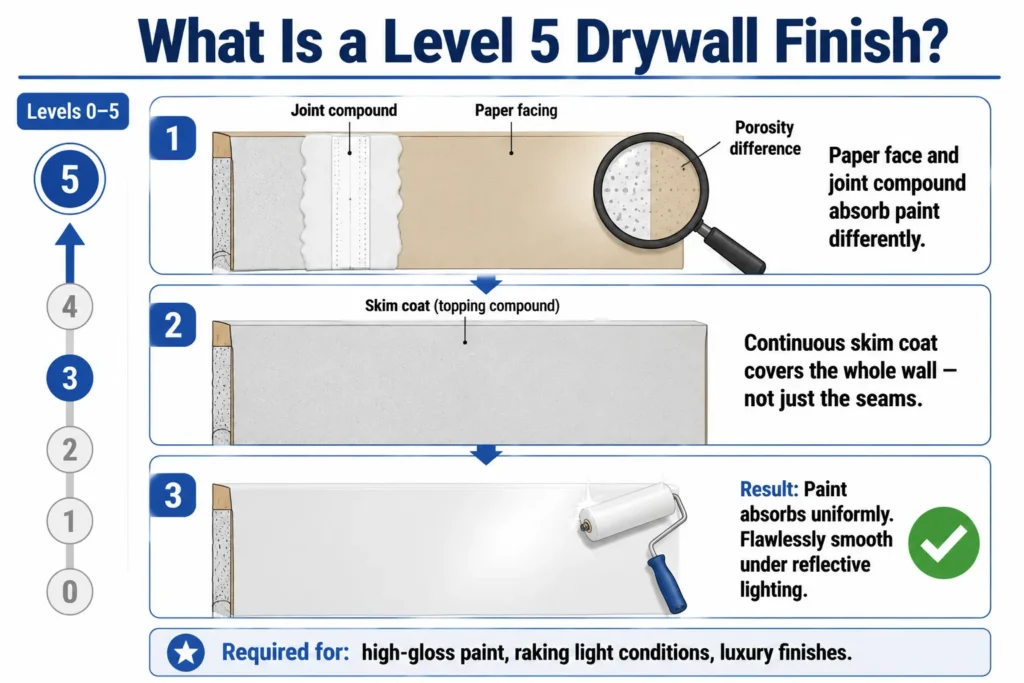
A Level 5 drywall finish is the highest standard of drywall finishing defined by the Gypsum Association (GA-214) and the Painting and Decorating Contractors of America (PDCA). It involves applying a continuous skim coat of joint compound — or a specialty topping compound — over the entire surface of the drywall, followed by finish sanding to achieve a flawlessly smooth, paint-ready plane.
Not all drywall is created equal, and the board you start with matters. If you’re unsure which panel type is right for your project, our complete guide to the types of drywall breaks down all eight varieties — including which ones take a Level 5 finish best.
To understand what sets Level 5 apart, it helps to see how it compares to lower finish levels:
| Level | What It Includes | Best For |
| Level 3 | Tape, two coats of compound, texture coat | Heavy textures (orange peel, knockdown) |
| Level 4 | Tape, three coats, sanded smooth | Flat or matte paint in standard lighting |
| Level 5 | All of Level 4 + full skim coat, fine-sanded | Gloss paints, critical lighting, high-end spaces |
The skim coat in Level 5 is what makes all the difference. It eliminates any surface porosity differences between the paper drywall face and the joint compound, so paint absorbs uniformly — a critical requirement when using reflective finishes.
If you’re wondering what that transformation actually looks like on a finished wall, these skim coat before and after examples show the visual difference more clearly than technical descriptions alone.
Why Level 5 Drywall Is More Expensive
1. Skilled Labor Commands a Premium
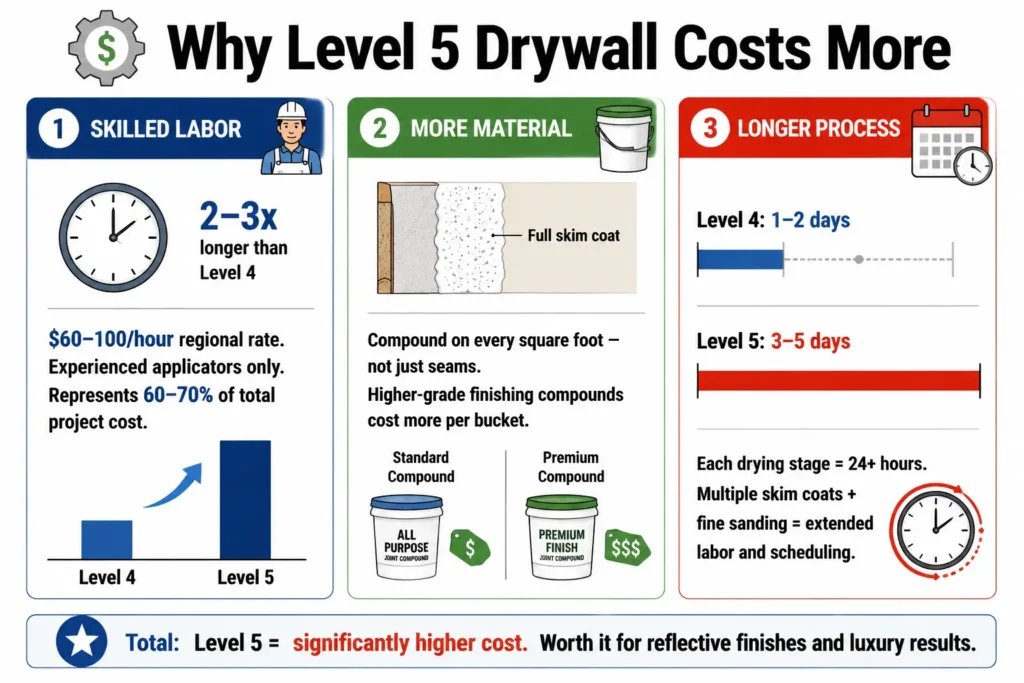
A Level 5 finish is not a job for a novice drywaller. Applying an even skim coat across an entire wall without trowel lines, ridges, or thin spots requires years of hands-on experience. According to the U.S. Bureau of Labor Statistics Occupational Outlook Handbook, the median annual wage for drywall tapers was $64,700 in May 2024 — a figure that reflects the precision and skill this trade demands. A skilled Level 5 applicator can take 2–3 times longer on a room than a standard Level 4 job, billed at $60–$100/hour depending on region, which alone can represent 60–70% of the total project cost.
2. More Material Is Used
Level 5 finishing requires significantly more joint compound or skim-coat material than lower levels. A full skim coat adds another layer of material across every square foot of wall and ceiling, not just at seams and fasteners. Higher-grade finishing compounds — such as lightweight all-purpose or specialty veneer plaster — also cost more per bucket than standard setting-type compounds.
3. The Process Takes More Time
The multi-step nature of Level 5 finishing means longer project timelines. After the base coats are applied and dried, the skim coat is applied, dried, and fine-sanded — often multiple times. Each drying stage can take 24 hours or more. One common issue that emerges during this process is drywall ridging where taped joints raise slightly above the surface and become visible after painting. On a Level 5 project, catching and correcting ridging before the skim coat goes on is critical. On a medium-sized room, the entire Level 5 finishing process can take 3–5 days, versus 1–2 days for a Level 4 finish.
Factors That Affect the Cost of Level 5 Finishing
Labor Skill and Market Rates
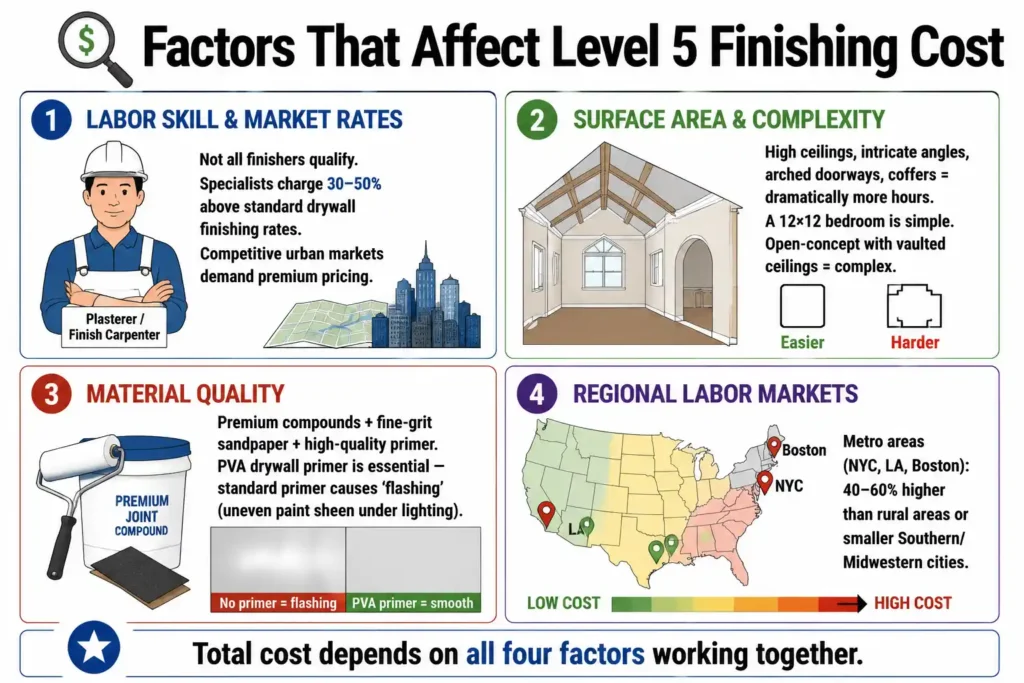
Not all drywall finishers are qualified to apply a proper Level 5 skim coat. You’ll need to source a specialist — sometimes called a plasterer or finish carpenter — who commands higher rates. In competitive urban markets, these professionals may charge a premium of 30–50% above standard drywall finishing rates.
Surface Area and Complexity
Larger rooms with high ceilings, intricate angles, arched doorways, or ceiling coffers dramatically increase labor hours. A straightforward 12×12 bedroom is far simpler to skim-coat than an open-concept living space with vaulted ceilings. Expect cost per square foot to drop slightly on larger projects due to efficiency, but total cost will increase proportionally.
Material Quality
Premium finishing compounds, fine-grit sandpaper, and high-quality primers all add to the material bill. A drywall primer specifically formulated for Level 5 surfaces (sometimes called a PVA drywall primer) is essential — using a standard primer on a skim-coated surface can lead to flashing, where paint sheen looks uneven under certain lighting.
Regional Labor Markets
Where you live has a significant impact on what Level 5 finishing costs. Labor rates in metropolitan areas like New York City, Los Angeles, or Boston can be 40–60% higher than in rural areas or smaller cities in the South or Midwest. For real-world cost data based on actual homeowner projects in your ZIP code, HomeAdvisor’s drywall cost guide is one of the most reliable publicly available references — built from surveys of over 10,000 real customer projects.
Typical Costs: How Much Does Level 5 Drywall Finish Cost?
Here is a practical cost breakdown based on typical market rates across the United States:
| Cost Item | Typical Range | Notes |
| Labor (per sq ft) | $2.00–$3.50 | Highest cost driver; skill-dependent |
| Materials (per sq ft) | $0.75–$1.50 | Compound, primer, sandpaper |
| Total (per sq ft) | $3.00–$5.00 | Average across US markets |
| 500 sq ft room | $1,500–$2,500 | Full walls + ceiling |
| 2,000 sq ft home | $6,000–$10,000 | New construction level finish |
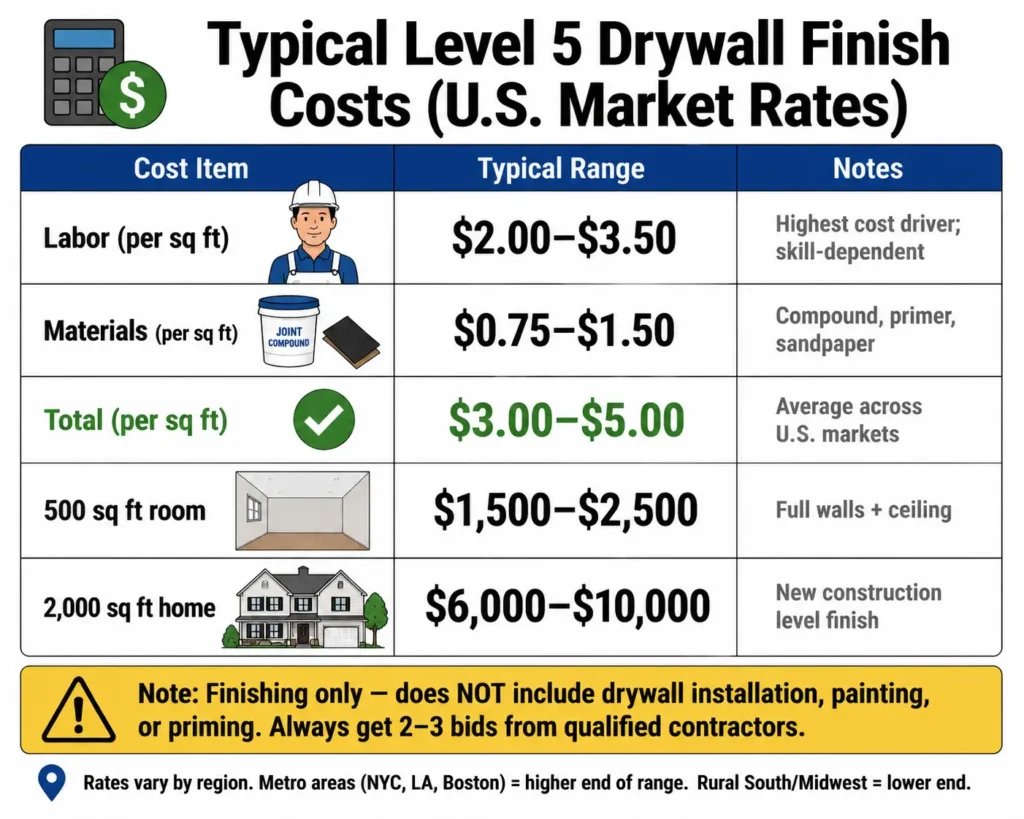
Note: These figures apply to finishing only — they do not include drywall installation, painting, or priming. Always get 2–3 bids from qualified finishing contractors before committing.
If you are still planning material quantities, start with the drywall sheet calculator before estimating Level 5 finishing costs.
When to Choose Level 5 vs. Lower Finishes
Choose Level 5 When:
- You plan to use gloss, semi-gloss, or enamel paint — these finishes act like mirrors and reveal every imperfection underneath.
- The space has strong directional or raking light (large windows, skylights, or open-plan rooms with dramatic sidelighting).
- It’s a high-end residential or luxury property where resale value and visual quality matter.
- You’re building a commercial showroom, gallery, or professional office where surfaces will be critically examined.
- The project requires flat paint in a space with multiple ceiling recessed lights aimed at angles that expose surface texture.
When Level 4 Is Sufficient:
- Standard residential rooms painted with flat or eggshell paint in normal lighting conditions.
- Budget-conscious projects where the paint sheen will be flat and lighting isn’t dramatic.
- Rooms where furniture, artwork, or other visual elements naturally draw attention away from the walls.
- Rental property renovations where durability and cost-efficiency outweigh premium aesthetics.
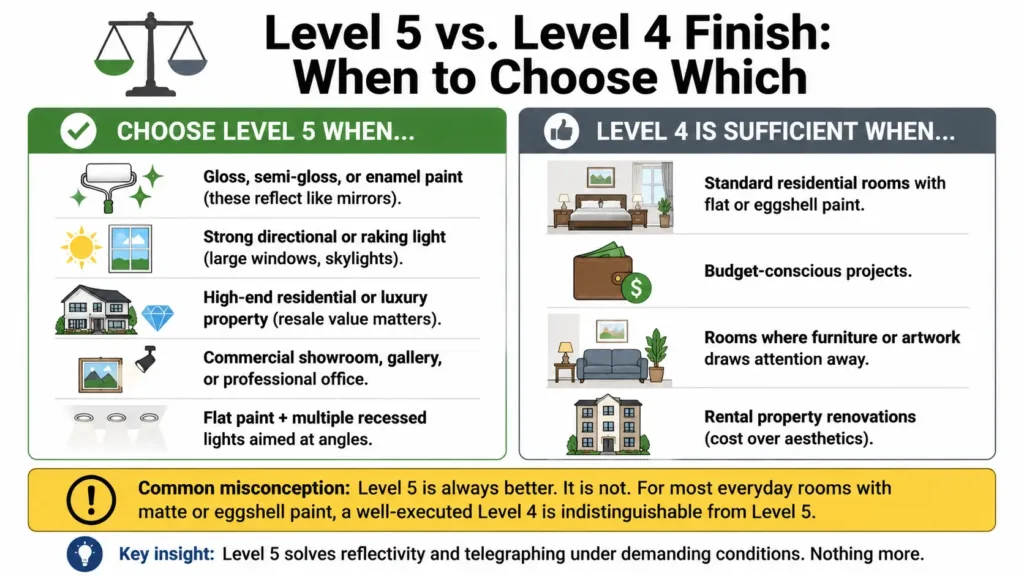
A common misconception is that Level 5 is always better. It is not always necessary — it is specifically engineered to solve the problem of surface reflectivity and telegraphing under demanding conditions. For most everyday rooms painted in matte or eggshell finishes, a well-executed Level 4 is indistinguishable from a Level 5 finish.
Regional Cost Variability
Labor markets vary dramatically across the United States, and Level 5 drywall finishing is no exception. Here is a general regional overview:
- Northeast (NYC, Boston, DC): $4.50–$5.50 per sq ft — highest labor costs in the country
- West Coast (LA, San Francisco, Seattle): $4.00–$5.00 per sq ft — premium labor market
- Midwest (Chicago, Columbus, Kansas City): $3.00–$4.00 per sq ft — moderate pricing
- Southeast (Atlanta, Charlotte, Nashville): $2.75–$3.75 per sq ft — growing markets, competitive rates
- South Central (Dallas, Houston, Phoenix): $2.50–$3.50 per sq ft — among the most affordable
Rural areas within any region will typically sit at the lower end of these ranges, while high-cost-of-living metros sit at the top. Material costs remain relatively consistent nationally, so the variation is almost entirely driven by local labor rates.
Final Thoughts: Is Level 5 Worth the Investment?
Level 5 drywall finishing is a specialized, premium service — and its cost reflects that. For homeowners planning to use reflective paints, installing high-end lighting, or finishing luxury spaces, it is not just worth it — it is required if you want the final result to look professional. Applying a glossy paint over a Level 4 surface is one of the most common and costly mistakes in residential renovation, since any surface imperfection becomes dramatically visible once the paint is on the wall.
That said, Level 5 is not the right choice for every project. If your paint choice is flat or matte, your lighting is forgiving, and your budget is constrained, a properly executed Level 4 finish will serve you well. The key is matching the finish level to the actual demands of the space — not simply defaulting to the highest level because it sounds premium.
Before committing to Level 5, consult with a finishing contractor who can assess your space’s lighting conditions and paint plan. That conversation may save you thousands — or confirm that Level 5 is exactly what your project demands.


Elena Hart is the founder and lead writer of Better Home Pro. She writes about drywall, home repair, and practical DIY home improvement topics, focusing on clear, useful information that helps homeowners make better decisions. Her work combines firsthand experience, manufacturer documentation, industry resources, and careful research to create content that is accurate, practical, and easy to understand. Through Better Home Pro, Elena aims to simplify complex home improvement topics and provide guidance that is genuinely helpful to homeowners and DIYers.










No Comments