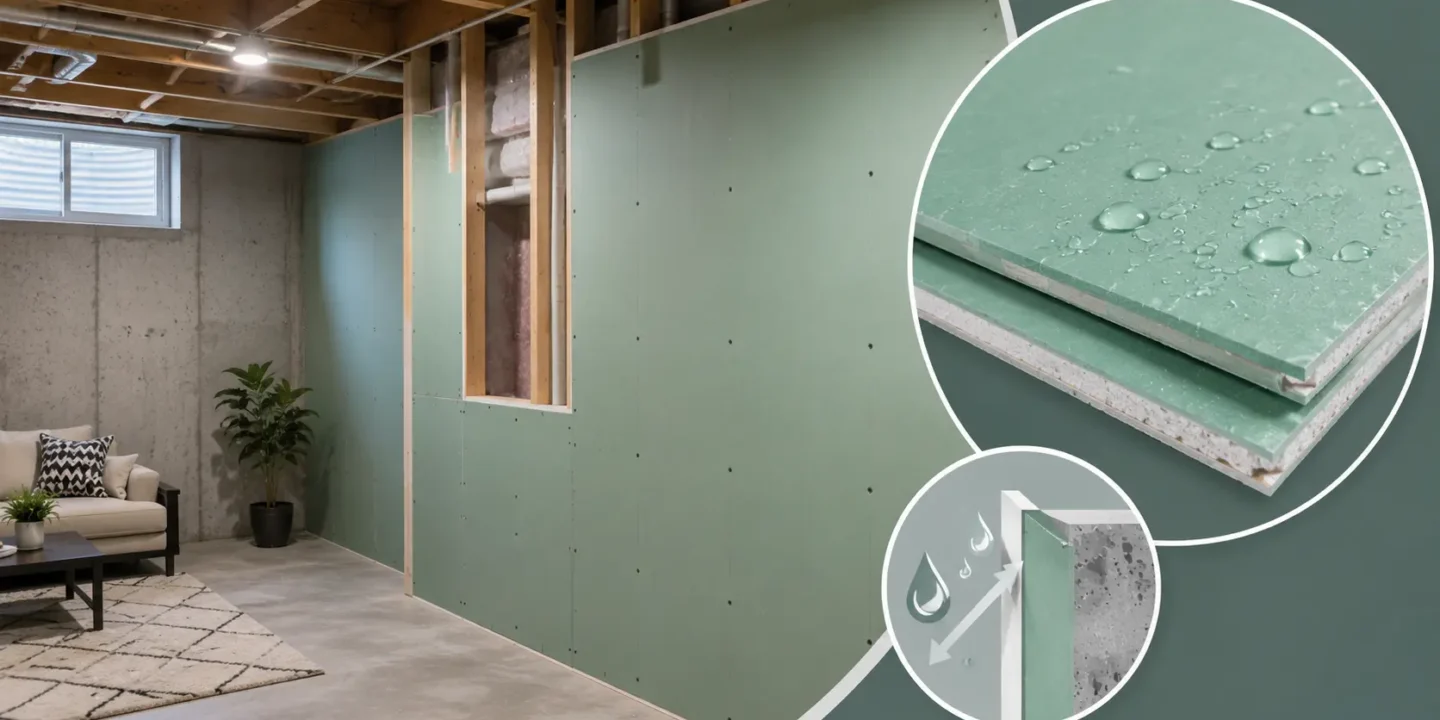



Before you choose a single sheet of drywall for your basement, answer this question: is your basement actively getting wet? If the answer is yes, if you see water seeping through the concrete after rain, if there are tide marks on the floor, if the walls are damp to the touch, no moisture-resistant drywall will save you.
The drywall is the last line of defence in a dry basement. It is not a substitute for waterproofing.The EPA specifically emphasizes controlling moisture first because mold problems cannot be solved without fixing the underlying water issue.
Most guides skip straight to listing products. This one doesn’t, because the material you choose matters far less than whether your basement is ready for drywall at all. Basements have four distinct moisture sources: external groundwater seepage, condensation on cold surfaces, plumbing leaks, and HVAC condensate overflow. Each one requires a different fix before any board goes up.
What follows is a moisture source diagnosis framework, a clear breakdown of every basement drywall material with honest assessments of each, a decision matrix matched to your specific basement profile, and the installation details most homeowner guides never cover.
Key Takeaways
- Waterproofing must happen first because moisture-resistant drywall only protects against ambient humidity, not active groundwater seepage.
- Regular paper-faced drywall should never be used below grade as it lacks the mold resistance required for continuous basement moisture cycles.
- Purple board works well for typical dry basements, but flood-prone or highly humid spaces require paperless fiberglass-faced board.
- Framing walls with at least a one-inch air gap from the concrete prevents moisture from trapping against the back of the drywall.
- Leave a tiny gap between the bottom of the drywall panels and the concrete floor to stop water from wicking upward into the walls.
Diagnose Your Moisture Source Before Choosing Any Drywall
This is the step every competing guide skips. There is a reason it comes first here: a homeowner who correctly identifies and fixes the moisture source before buying materials can avoid thousands of dollars in failed drywall down the road. The diagnosis is not complicated, but it is essential.
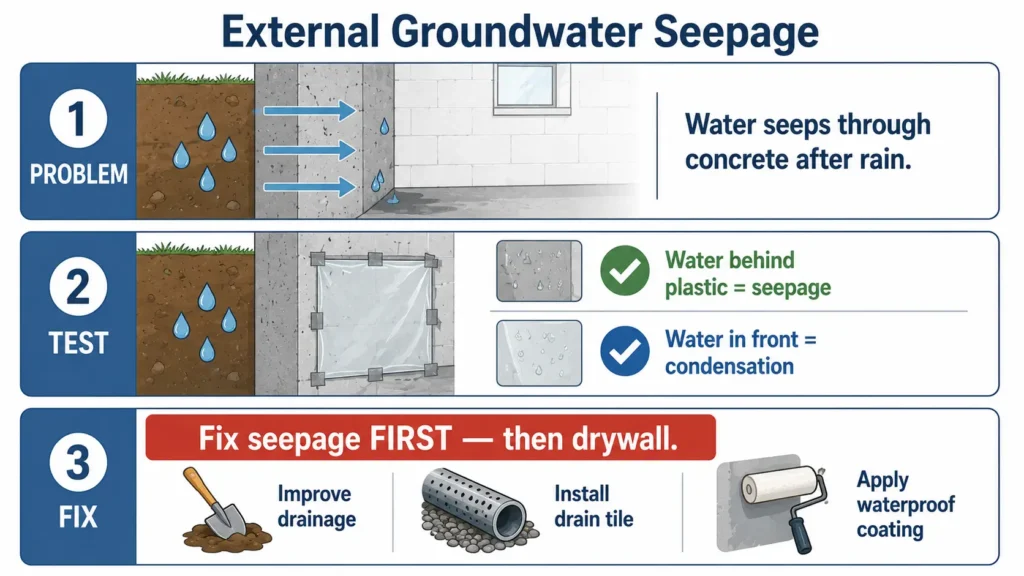
Source 1: External Groundwater Seepage
This is the most serious basement moisture problem, and no amount of mold-resistant drywall addresses it.
External groundwater seepage happens when water migrates through porous concrete from saturated soil outside the foundation. The concrete is not waterproof by nature. It is porous enough that water under pressure from saturated soil will eventually find its way through.
How to identify it: Water stains or wet spots appear on walls or the floor after heavy rain or snowmelt. You may see white mineral deposits on the concrete surface, called efflorescence. These chalky deposits form when water continuously migrates through porous concrete and evaporates at the surface.The International Association of Certified Home Inspectors (InterNACHI) has a good technical explanation of how efflorescence develops in basement foundations. A damp smell concentrated near exterior walls after rain is another indicator.
The plastic sheet test: Tape a 12″ x 12″ piece of plastic sheeting to the suspect wall with all four edges sealed tight. Leave it for 24 to 48 hours. If water forms on the back side, between the plastic and the wall, you have external infiltration. If water forms on the front (the room side of the plastic), you have a condensation problem instead.
Required intervention before drywalling: Exterior drainage correction, an interior drain tile system, or crystalline waterproofing coating on the concrete. This source is not optional to fix. No moisture-resistant drywall performs adequately over an actively seeping wall.
Source 2: Condensation on Cold Surfaces
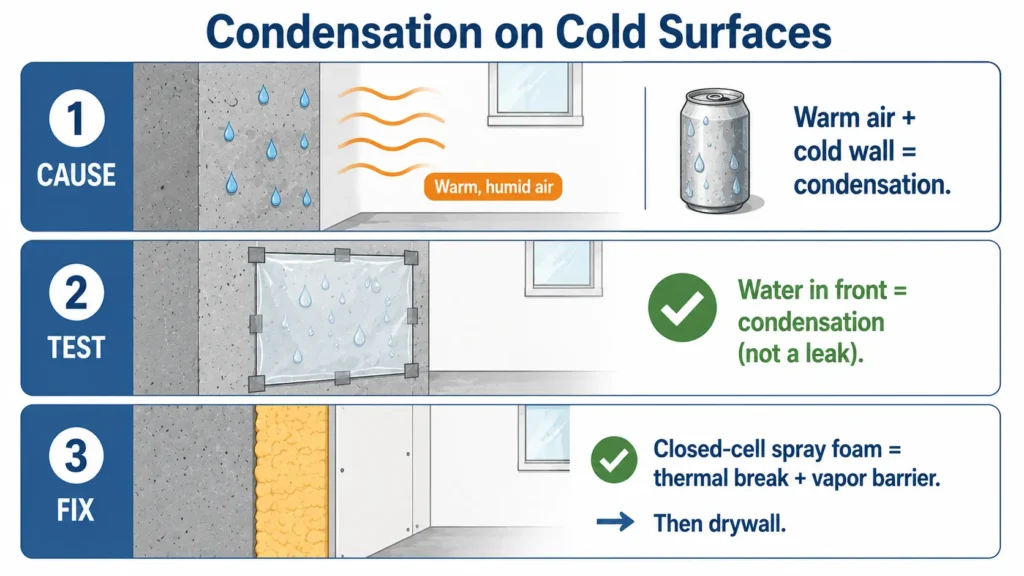
This one is extremely common in uninsulated basements, especially in humid climates, and it is frequently misdiagnosed as a leaking wall.
Condensation forms when warm, humid air contacts a cold surface. In a basement, the concrete walls and floor stay cold year-round due to thermal mass. Every time warm summer air enters the space, condensation forms on those cold surfaces, the same way moisture forms on the outside of a cold drink glass.
How to identify it: Use the plastic sheet test described above. Water forming on the front (room side) of the plastic means condensation, not infiltration. Condensation-related moisture tends to be diffuse rather than concentrated in specific spots, and it is worse in summer rather than during or after rain.
Required intervention: Proper insulation that creates a thermal break between the cold concrete and the interior air. Closed-cell spray foam is the most effective option because it both insulates and acts as a vapour barrier simultaneously. The U.S. Department of Energy explains why closed-cell foam performs well in below-grade insulation assemblies. After insulating correctly, moisture-resistant drywall is appropriate.
Source 3: Plumbing Leaks
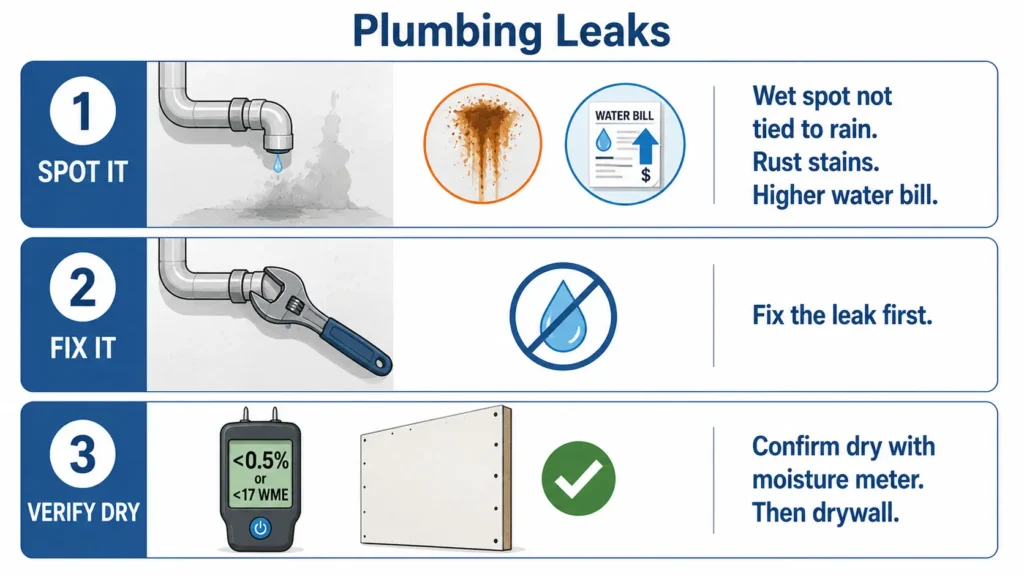
Plumbing leaks are the most straightforward source to diagnose and fix, but they are still easy to overlook if nobody is actively looking.
How to identify it: Look for isolated wet spots that are not correlated with rainfall or seasonal changes. Rust stains on concrete or framing lumber near pipes, or a water bill that has increased unexpectedly, are also indicators.
Required intervention: Fix the leak. After fixing, allow the area to dry completely. Use a moisture meter to confirm readings are below 0.5% MC (moisture content) or 17 WME (wood moisture equivalent) before installing any drywall. The International Institute of Building Enclosure Consultants and professional restoration standards both stress verifying moisture content before closing wall assemblies. Moisture-resistant drywall is appropriate once the area is confirmed dry.
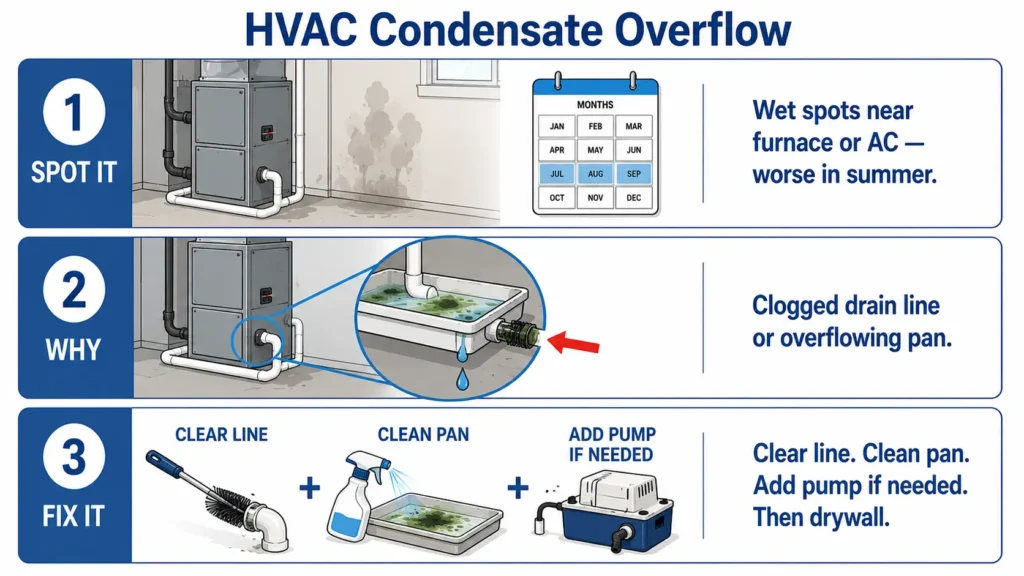
Source 4: HVAC Condensate Overflow
Air handlers, furnaces, and dehumidifiers all produce condensate, which drains through a dedicated line. When that line clogs or the drain pan overflows, you can end up with moisture in the wall framing near the unit.
How to identify it: Wet spots concentrated near the air handler or furnace, especially in humid months. Algae growth in the condensate drain pan. Intermittent moisture that does not correlate with rainfall.
Required intervention: Clear the drain line, clean the pan, and install a condensate pump if the drain line lacks adequate gravity drainage. This is a completely fixable source and should be fully resolved before drywalling the basement.
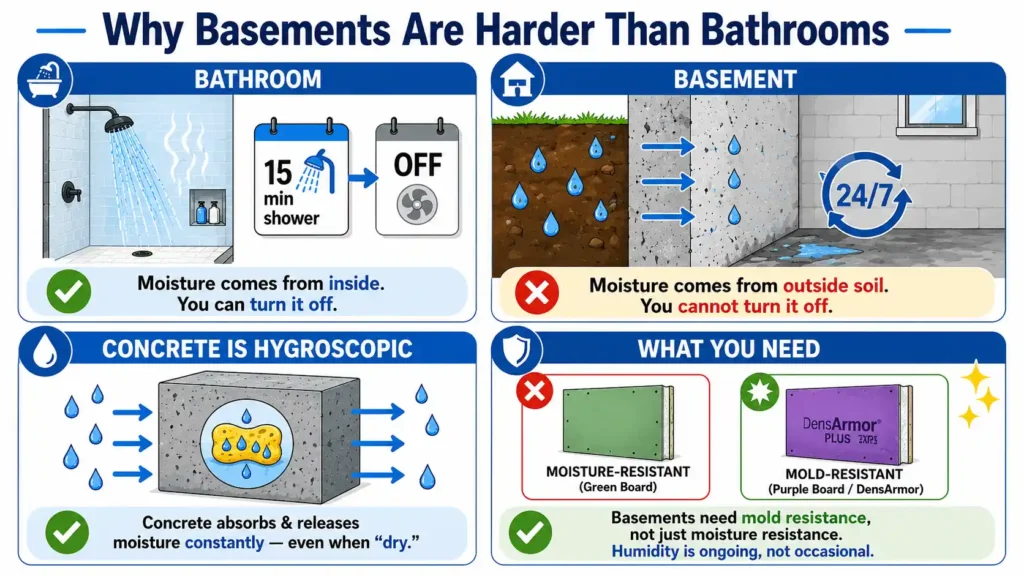
Why Basements Are Harder Than Bathrooms
Most guides approach basement drywall the same way they approach bathroom moisture-resistant drywall, even though the moisture behavior is fundamentally different between the two environments.
List the same products, pick a winner, done. But the moisture physics are fundamentally different, and that difference changes what you need from the material you choose.
A bathroom generates moisture from inside. Steam from a shower, splashing from a sink. You can turn off a shower. You cannot turn off the exterior soil moisture that surrounds a basement wall.
Concrete is also hygroscopic, meaning it absorbs and releases moisture continuously in response to the moisture levels in the surrounding soil. Even a “dry” concrete basement wall in a well-drained location is cycling moisture constantly, just at a rate too slow to cause visible problems, provided the wall assembly allows adequate vapour movement and air circulation.
The condensation problem compounds this. Basement concrete stays cold year-round because of its thermal mass. In summer, warm humid air that enters the space through windows, doors, or the HVAC system condenses on those cold surfaces. This is a repetitive daily cycle in humid climates, not a one-time event like a shower.
The practical implication for material selection: basements need mold resistance more than moisture resistance. Elevated humidity is persistent and ongoing. A material designed to resist occasional moisture splash, which is what green board was designed for, is inadequate for the continuous humidity exposure of a basement environment.
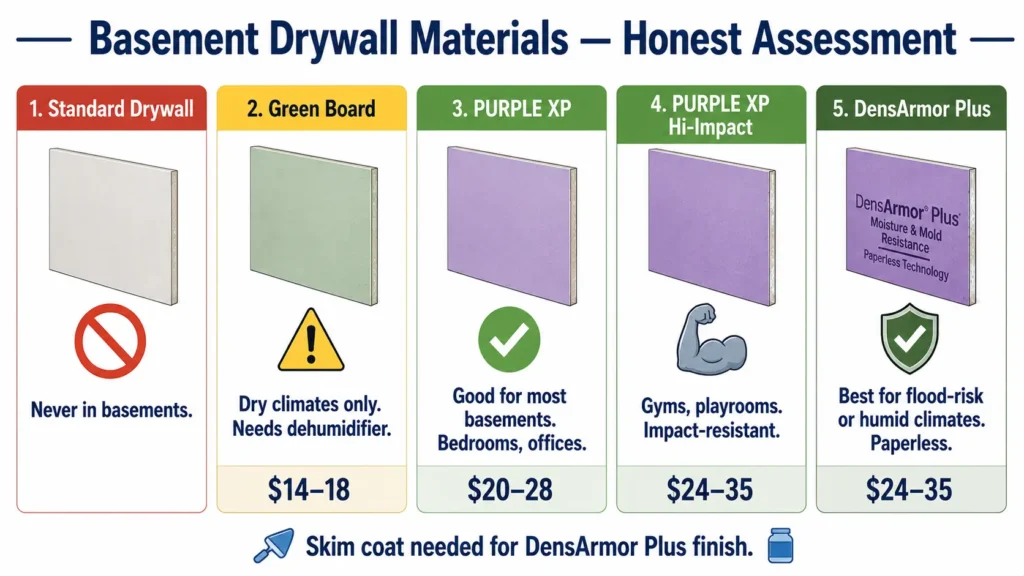
Basement Drywall Materials: Honest Assessment
Standard Drywall: Never in Basements
Standard drywall with a paper facing and regular gypsum core should not be used in a basement under any circumstances. The paper facing absorbs moisture readily, the gypsum core degrades when wet, and mold can colonise within days of sustained humidity exposure. This is not a budget option for basement finishing. It is a failure waiting to happen.
Green Board: Limited Use, Dry Climates Only
Green board is moisture-resistant drywall with a wax-treated paper facing and a water-resistant core additive. It is commonly used in basements, and it does offer some improvement over standard drywall, but its limitations matter here.
The paper facing on green board is still organic. Once moisture penetrates the wax coating, which can happen with sustained humidity exposure over time, the paper supports mold growth. Green board is acceptable in basements with excellent exterior drainage, active and consistent dehumidification, and no history of any water intrusion. In humid climates, flood-prone areas, or any basement with even a mild history of water problems, skip green board and start with purple board at minimum. Cost: approximately $14 to $18 per panel.
PURPLE XP: Good for General Basement Spaces
National Gypsum’s PURPLE XP Drywall resists moisture, mold, and mildew, far more effectively than traditional moisture-resistant drywall products. It uses SPORGARD mold-inhibiting technology and is rated for under 5% water absorption. It is GREENGUARD Gold certified, which matters if you are finishing a basement bedroom where air quality affects sleep.
PURPLE XP is the right board for finished basement bedrooms, offices, family rooms, and utility walls in most climates. It is not the top choice for basements with a history of water events, but it covers the majority of typical finished basement scenarios well. Cost: approximately $20 to $28 per panel.
PURPLE XP Hi-Impact: Best for Active Use Spaces
PURPLE XP Hi-Impact has the same mold and moisture resistance as standard PURPLE XP, but adds a fibreglass mesh embedded in the core that prevents impact damage that would otherwise crack or weaken finished basement wall surfaces over time.
National Gypsum specifically markets this product for basement gyms, playrooms, and game rooms, where wall damage from equipment, furniture, or physical activity is a realistic possibility. If you are finishing a basement for active use and do not want to repair drywall holes a year in, Hi-Impact is worth the premium. Cost: approximately $24 to $35 per panel. The fibreglass mesh core makes this board heavier than standard PURPLE XP, so plan your installation logistics accordingly.
DensArmor Plus: Best for Chronically Humid or Flood-Risk Basements
DensArmor Plus from Georgia-Pacific is paperless drywall. It uses a fibreglass mat facing instead of traditional paper, which completely eliminates the organic food source that supports mold growth on the board surface. It scores a perfect 10 on the ASTM International mold resistance test, which evaluates mold growth resistance under controlled humidity conditions.
For basements with any history of water intrusion, coastal locations, or basements in climates with chronically elevated outdoor humidity, DensArmor Plus is the strongest drywall choice available. The tradeoff: the fibreglass mat facing has a different texture than paper-faced board, and it requires a skim coat to achieve a smooth painted finish. That adds finishing time and cost, which is worth factoring into your project estimate. Cost: approximately $24 to $35 per panel.
Basement-Type Decision Matrix
Not all drywall products are designed for the same environment. Some are optimized for moisture resistance, others for impact durability, fire resistance, or mold prevention. Use this to match your basement’s actual conditions to the appropriate board.
| Basement Condition | Recommended Board |
| Dry basement, arid climate, excellent drainage | Green board acceptable; PURPLE XP preferred |
| Humid climate, no flooding history | PURPLE XP, as persistent humidity needs mold resistance |
| Previous water event, now resolved and confirmed dry | DensArmor Plus, for highest mold resistance given the history |
| Basement gym or high-activity playroom | PURPLE XP Hi-Impact, for mold resistance plus physical durability |
| Basement bedroom or home office | PURPLE XP, as mold resistance matters for air quality in sleeping and working spaces |
| Basement laundry room | DensArmor Plus, as appliance leaks and steam make this a high-risk zone |
| Basement bathroom shower area | Cement board only; drywall is not appropriate in shower zones |
| Basement that gets wet seasonally | Fix the water source first; no drywall is appropriate until the source is resolved |
The Standoff Wall and Vapour Barrier: The Installation Requirements Nobody Covers
Even if you select the right board, you can create a mold problem by installing it incorrectly. These two requirements are the ones most homeowner guides skip entirely.
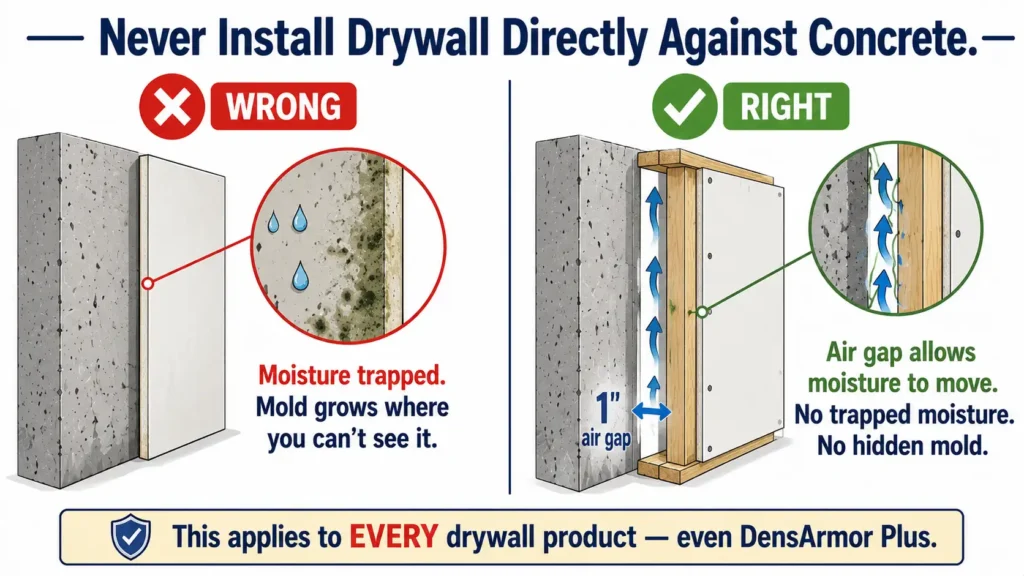
Never Install Drywall Directly Against Concrete
This applies to every product, including DensArmor Plus. Even the best moisture-resistant drywall installed flat against a concrete wall will trap moisture between the board and the concrete. The concrete cycles moisture continuously. The back face of the board gets wet. Mold grows on the back side where you cannot see it until the damage is structural.
The solution is a framed standoff wall. Frame stud walls at least 1″ away from the concrete face. Most builders set 2×4 studs 3/4″ to 1″ from the wall. This air gap allows moisture to move rather than accumulate against the back of the board, which fundamentally changes how the wall assembly behaves over time.
Insulation Type Changes What You Need
The insulation you choose between the studs affects what drywall product is appropriate and whether you need an additional vapour barrier.
Closed-cell spray foam is the best option for basement walls. It adheres directly to the concrete, creates a thermal break that eliminates condensation on the cold concrete surface, and acts as its own vapour barrier. After closed-cell foam, any moisture-resistant drywall is appropriate, and you do not need poly sheeting.
Fibreglass batt insulation does not act as a vapour barrier. It requires a separate 6-mil poly vapour barrier on the warm side, between the insulation and the drywall. This creates an important complication: moisture-resistant drywall should not be installed over a vapour retarder if you plan to finish it with another vapour-retardant material such as ceramic tile, vinyl, or oil-based paint. That assembly creates a sealed moisture trap between two vapour barriers. Moisture that gets in cannot get out, and mold follows. If you use poly sheeting behind moisture-resistant drywall, finish the surface with latex paint only. Latex paint allows vapour movement, which prevents moisture from accumulating in the wall assembly.
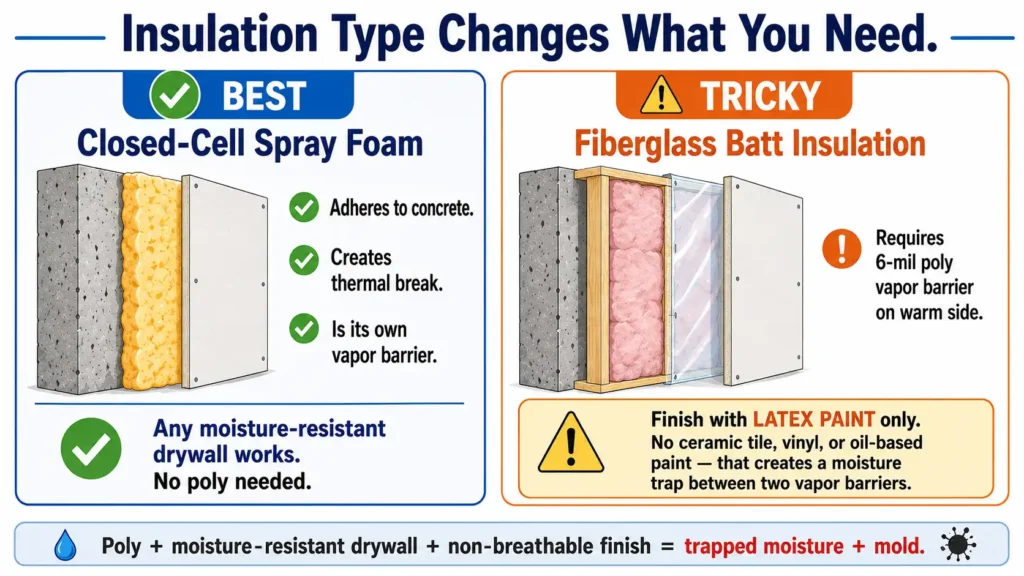
The correct assembly sequence for fibreglass batt insulation:
Concrete wall > air gap > framed stud wall > fibreglass insulation > 6-mil poly vapour barrier > moisture-resistant drywall > latex paint
Substituting oil-based paint or installing tile directly over this assembly without a cement board transition is one of the more common and costly mistakes in basement finishing.
Basement-Specific Installation Tips
Confirm Dryness Before Starting
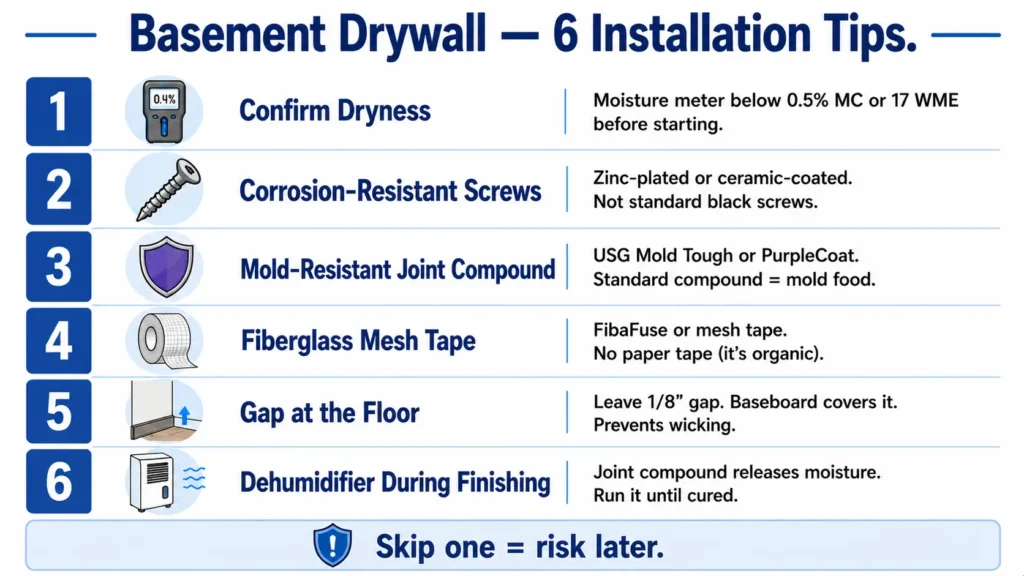
Take moisture meter readings throughout the planned drywall area before any board goes up. All readings should be below 0.5% MC or 17 WME. Installing over even slightly elevated moisture levels starts the mold clock immediately. This is not a step to estimate visually. Use a meter.
Use Corrosion-Resistant Screws
Standard black phosphate drywall screws corrode in the persistent humidity of basements, particularly near pressure-treated lumber commonly used in basement framing. Use zinc-plated or ceramic-coated screws throughout the entire project.
Mold-Resistant Joint Compound Throughout
Standard joint compound contains organic binders that support mold growth in humid environments. Use USG Mold Tough or National Gypsum PurpleCoat at all seams and screw heads. This is a small cost difference that matters over the long term.
Fibreglass Mesh Tape at All Seams
Paper tape is organic. Use FibaFuse or standard fibreglass mesh tape at all seams in basement applications. This removes another organic material from the wall assembly.
Leave a Gap at the Floor
Do not install drywall tight to the concrete floor. Leave a 1/8″ gap between the board and the floor to prevent wicking if any surface water occurs. Cover with baseboard once finishing is complete.
Run a Dehumidifier During the Finishing Process
Joint compound releases moisture as it cures. In a closed basement, this significantly raises humidity during the finishing process. Run a dehumidifier continuously until all compound is fully cured. Skipping this can leave elevated moisture levels in the wall assembly from day one.
Product Picks by Basement Type
Best Overall Basement Board: National Gypsum PURPLE XP Drywall
SPORGARD mold-inhibiting technology, under 5% water absorption, GREENGUARD Gold certified. The right board for finished basement bedrooms, offices, and family rooms in most climates. Appropriate for the majority of typical basement finishing projects. Price: approximately $20 to $28 per 4×8 panel. Limitation: not the top choice for basements with any history of water events; upgrade to DensArmor Plus in that scenario.
Best for Gyms, Playrooms, and High-Activity Spaces: National Gypsum PURPLE XP Hi-Impact
All the mold and moisture resistance of standard PURPLE XP, plus a fibreglass mesh core that prevents holes from gym equipment, furniture, or physical activity. Purpose-built for active-use basement spaces. Price: approximately $24 to $35 per 4×8 panel. Limitation: heavier than standard drywall, so plan your installation logistics accordingly.
Best for Flood-Risk or Chronically Humid Basements: Georgia-Pacific DensArmor Plus
Fibreglass mat facing eliminates all organic material from the board surface. Perfect ASTM D3273 mold resistance score. The right call for any basement with a water history, coastal locations, or chronically elevated humidity environments. Price: approximately $24 to $35 per 4×8 panel. Limitation: requires a skim coat for a smooth painted finish, which adds finishing time and material cost.
Best Budget Option for Dry Basements in Arid Climates: National Gypsum Standard PURPLE
Mold and moisture resistant at a lower price point. Appropriate for dry-climate basements with solid drainage, consistent dehumidification, and no flooding history. Price: approximately $15 to $22 per panel. Limitation: lacks PURPLE XP’s enhanced moisture performance and is not suitable for humid climates or any basement with a water history.
Frequently Asked Questions
What is the best drywall to use in a basement?
For most finished basements in humid or temperate climates, National Gypsum PURPLE XP is the right choice. It resists mold and moisture effectively, is GREENGUARD Gold certified, and is widely available. For basements with any history of water intrusion or in coastal locations, upgrade to Georgia-Pacific DensArmor Plus, which uses fibreglass mat facing instead of paper and scores a perfect rating on the ASTM mold resistance test.
Should I use green board or purple board in my basement?
Purple board in almost all cases. Green board’s wax-treated paper facing still supports mold growth once humidity penetrates it consistently, which is the normal condition in a basement. Purple board (PURPLE XP) is mold-resistant rather than simply moisture-resistant, which better matches the persistent humidity exposure that below-grade spaces experience. Green board is only acceptable in dry-climate basements with excellent drainage and active dehumidification.
Can you use regular drywall in a basement?
No. Standard drywall with paper facing and regular gypsum core is not appropriate for basement walls under any circumstances. The paper facing absorbs moisture readily, the gypsum degrades when wet, and mold can establish itself within days of sustained humidity exposure. There is no situation in a basement where standard drywall is the right choice.
What drywall is mold resistant for basement walls?
Both PURPLE XP and DensArmor Plus provide genuine mold resistance for basement drywall applications. PURPLE XP uses SPORGARD mold-inhibiting technology. DensArmor Plus eliminates the organic paper facing entirely with fibreglass mat, which removes the food source mold requires to colonise the board surface. For the highest mold resistance available in a standard drywall format, DensArmor Plus is the stronger product.
Do I need a vapour barrier behind drywall in a basement?
It depends on your insulation. If you use closed-cell spray foam on the concrete wall, the foam acts as its own vapour barrier and no additional poly sheeting is needed. If you use fibreglass batt insulation, add a 6-mil poly vapour barrier on the warm side, between the insulation and the drywall. One important caveat: if you install a poly vapour barrier, finish the drywall surface with latex paint only. Oil-based paint and vinyl finishes are vapour-retardant, and combining them with poly sheeting traps moisture in the wall assembly with no path out.
Should basement drywall touch the floor?
No. Leave a 1/8″ gap between the bottom of the drywall and the concrete floor. This prevents the board from wicking moisture if any surface water occurs. The gap will be covered by baseboard when finishing is complete. It is a small detail that protects the board from one of the most common moisture entry points in a finished basement.
How do I stop mold on basement drywall?
The most effective approach is addressing moisture at the source before installing drywall. After confirming the basement is dry, choose a mold-resistant board (PURPLE XP or DensArmor Plus), install it on a properly framed standoff wall with an air gap from the concrete, use mold-resistant joint compound and fibreglass mesh tape throughout, and finish with latex paint rather than oil-based. Running a dehumidifier to maintain interior humidity below 50% year-round is the ongoing maintenance step that protects the wall assembly long-term.
Conclusion
The material hierarchy for basement drywall is straightforward once you understand the environment: standard drywall is never appropriate; green board is limited to dry climates with no water history; PURPLE XP covers most finished basement applications; PURPLE XP Hi-Impact is the right choice for gyms and active spaces; and DensArmor Plus is the top choice for humid climates, flood-risk locations, or any basement with a history of water events.
But the most important rule comes before any of that: diagnose and fix the moisture source first. No drywall product compensates for an actively wet basement, and no amount of mold resistance helps when moisture is cycling continuously through an assembly that was never designed to handle it.
Frame a proper standoff wall with an air gap so the finished basement assembly has a path to manage moisture instead of trapping it behind the drywall.
Match your vapour barrier approach to your insulation choice. Finish with latex paint. Confirm the space is dry with a moisture meter before any board goes up.
Those steps, not the brand of drywall you choose, are what determine whether a finished basement stays finished.


Elena Hart is the founder and lead writer of Better Home Pro. She writes about drywall, home repair, and practical DIY home improvement topics, focusing on clear, useful information that helps homeowners make better decisions. Her work combines firsthand experience, manufacturer documentation, industry resources, and careful research to create content that is accurate, practical, and easy to understand. Through Better Home Pro, Elena aims to simplify complex home improvement topics and provide guidance that is genuinely helpful to homeowners and DIYers.






No Comments