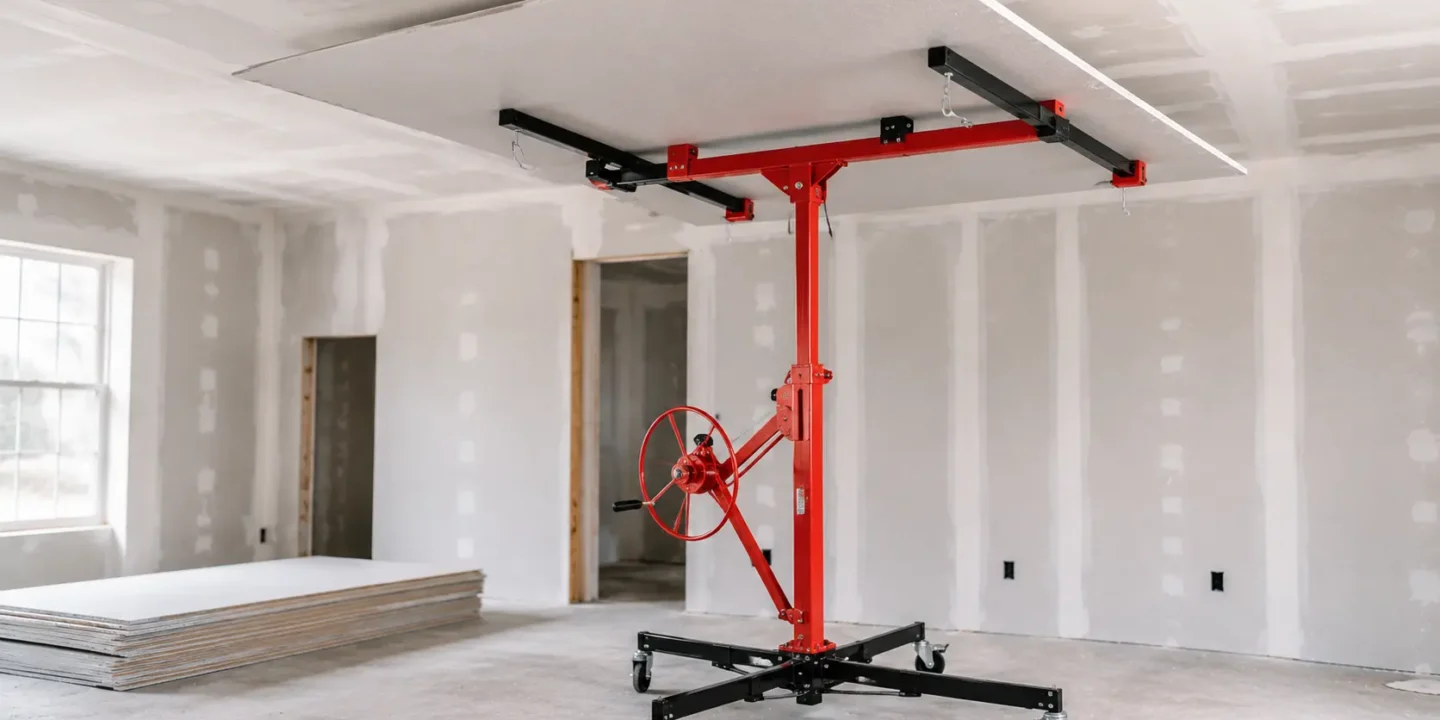



The Harbor Freight drywall lift is one of the most searched budget options for homeowners trying to avoid the cost of renting. At under $200 on sale, it’s easy to understand the appeal. But whether it’s actually the right buy depends on your project, your expectations, and how you plan to use it.
This article covers what the Pittsburgh-branded lift at Harbor Freight actually includes, how it performs in real use, who it makes sense for, and what the realistic alternatives are if it doesn’t fit your situation. If you want a broader look at how drywall lifts work in general and when you need one at all, the full drywall lift guide covers that in detail.
Key Takeaways:
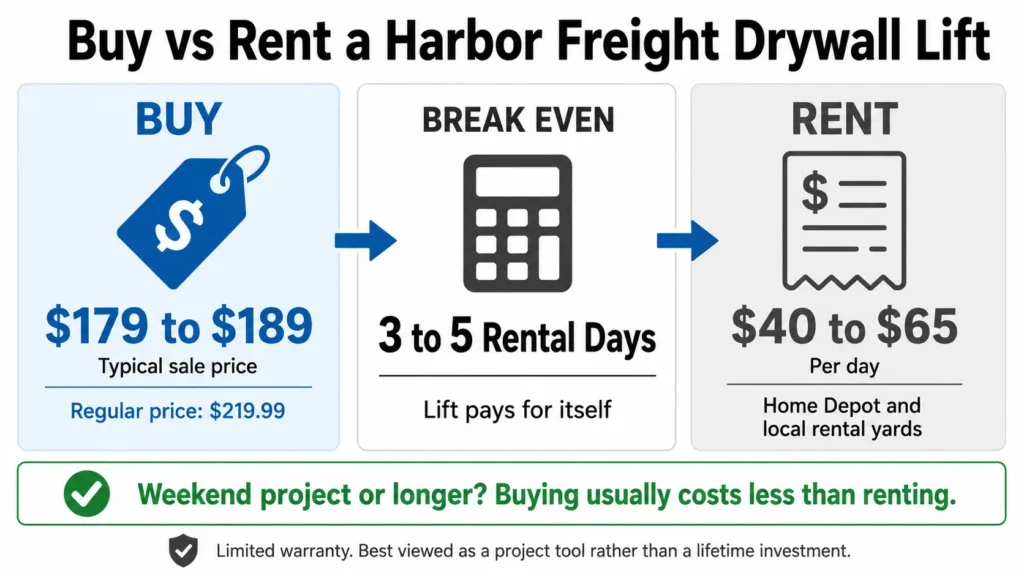
- The Harbor Freight drywall lift retails around $219.99 but regularly goes on sale for $179 to $189 with coupons, making it financially competitive once your project exceeds three to five rental days.
- It maxes out at 11 feet 2 inches, which covers most standard residential ceilings. Anything above that height requires a rental with extended reach.
- The lift performs best in open spaces like basements and garages. Tight hallways, closets, and oddly shaped rooms make repositioning the tripod base genuinely frustrating.
- Stability on uneven or sloped floors requires extra care at full extension. Always find a level position and lock all wheels before raising a loaded sheet.
- For a single-room weekend project, renting still makes more financial sense. Buying pays off when you have multiple rooms, a longer timeline, or future drywall work planned.
The Harbor Freight Drywall Lift: Quick Overview
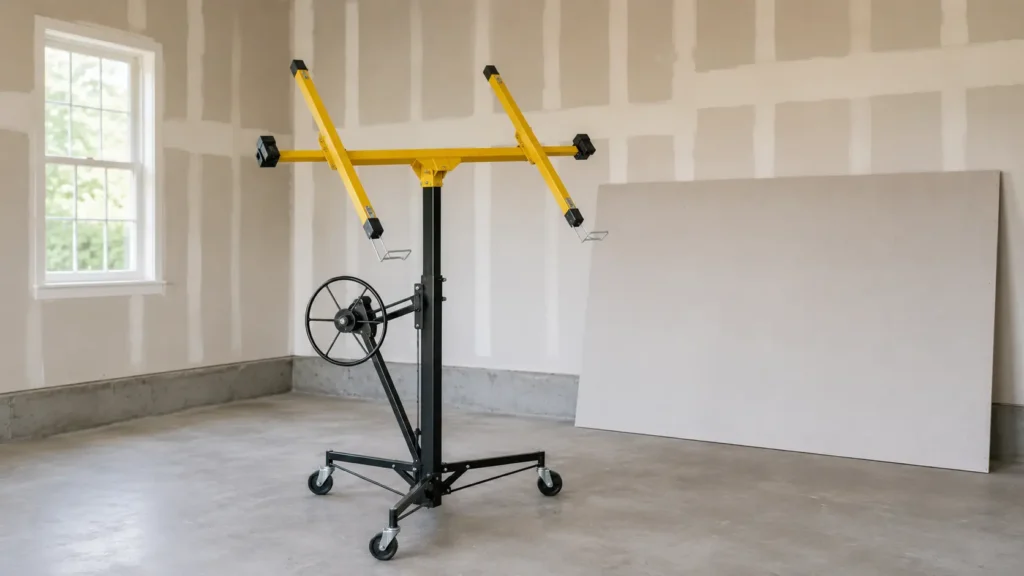
Harbor Freight sells one primary drywall lift under their Pittsburgh brand. It’s a manually operated panel hoist designed for ceiling and upper wall installation, built around the same mechanical principle as most lifts in this price range: a wheeled base, a telescoping mast, a hand crank, and a tilting cradle that holds the sheet while you fasten it.
It’s aimed squarely at DIY homeowners. The pricing, build quality, and design all reflect that. It’s not built for daily jobsite use, and Harbor Freight isn’t trying to compete with professional-grade panel hoists. What it’s trying to do is give a homeowner finishing a basement or drywalling a garage a functional tool at a fraction of rental cost for longer projects.
Price
The Harbor Freight drywall lift retails at approximately $219.99 at full price. With Harbor Freight’s frequent coupons and promotional sales, it regularly drops to around $179 to $189. The brand runs sales often enough that paying full price is avoidable if you wait even a short time or check for active coupons before purchasing.
Compared to rental, a single-day lift rental from Home Depot or a local equipment yard runs $40 to $65. That means the Harbor Freight lift pays for itself in three to five rental days at standard rates. For a project that will run a weekend or longer, the math starts to shift toward ownership, especially if you have any chance of using it again. If you’re planning a larger job, understanding drywall hanging labor cost per sheet can help you decide between DIY and hiring out.
One thing worth factoring in: Harbor Freight’s warranty on this tool is limited. You’re not getting long-term coverage, and if something fails outside the return window, replacement parts aren’t always easy to track down. Buy it knowing it’s a project tool, not a decade-long investment.
Features
The Pittsburgh drywall lift includes:
Maximum lift height of 11 feet 2 inches. This covers the vast majority of residential ceilings, including 8-foot, 9-foot, and most 10-foot rooms. If your space has ceilings above 11 feet, this lift won’t reach, and you’ll need to rent an extended-reach model instead.
150 lb weight capacity. Standard half-inch 4×8 drywall runs roughly 57 pounds. A 4×12 sheet of half-inch comes in around 85 pounds. The lift handles both comfortably within its rating. 5/8-inch fire-rated board is heavier, but still within spec for standard sheet sizes. If you’re installing thicker panels, it’s also important to use the correct screw size for 5/8-inch drywall to maintain proper fastening performance.
Tilting cradle with panel hooks. The cradle adjusts from vertical for loading to horizontal for ceiling work, with angle adjustments in between for sloped surfaces. The hooks hold the sheet along its edges so it’s supported rather than balanced, which is what makes solo ceiling work possible.
Telescoping mast. The mast extends in sections to reach ceiling height. The extension system is functional but requires careful alignment during setup or the sections can bind.
Wheeled tripod base with casters. The base locks in place once positioned. The casters on budget models are a known weak point across the category, and the Harbor Freight unit is no exception. On smooth concrete they perform fine. On rough or uneven surfaces, the wheels can stick or catch.
Folds for storage. The lift breaks down into three main sections and stores flat. It fits in most vehicle trunks for transport.
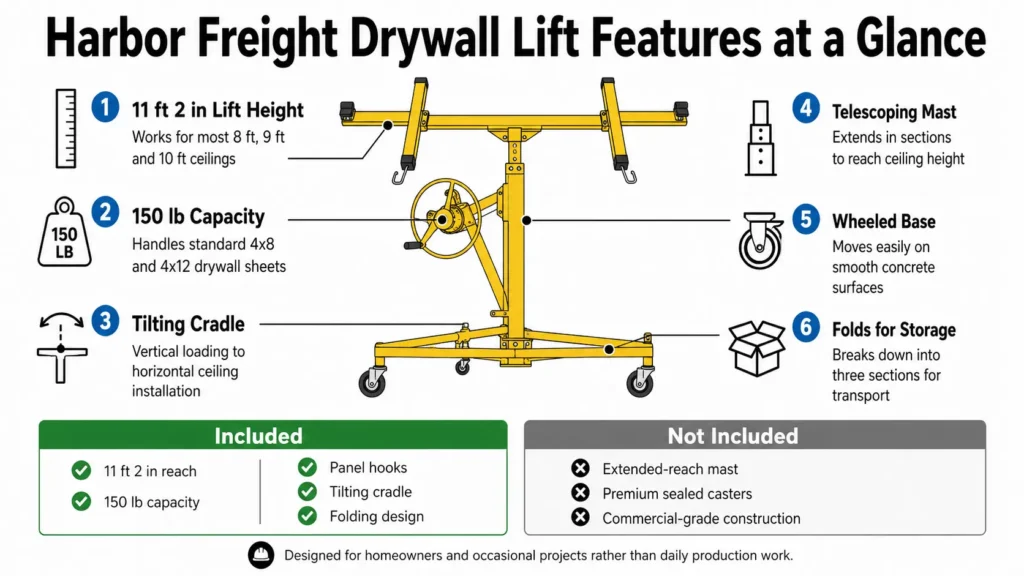
What it doesn’t include: an extended-reach mast, premium sealed casters, or the build quality you’d find on lifts costing twice as much. Those aren’t gaps for the target buyer. They matter if you’re running a lift daily on a production project.
Review: How It Actually Performs
For a single-room basement finish or a garage drywall project, the Harbor Freight lift does the job it’s designed to do. It holds the panel at ceiling height, frees your hands for the drill, and eliminates the overhead strain that makes solo ceiling work genuinely unsafe. That’s the core function, and it works.
Where it earns its price is straightforward ceiling work in open, accessible spaces. Load the sheet, wheel it into position, crank it up, fasten it. The ratchet holds the sheet at height without continuous cranking, so once you’re raised you can take your time driving screws.
Setup takes longer than people expect. First-time assembly from the box typically runs 30 to 45 minutes, and the instructions leave something to be desired. It’s not complicated, but plan for it. Even after you’re familiar with the lift, breaking it down and repositioning it between bays adds time that accumulates on larger jobs.
Stability on uneven floors is a real concern. The base isn’t self-leveling, and on sloped garage floors or slightly uneven basement concrete, the lift can feel less secure at full extension. This isn’t dangerous if you’re paying attention, but it does require that you take the time to find a stable position before raising a loaded sheet. Rushing this step is where problems happen.
Tight spaces expose the lift’s limitations. In hallways, closets, or rooms with existing framing close in, maneuvering the tripod base becomes awkward. The footprint isn’t small, and in genuinely narrow spaces you’ll spend real time working around it. If your project involves a lot of tight rooms or corridors, the friction of repositioning adds up fast.
The casters work adequately on smooth surfaces. On polished concrete or wood subfloor they roll without much complaint. On rougher surfaces or across thresholds, you’ll feel the budget construction. They don’t fail in normal use, but they’re not smooth.
12-foot sheet handling is manageable but awkward solo. The lift holds them within its capacity, but loading a 12-foot panel onto the cradle alone is genuinely difficult because of flex in the sheet. This is a category-wide issue with single-mast lifts, not a Harbor Freight-specific flaw, but it’s worth knowing going in. Loading 12-foot sheets is significantly easier with a second person.
For occasional DIY use across one or two projects, most buyers don’t have serious complaints. The common frustrations are setup time, maneuvering in tight spaces, and caster quality. None of those are project-ending. They’re the expected tradeoffs of a budget tool.
Where it earns harder criticism is on larger whole-house projects where the setup-and-breakdown cycle becomes genuinely tedious, or when buyers expect contractor-grade performance for DIY pricing.
Alternatives to the Harbor Freight Drywall Lift
If the Harbor Freight lift isn’t the right fit for your project, there are a few legitimate alternatives worth knowing about.
Renting a lift from Home Depot or a local rental yard is the most straightforward option. Rental lifts in the $40 to $65 per day range are typically better maintained and often sturdier than what you’ll get from Harbor Freight at this price point. For a single-room project you’ll finish in a day or two, renting is almost always the better financial decision. The Harbor Freight lift only makes financial sense once you’re looking at three or more rental days worth of use.
The Telpro Panel Lift (Panel Hoist 200) is the most widely trusted mid-range upgrade. It runs $350 to $500 depending on where you find it, and it delivers noticeably better stability, smoother crank operation, and higher-quality casters. For a homeowner doing a full house or a contractor doing occasional residential work, the Telpro is the step up that’s actually worth the price difference. It’s not professional production equipment, but it’s built more solidly than anything in the Harbor Freight price range.
The Metaltech Drywall Lift, available through Home Depot, sits between Harbor Freight and Telpro in both price and quality. It runs roughly $250 to $300, has a better caster setup than the Pittsburgh model, and is a reasonable choice if you want something slightly more robust without going to Telpro pricing.
For wall panels specifically, a simple panel foot lifter handles bottom-edge positioning well for standard 8-foot vertical hanging. It won’t help with ceiling work, but if your project is primarily walls at standard height, a $15 foot lifter and a helper covers the job without a full lift. The drywall lift guide covers T-braces and other low-cost alternatives in more detail if your situation is simpler than a full ceiling project.
Where to Buy and Availability
The Harbor Freight drywall lift is available in-store at any Harbor Freight location and through the Harbor Freight website. In-store pickup is usually the more practical option since shipping a lift-sized item can be expensive or unavailable depending on your region.
Availability is generally consistent. This isn’t a product that sells out for weeks at a time, though specific sales pricing can come and go. If you’re watching for a coupon deal, Harbor Freight’s email list and the Harbor Freight coupon app are the most reliable ways to catch a discount before buying.
It does not appear at Home Depot, Lowe’s, or most other major retailers. If Harbor Freight isn’t convenient or accessible in your area, the Metaltech model at Home Depot is the closest comparable option at a slightly higher price point.
Used units appear occasionally on Facebook Marketplace and Craigslist, sometimes at significant discounts. Given that most DIY buyers only use a drywall lift for one or two projects, used condition on these lifts is often better than you’d expect. Worth checking before buying new if price is the primary concern.
The Bottom Line
The Harbor Freight drywall lift is a reasonable buy for DIY homeowners finishing a basement, garage, or multi-room project where repeated panel lifting would otherwise require multiple helpers. It handles the core job, the price is genuinely competitive, and for occasional use the build quality is adequate.
It’s not the right tool for tight, complex spaces, for production-scale projects, or for anyone who needs contractor-grade reliability. For a single-room job you’ll finish in a weekend, renting remains the smarter financial choice.
Buy it if you have enough drywall work ahead that rental costs would match or exceed the purchase price, you have storage for it afterward, and your project is primarily open ceiling work where the lift can do what it’s designed to do.


Elena Hart is the founder and lead writer of Better Home Pro. She writes about drywall, home repair, and practical DIY home improvement topics, focusing on clear, useful information that helps homeowners make better decisions. Her work combines firsthand experience, manufacturer documentation, industry resources, and careful research to create content that is accurate, practical, and easy to understand. Through Better Home Pro, Elena aims to simplify complex home improvement topics and provide guidance that is genuinely helpful to homeowners and DIYers.









No Comments