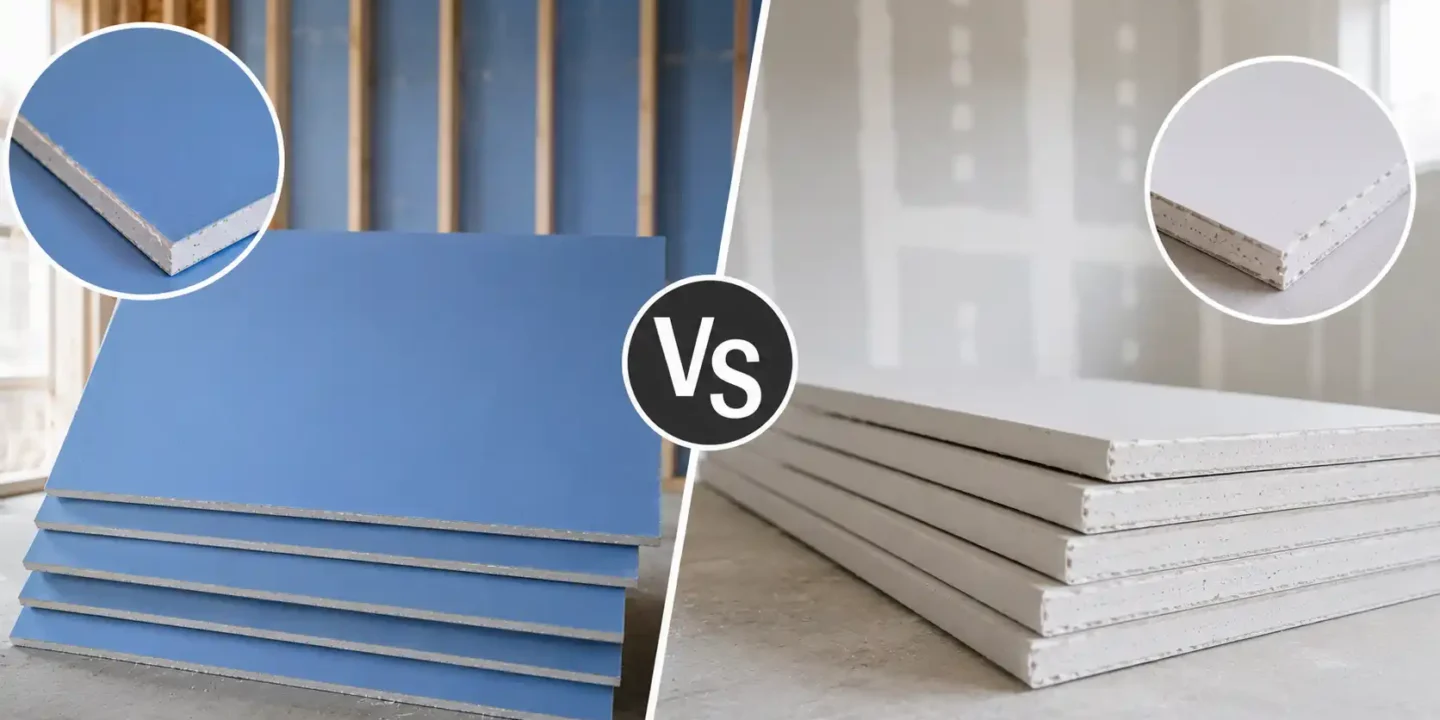



Most people standing in the drywall aisle see blueboard and standard drywall as close relatives: same thickness, similar weight, both made with a gypsum core. The difference only becomes obvious later, after installation, when the finish goes on. Standard Sheetrock gets taped, mudded, sanded, and painted. Blueboard gets coated with veneer plaster. That’s not a small distinction. It’s an entirely different wall system, and understanding that changes how you should think about which one belongs in your project.
Key Takeaways:
- Blueboard requires a veneer plaster finish because its specialized face paper chemically bonds with plaster, whereas regular drywall rejects it.
- Veneer plaster over blueboard creates a noticeably harder, denser wall surface that resists impacts and dents far better than standard drywall.
- Standard Sheetrock is highly practical for typical budgets and DIY projects due to cheaper labor, easy repairs, and widespread contractor availability.
- Plaster finishes over blueboard offer uniform paint absorption and zero visible seams, while standard drywall can show ridges under direct light.
- Repairing damaged blueboard requires specialized plastering skills and materials, making future maintenance trickier than a basic drywall patch.
What Is Blueboard?
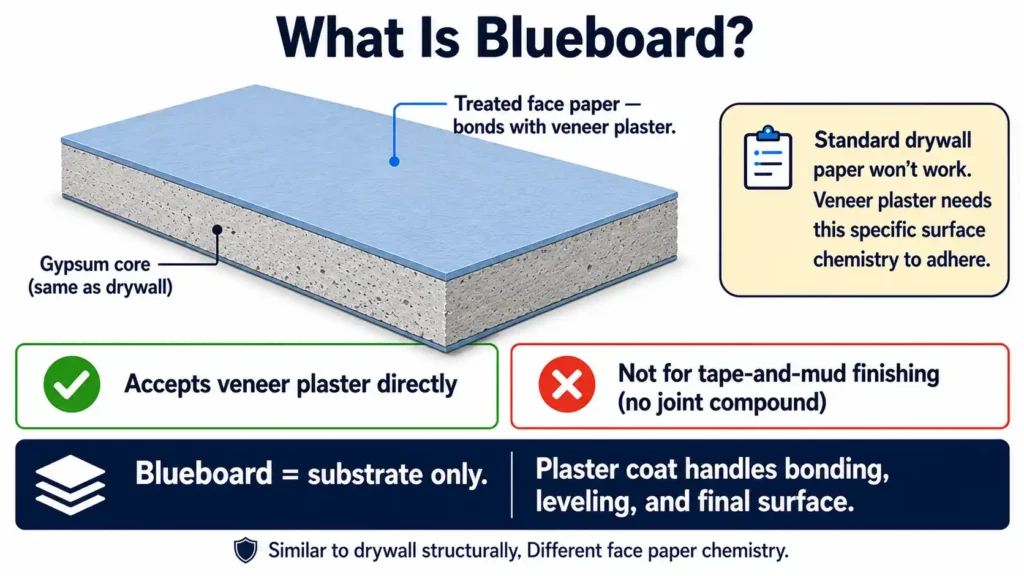
Blueboard is a type of gypsum board, structurally similar to standard drywall, but with one important difference: its face paper. The blue-tinted paper is treated to accept and bond with veneer plaster, which is a thin-coat plaster applied directly over the board surface after installation.
The paper’s surface chemistry is designed specifically for this. Veneer plaster chemically keys to the blue paper in a way it simply won’t do with standard drywall face paper. If you tried to apply veneer plaster over regular drywall, the adhesion would be poor and the finish would likely fail.
Blueboard is not intended for tape-and-mud finishing. You won’t see joint compound on a properly installed blueboard wall. The plaster coat handles everything: bonding, leveling, and creating the final surface. The board itself is just the substrate.
What Is Standard Sheetrock?
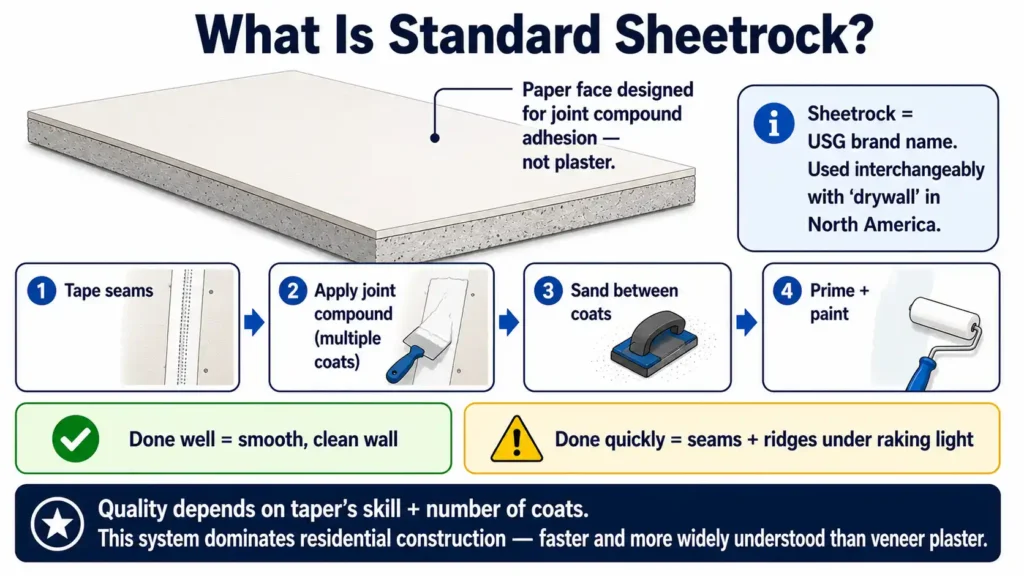
Sheetrock is a drywall brand name from USG that became so common it’s now used interchangeably with “drywall” in most of North America. Standard drywall panels, whatever brand they carry, use a paper face designed for joint compound adhesion, not plaster.
The finishing process for standard drywall involves taping seams, applying multiple drywall finishing coats with sanding between applications before primer and paint go on. Done well, it produces a smooth, clean wall. Done quickly, it often shows seams and ridges under raking light. The quality of the finish depends heavily on the skill of the taper and the number of coats applied.
This system is faster and more widely understood than veneer plaster work, which is a big reason it dominates residential construction.
The Real Difference: Veneer Plaster vs Tape-and-Mud
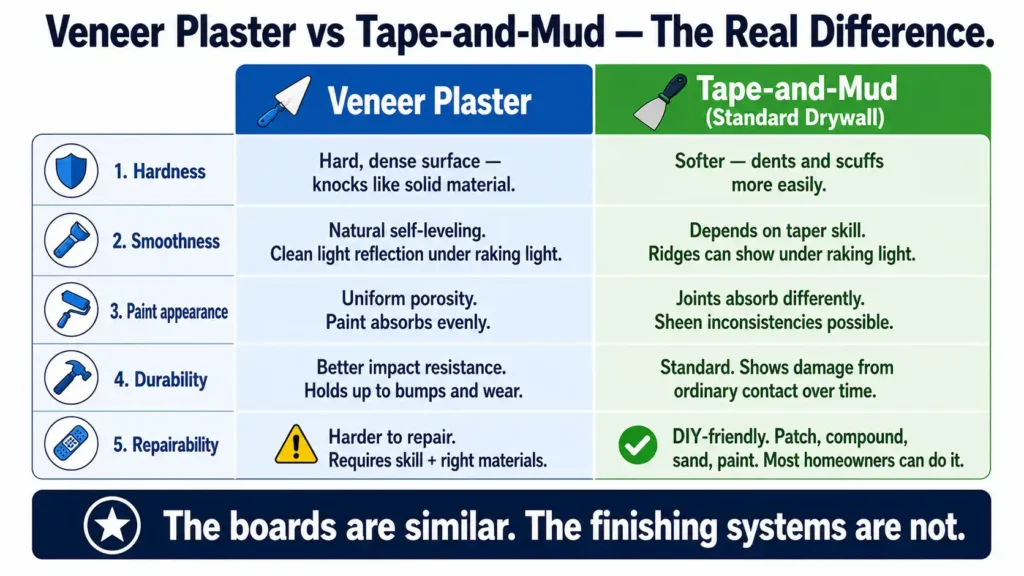
This is where the actual comparison lives. The boards are similar. The finishing systems are not.
Surface hardness is probably the most noticeable difference once the walls are finished. Veneer plaster cures into a denser and harder wall surface than standard painted drywall systems. You can knock on a well-finished veneer plaster wall and it sounds and feels dense, almost like it’s hitting something solid behind it. Standard drywall with a paint finish is softer. It dents more easily, scuffs more readily, and can show surface damage from ordinary contact over time.
Finish smoothness depends on execution in both systems, but veneer plaster has a natural advantage for very smooth, flat walls. The plaster levels itself during application and, when done by a skilled plasterer, produces a surface that reflects light cleanly without the subtle ridges and trowel marks that can show up in tape-and-mud work. Under direct or raking light, the difference becomes more visible.
Paint appearance often looks noticeably better over plaster. The surface is more uniform in porosity, so primer and paint absorb evenly. Freshly mudded drywall surfaces often absorb primer and paint unevenly around seams and repaired areas.
Durability and impact resistance are genuinely better with veneer plaster. It holds up to regular household use, furniture bumps, and general wear in a way that standard drywall surfaces don’t match. For high-traffic areas, this difference is practical, not cosmetic.
Repairability is where veneer plaster starts to show a downside. Patching plaster requires skill and the right materials. A standard drywall repair usually involves patching compound, sanding, and repainting rather than specialized plaster work. A plaster repair done badly can be more visible than the damage it was fixing.
How a Blueboard Wall Actually Feels
If you’ve only ever been in buildings finished with standard drywall, you might not notice anything specific about a veneer plaster wall at first. But spend time in an older home with original lime plaster or a well-done modern veneer plaster finish, and the difference becomes clear.
The walls feel more solid underfoot. Tapping them produces a denser sound. The surface doesn’t flex or give the way drywall can in lighter framing. Acoustically, the added density and surface hardness actually dampens sound a bit more than standard drywall finishes.
Visually, under good lighting, the walls have a depth and reflective quality that paint over joint compound doesn’t fully replicate. It’s subtle, but it reads as quality. High-end spec homes and historic restorations often choose veneer plaster specifically for this reason.
There’s also a tactile quality to the surface. Run your hand across a properly finished plaster wall and it feels smooth in a way that’s slightly different from painted drywall: more consistent, denser, without the slight give you get from standard compound work.
Where Blueboard Makes Sense
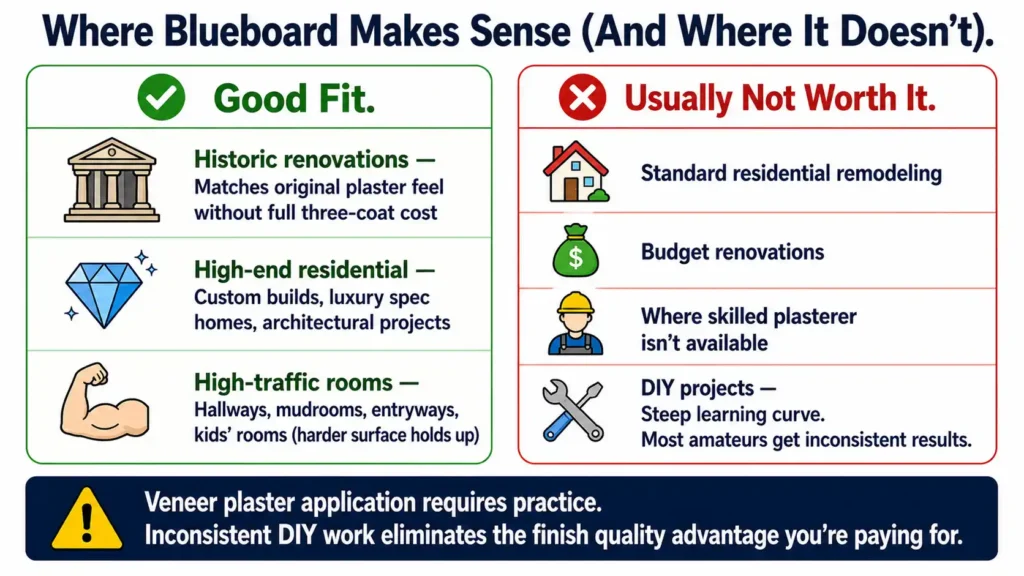
Historic renovations are a natural fit. If you’re restoring a house that originally had plaster walls, blueboard with veneer plaster gets you close to the original feel without the cost and complexity of full three-coat traditional plaster. The wall system matches the original intent.
High-end residential construction often uses veneer plaster when the client wants premium smooth walls and is willing to pay for the finish. Spec homes in higher price brackets, custom builds, and architectural projects where wall quality is a priority are where you see this system most often.
Rooms where durability matters are worth considering for plaster. Hallways, mudrooms, entryways, and children’s rooms all take more physical abuse than a spare bedroom. The harder surface holds up better.
Where blueboard usually doesn’t make sense is in standard residential remodeling, budget renovations, or any project where a skilled plasterer isn’t readily available. It also doesn’t make sense for DIY projects. Veneer plaster application requires practice. There’s a learning curve to getting it flat, smooth, and well-blended across seams and fields. Most amateur applicators get inconsistent results, which eliminates the finish quality advantage you’re paying for.
Installation and Repair Differences
The installation of the boards themselves is essentially the same process. Hang, screw, tape seams, and move on. The difference starts when finish work begins.
With standard drywall, you’re calling a taper. Tapers are common, widely available, and work fast on residential projects. With blueboard, you need a plasterer specifically familiar with veneer work. That’s a different trade, and in many markets it’s harder to find. In some regions, experienced veneer plasterers are genuinely scarce, which means longer scheduling windows, higher bids, and less price competition.
Repairs reflect the same skill gap. A damaged blueboard wall that loses plaster to impact requires a plaster repair, not a drywall patch. The materials are different, the process is different, and the color match can be tricky depending on how old the original plaster is. If you’re buying a house with veneer plaster walls, factor this into your maintenance thinking.
Cost: The Board Price vs the Labor Reality
Blueboard itself typically costs more per sheet than standard drywall, but the price gap is not enormous. The real cost difference isn’t in materials.
Veneer plaster labor runs significantly higher than tape-and-mud work. You’re paying for a specialized skill applied at a different pace than standard finish work. On top of that, the plaster materials add cost beyond what you’d spend on joint compound and primer. When you add it all together, a blueboard and veneer plaster system will cost more than standard drywall finishing, sometimes considerably more depending on your market and the size of the project.
For most budget-conscious homeowners, the cost premium is hard to justify unless finish quality and durability are genuine priorities. The practical benefit is real, but so is the price difference.
Which One Should You Choose?
For a smooth, painted modern wall on a typical renovation budget: Standard drywall, done by a competent taper with proper coats and good priming, is the right answer. It performs well, it’s easy to repair, and any contractor can work with it.
For maximum durability in high-use spaces: Veneer plaster over blueboard is worth considering if you can find a skilled plasterer and the budget supports it. The surface hardness is a real advantage in spaces that take daily abuse.
For historic or architectural projects where finish quality is a priority: Blueboard and veneer plaster are appropriate. The wall feel, the surface depth, and the light-reflection quality justify the premium in contexts where the walls are part of the design intent.
For DIY projects: Use standard drywall. Veneer plaster is not a forgiving material for first-time applicators, and a bad plaster finish is harder to correct than a bad tape-and-mud job.
For production or spec building where speed matters: Standard drywall finishing wins. Faster availability, wider contractor base, simpler logistics.
The core takeaway is this: blueboard is not an upgraded version of Sheetrock you use everywhere for better results. It’s a substrate for a specific finishing system. When that system is executed well, the results are genuinely superior. But it only makes sense when the project, budget, and available labor support it. Otherwise, properly finished standard drywall remains the more practical and cost-effective wall system for most residential projects.


Elena Hart is the founder and lead writer of Better Home Pro. She writes about drywall, home repair, and practical DIY home improvement topics, focusing on clear, useful information that helps homeowners make better decisions. Her work combines firsthand experience, manufacturer documentation, industry resources, and careful research to create content that is accurate, practical, and easy to understand. Through Better Home Pro, Elena aims to simplify complex home improvement topics and provide guidance that is genuinely helpful to homeowners and DIYers.










No Comments