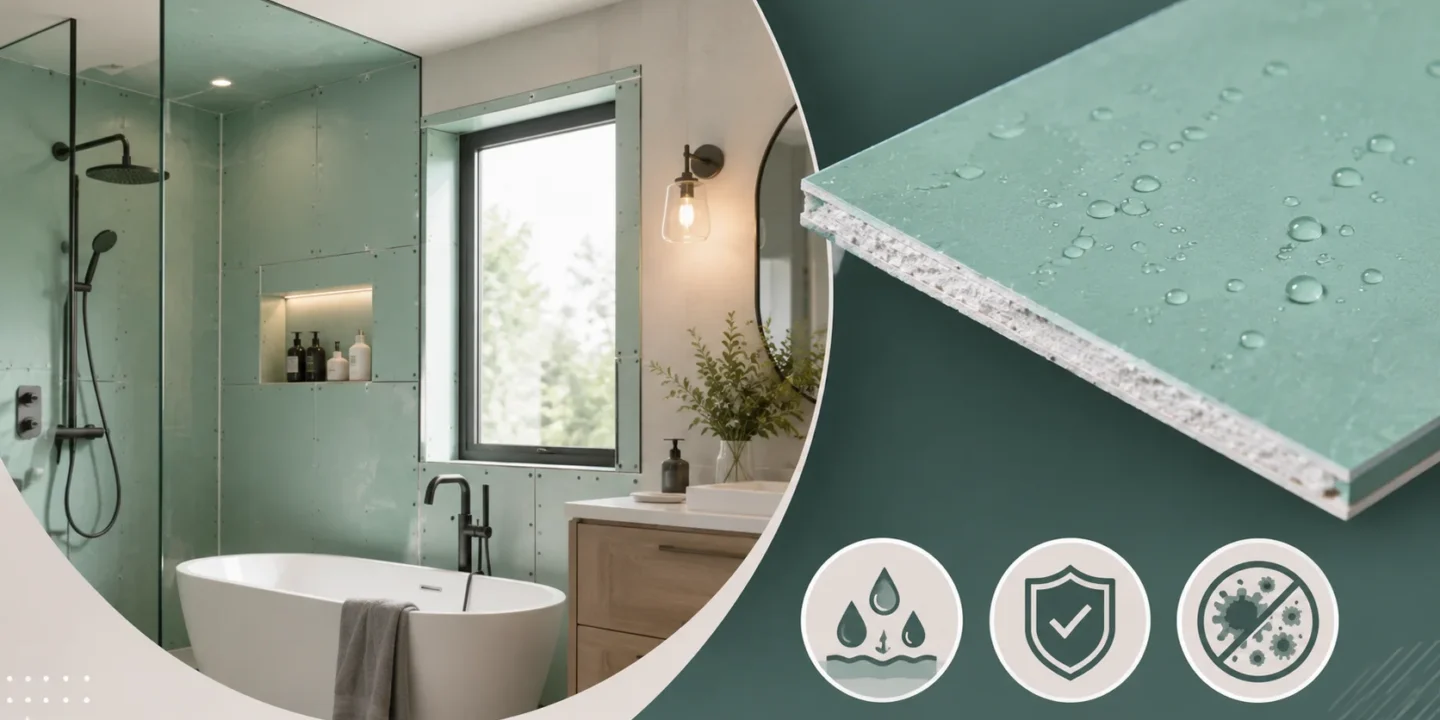



A bathroom isn’t one moisture environment — it’s three. The wall behind your shower sees direct daily water contact. The wall near your sink sees occasional splashes and steam. The wall behind your toilet sees humidity only. Using cement board everywhere costs more and can’t be painted directly. Using green board in the shower fails building code in most US jurisdictions. The material choice depends entirely on which zone you’re working in.
This guide breaks down all three zones, compares the five main drywall types, covers the building code reality for shower surrounds, and gets into one installation detail that no other consumer guide seems to mention: what happens when you pair the wrong joint compound with the right board.
Key Takeaways
- Shower and tub walls require cement board because no gypsum-based drywall is code-approved for direct, sustained water contact.
- Purple board or paperless drywall is best for splash zones and ceilings where rising steam creates constant high humidity.
- Standard white drywall has no place in a full bathroom because the paper facing acts as an organic food source for mold.
- Paperless fiberglass drywall offers the highest mold resistance but requires a full skim coat before painting to hide the texture.
- Standard joint compound contains organic starches that feed mold, meaning you must use mold-resistant compound and mesh tape at all seams.
The Three Bathroom Moisture Zones: Which Material for Which Zone
Most drywall guides treat a bathroom as a single wet environment and give you a blanket recommendation. That’s where most bad material decisions start. A standard bathroom actually contains three distinct moisture conditions, and the right material for each one is different.
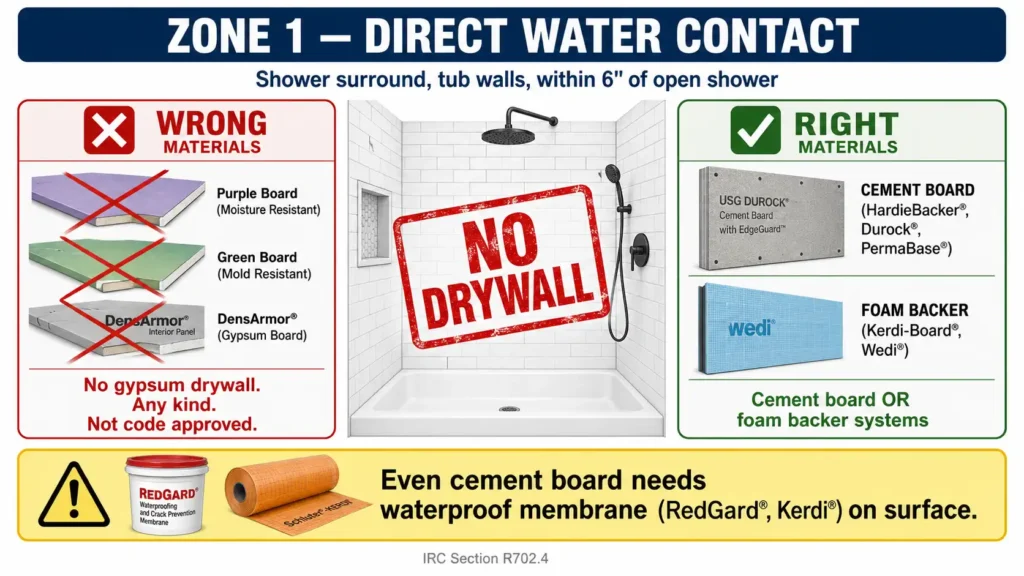
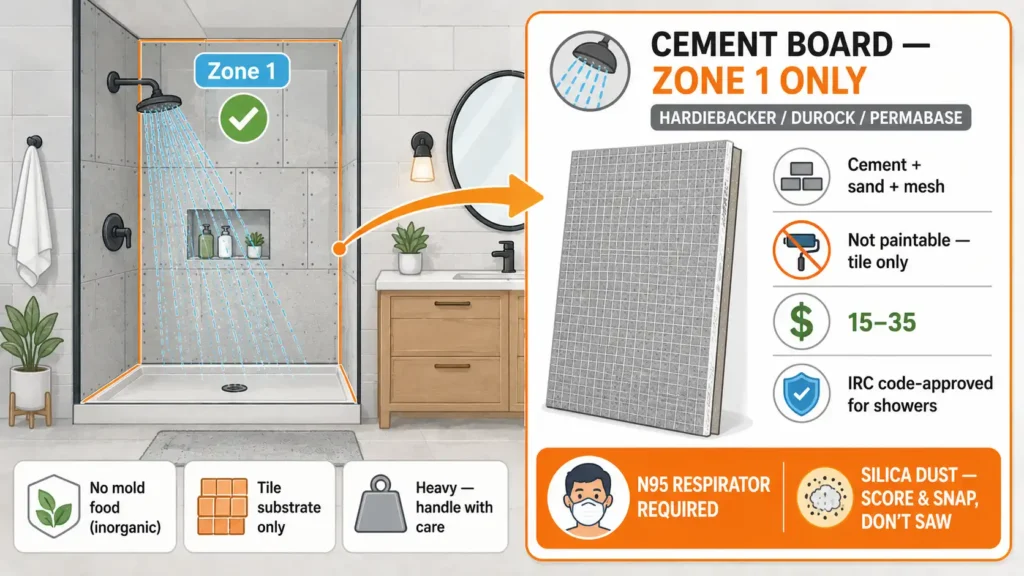
Zone 1: Direct Water Contact (Shower Surround, Tub Walls)
Where it applies: Any wall surface inside the shower enclosure, tub surround walls, floor-to-ceiling in wet shower areas, and any surface within 6 inches of an open shower without a door.
Required material: Cement board — or a foam backer system like Schluter Kerdi-Board or Wedi. No gypsum-based drywall product qualifies for sustained direct water exposure inside a true wet-area assembly. Not purple board. Not DensArmor Plus. Not green board. Gypsum-based drywall of any formulation is not code-approved for direct sustained water contact in most US jurisdictions, regardless of how moisture-resistant it’s labeled.
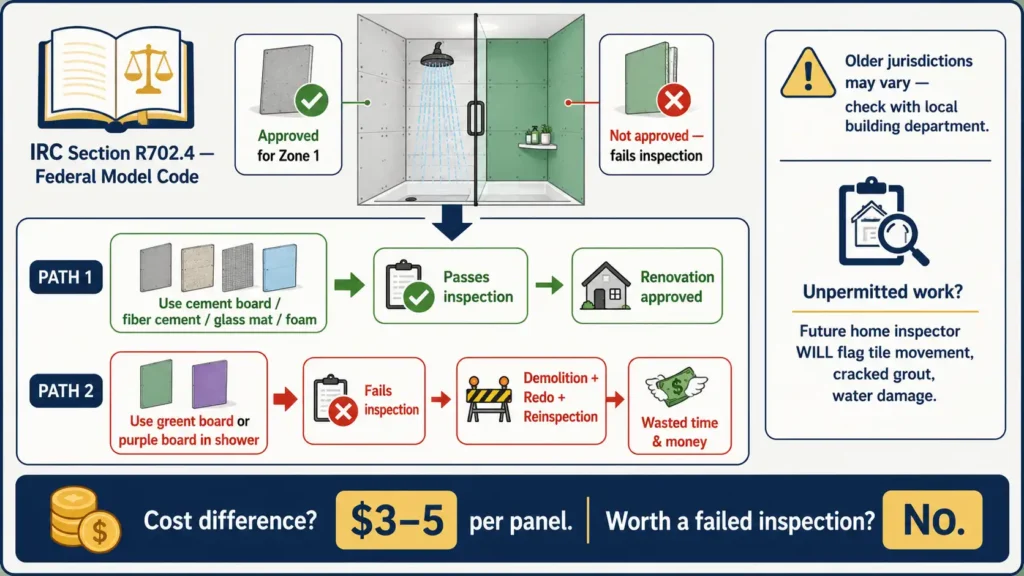
Code reference: IRC Section R702.4 governs tile backer materials in wet areas and specifically lists the approved options: cement board, fiber cement board, glass mat gypsum (specific products only), and foam backer systems. Standard gypsum drywall — including moisture-resistant types — does not appear on that list.
Products to use: HardieBacker, Durock, or PermaBase for cement board; Schluter Kerdi-Board or Wedi for foam backer systems. Even cement board in a true wet area should be paired with a waterproof membrane such as RedGard or Schluter Kerdi. The board alone is not waterproof.
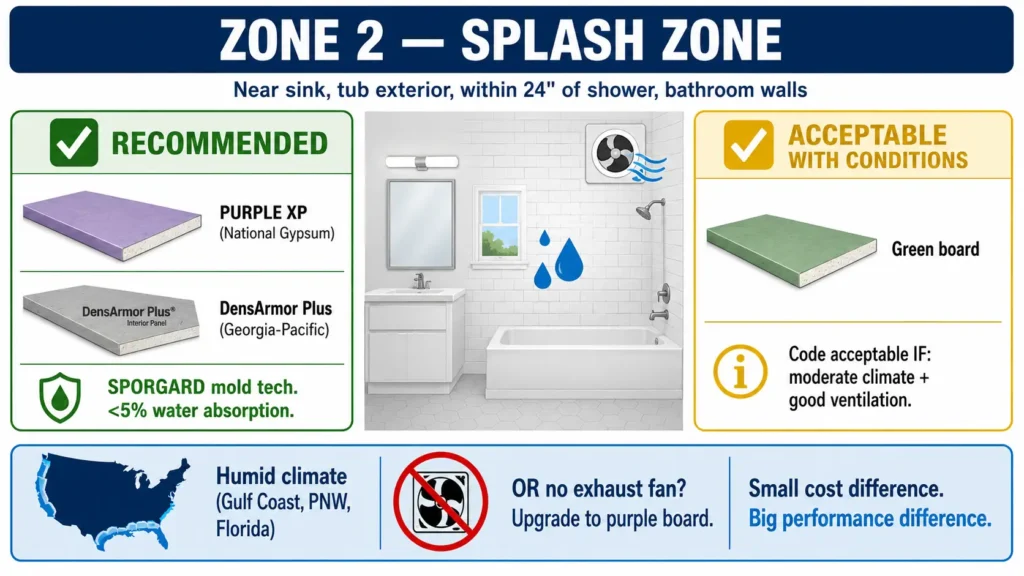
Zone 2: Splash Zone (Near Sink, Tub Exterior, High-Humidity Walls)
Where it applies: Walls within 24 inches of a shower opening, the sink backsplash area, exterior tub surround walls (outside the wet enclosure), and lower bathroom walls near the floor.
Recommended material: Purple board — specifically PURPLE XP from National Gypsum, or DensArmor Plus paperless drywall from Georgia-Pacific. PURPLE XP uses SPORGARD mold-inhibiting technology with less than 5% water absorption, which is a meaningful step up from standard green board in areas that see regular moisture exposure.
Green board is technically code-acceptable in Zone 2 for moderate climates with good ventilation. In humid climates (Gulf Coast, Pacific Northwest, Florida), or in bathrooms without a functioning exhaust fan, upgrading to purple board is the right call. The cost difference is relatively minor, but moisture performance and long-term mold resistance improve noticeably in consistently humid bathrooms.
Products to use: National Gypsum PURPLE XP, DensArmor Plus by Georgia-Pacific.
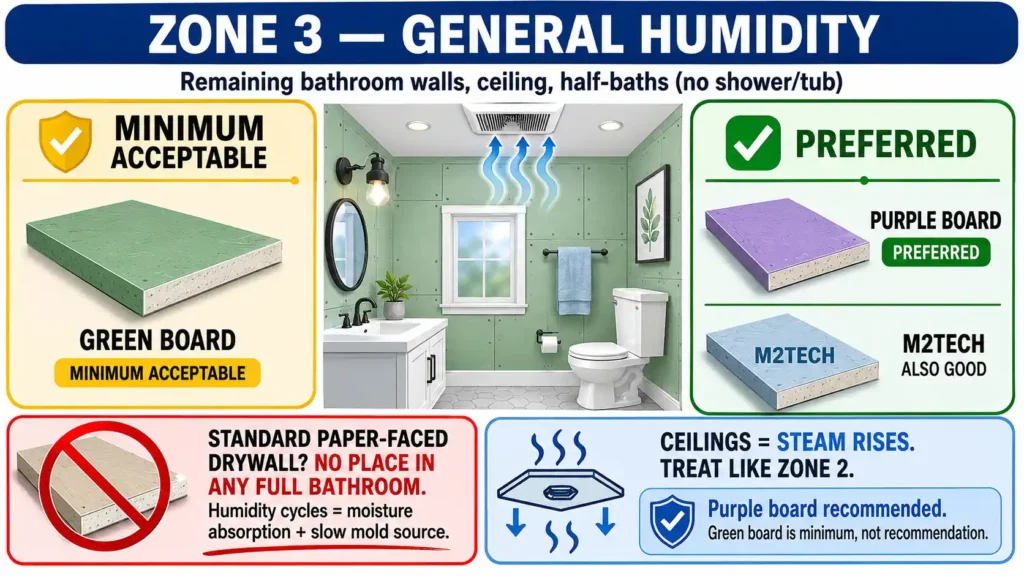
Zone 3: General Humidity (Remaining Walls, Ceiling, Half-Baths)
Where it applies: All other bathroom walls beyond the splash zone, the bathroom ceiling, and the entire footprint of a half-bath with no shower or tub.
Minimum acceptable: Green board. Preferred: Purple board. Standard drywall with paper facing has no place in a full bathroom, even in areas with no direct water exposure. Humidity cycles alone are enough to cause moisture absorption in standard gypsum over time, and the paper facing becomes a slow mold source.
A note on ceilings: Steam rises. Bathroom ceilings behave like Zone 2 in any actively used full bathroom, even though they never see direct water contact. Purple board or a moisture-resistant ceiling board is the correct choice. Green board is the minimum, not the recommendation.
Products to use: National Gypsum standard PURPLE, CertainTeed M2Tech, or standard green board for low-humidity situations.
The 5 Materials Compared: Which One for Your Situation
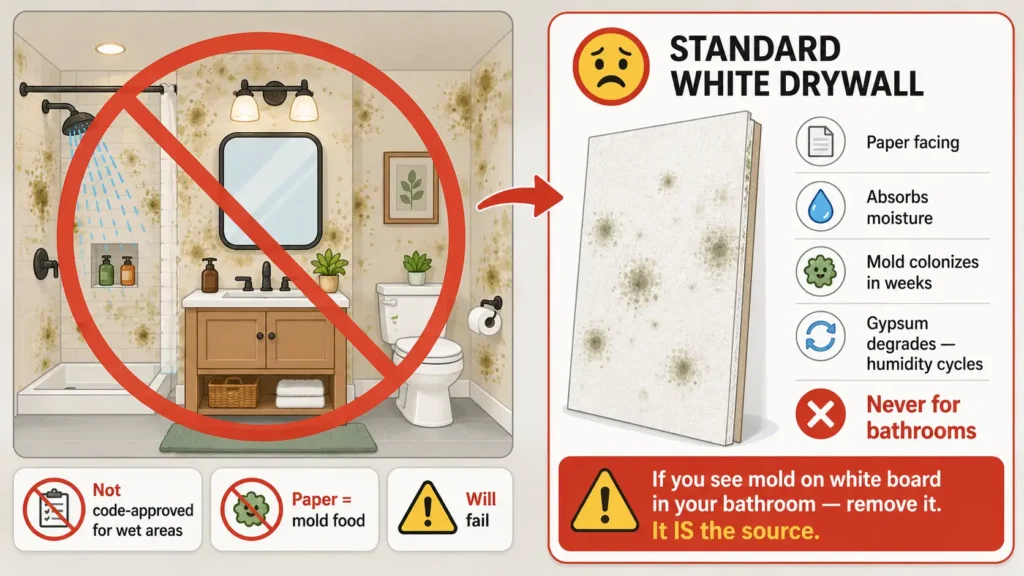
Standard Drywall (White Board)
Never appropriate for bathrooms. The paper facing absorbs moisture readily, the gypsum core degrades with repeated humidity cycles, and mold can colonize the paper facing quickly once repeated humidity cycles begin breaking down the surface. If you have existing standard drywall in a bathroom and you’re seeing mold, the board is very likely the source. It needs to come out.
Green Board (Moisture-Resistant Drywall)
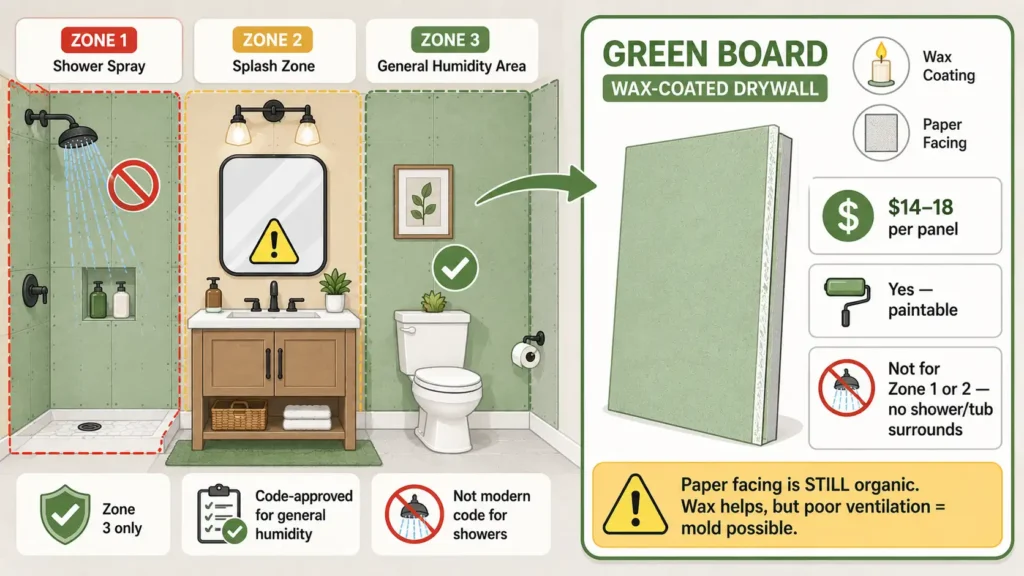
Zone 3 only. The wax-coated paper facing repels surface moisture reasonably well, but the gypsum core is still vulnerable if the paper facing is ever breached. Code-approved for Zone 3 general humidity. Not code-approved for shower or tub surrounds in most modern jurisdictions.
- Cost: $14–$18 per panel
- Paintable: Yes
- Limitation: Paper facing is still organic and can support mold growth in chronically humid bathrooms or where ventilation is inadequate
Purple Board — PURPLE XP
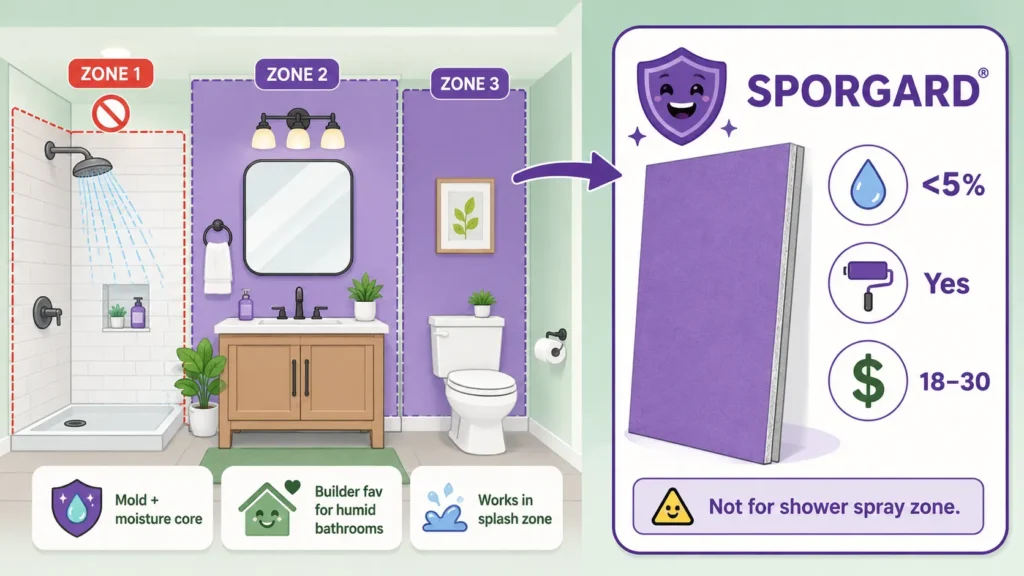
Zones 2 and 3. The preferred choice for most bathrooms. SPORGARD mold and moisture-resistant core with less than 5% water absorption. This is the product home builders specify in humid climates for all bathroom walls outside the wet zone. It handles the splash zone reliably and performs better than standard green board in every humidity condition.
- Cost: $18–$30 per panel
- Paintable: Yes
- Limitation: Not appropriate for Zone 1 direct water contact, despite its superior moisture performance
DensArmor Plus (Paperless / Fiberglass Mat Facing)
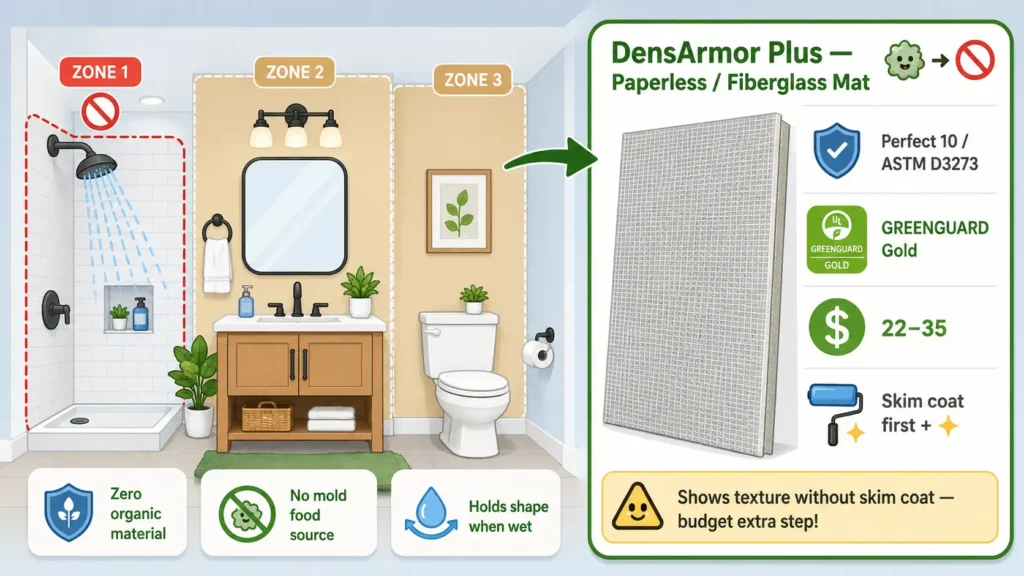
Zones 2 and 3. Best mold resistance of any paintable board. The fiberglass mat facing eliminates all organic material from the surface, removing the mold food source entirely. Unlike standard drywall that swells and loses structural integrity when wet, DensArmor Plus maintains its shape and strength after moisture exposure. It scores a perfect 10 on ASTM D3273 mold resistance testing and carries GREENGUARD Gold certification.
- Cost: $22–$35 per panel
- Paintable: Yes, but requires a skim coat first
- Limitation: The fiberglass mat texture shows through paint without a skim coat. Budget the extra labor step if you’re using this product.
Cement Board (HardieBacker, Durock, PermaBase)
Zone 1 only. Not paintable. Portland cement, sand, and fiberglass mesh. Completely inorganic, so there is nothing for mold to feed on. The only code-approved tile substrate for shower and tub surrounds in jurisdictions following current IRC. Cannot be painted directly and should not be used as a substitute for drywall on paintable wall surfaces.
- Cost: $15–$35 per panel
- Paintable: No (must be tiled or covered)
- Limitation: Heavy, and cutting it creates silica dust. Use an N95 respirator and score-and-snap wherever possible instead of grinding or sawing.
Bathroom-by-Bathroom Decision Matrix
| Bathroom Type | Zone 1 | Zones 2–3 |
| Standard full bath (shower + tub + sink) | Cement board | Purple board |
| Master bath with large walk-in shower | Cement board + waterproof membrane | PURPLE XP |
| Half bath / powder room (no shower or tub) | N/A | Green board throughout |
| Basement bathroom | N/A | DensArmor Plus |
| Coastal or high-humidity climate | Cement board | PURPLE XP throughout |
| Rental property bathroom | Cement board | PURPLE XP (durability pays long-term) |
| Tight budget remodel | Cement board (non-negotiable) | Green board (acceptable) |
| Steam shower | Cement board + full waterproof membrane | PURPLE XP |
Steam shower note: Steam penetrates joints and small gaps far more aggressively than most homeowners realize, especially around seams and corners. A full waterproof membrane over cement board is not optional in a steam shower, and every penetration point needs to be sealed completely.
Building Code Reality: Why the Shower Zone Is Non-Negotiable
IRC Section R702.4 is the federal model code section governing tile backer materials in wet areas. It explicitly lists the approved materials: cement board, fiber cement board, glass mat gypsum (specific products only, such as DensShield), and foam backer systems. Green board and purple board are not included among the approved shower substrate materials listed for direct wet-zone installations.
The real-world consequence of ignoring this is straightforward. A permitted bathroom renovation using green board behind shower tile can fail inspection. The inspector doesn’t care that the package says “moisture resistant.” If the jurisdiction follows current IRC, it fails. That means demolition, reinstallation, and reinspection. The cost savings between green board and cement board runs about $3–$5 per panel. That delta is not worth a failed inspection and a forced redo.
The local caveat worth knowing: some older jurisdictions still operate under legacy code versions that permit green board for shower surrounds. Before starting any permitted renovation, verify the specific requirements with your local building department. The national trend is firmly toward cement board only in Zone 1, but local authority controls.
For unpermitted work, the inspection risk shifts to a future buyer’s home inspection. Using the wrong substrate behind shower tile is a defect that experienced home inspectors flag, and it typically shows up as visible tile movement, cracking grout, or early water damage behind walls. The liability doesn’t disappear because no permit was pulled.
The Joint Compound Rule Nobody Mentions
This is the most overlooked detail in bathroom drywall installation, and it matters more than most homeowners realize.
Standard all-purpose joint compound contains organic starches and binders. Those organic components are mold food. If you use standard joint compound at the seams and screw holes of purple board or DensArmor Plus, you’re reintroducing organic material at every joint in the wall. Moisture tends to accumulate at joints, which are also the spots most vulnerable to backer failure. You end up with a mold-resistant board and a conventional mold food source running across every seam.
The fix is simple: use mold-resistant joint compound throughout all bathroom applications. USG Sheetrock Mold Tough and National Gypsum PurpleCoat are both widely available and formulated with mold inhibitors throughout. National Gypsum specifically specifies mold-resistant compound to be used alongside their PURPLE products in wet locations. You’ll find that requirement in their technical data sheets, not in consumer guides.
The tape choice matters too. Standard paper tape is organic. Use fiberglass mesh tape or FibaFuse tape at bathroom seams. These materials give mold nothing to feed on at the joints, which is where moisture is most likely to accumulate: corners, floor-level seams, and seams adjacent to the shower surround.
Specific Product Picks by Zone
Best Overall Bathroom Board (Zones 2–3)
National Gypsum PURPLE XP Drywall
SPORGARD mold-inhibiting technology, under 5% water absorption, GREENGUARD Gold certified. This is what production builders specify for all wet locations in humid climates. It’s paintable directly with standard primers and paints, which DensArmor Plus isn’t without a skim coat. Price runs approximately $20–$28 per 4×8 panel depending on market and supplier.
The one thing to keep clear: PURPLE XP performs exceptionally in Zones 2 and 3. It is not appropriate for Zone 1 direct water contact, no matter how well it handles humidity.
Best for High-Humidity and Basement Bathrooms
DensArmor Plus by Georgia-Pacific
Fiberglass mat facing with no paper, no organic material on the surface. Perfect 10 on ASTM D3273 mold testing. It holds its shape and structural integrity after moisture exposure in a way paper-faced boards simply don’t. GREENGUARD Gold certified. Price runs $24–$35 per 4×8 panel.
Plan to skim coat before painting. The fiberglass mat texture telegraphs through paint without it. The extra step is worth the material performance if you’re dealing with a basement bathroom where humidity is persistent rather than intermittent.
Best Budget Option for Zone 3 and Half-Baths
National Gypsum Standard PURPLE
Mold and moisture resistant at a lower price than PURPLE XP, without the SPORGARD XP technology. Adequate for half-baths, powder rooms, and general bathroom walls in drier climates. Suitable where Zone 3 conditions are consistent rather than high humidity. Price runs approximately $15–$22 per panel.
Best Zone 1 Cement Board
James Hardie HardieBacker 1/2″
The industry-standard tile backer for a reason. Fibre-reinforced cement, completely inorganic, code-approved for shower tile substrate in virtually every US jurisdiction. More flexible during installation than Durock, which means fewer stress cracks when cutting and fastening. Price runs $18–$28 per 3×5 or 4×8 panel.
Cut it by scoring and snapping where possible. Grinding or sawing creates silica dust, which requires proper respiratory protection. An N95 at minimum; a P100 respirator for extended cutting work.
The Ventilation Prerequisite: No Drywall Saves a Poorly Ventilated Bathroom
Even the best moisture-resistant board will eventually fail in a bathroom without adequate exhaust ventilation. PURPLE XP and DensArmor Plus are significantly more resilient than standard drywall, but neither is immune to chronic moisture accumulation in a sealed, unventilated room. The board is one layer of protection. Ventilation is the foundation everything else depends on.
Minimum requirements per HVI/ASHRAE 62.2:
- Bathrooms under 50 square feet: 50 CFM minimum
- Larger bathrooms: 1 CFM per square foot
- Master bathrooms with a separate toilet compartment: each space needs its own exhaust fan
The 20-minute rule is the practical version of the code requirement. Run the exhaust fan during every shower and for 20 minutes after. A timer switch is the most reliable enforcement mechanism. Set it before you get in the shower and don’t think about it again.
Target indoor bathroom humidity below 50% RH consistently. Above 60% RH, even mold-resistant materials are operating under stress. A cheap hygrometer installed near the shower gives you a real-time read on whether your fan is doing its job.
FAQ
What drywall should I use in a bathroom?
It depends on where in the bathroom. Shower and tub surrounds require cement board — no drywall product is code-approved for direct water contact. Walls near the sink and in the splash zone should use purple board, with PURPLE XP being the preferred option. The remaining walls and ceiling need at minimum green board, though purple board is the better long-term choice. Standard white drywall is never appropriate anywhere in a full bathroom.
Can you use green board in a shower?
No. Green board is not code-approved for shower or tub surround tile backing in jurisdictions following current IRC Section R702.4. Using it in a shower on a permitted renovation can result in a failed inspection and forced demolition. Even on unpermitted work, it’s an installation error that leads to tile failure, water damage, and mold behind the walls. Cement board is the only appropriate material in Zone 1.
What is the best drywall for a bathroom ceiling?
Purple board is the right choice for bathroom ceilings. Steam rises, so bathroom ceilings are exposed to more moisture than the general humidity zone might suggest, particularly in master bathrooms and frequently used showers. Green board is the minimum; purple board is where you should actually land. Some contractors use moisture-resistant ceiling board specifically for high-steam environments.
Is purple board better than green board for bathrooms?
Yes, in most cases. Purple board offers mold resistance in addition to moisture resistance, while green board only addresses surface moisture with its wax-coated paper facing. PURPLE XP specifically adds SPORGARD technology with under 5% water absorption, which green board can’t match. In humid climates, steam showers, or any bathroom with less-than-ideal ventilation, purple board is the clear choice.
What drywall is waterproof for bathrooms?
None of them. No gypsum-based drywall product is waterproof. Moisture-resistant boards resist humidity and tolerate incidental moisture contact better than standard drywall, but they are not waterproof and are not appropriate for direct water exposure. For true waterproofing in Zone 1, cement board combined with a waterproof membrane (RedGard, Schluter Kerdi) is the correct system.
Do I need cement board in a bathroom?
Only in Zone 1: the shower surround, tub walls, and any surface with direct water contact. Outside those areas, cement board is unnecessary and impractical since it can’t be painted directly. For Zones 2 and 3, purple board or DensArmor Plus gives you the moisture and mold resistance you need at a lower cost and with a paintable surface. Those same materials are also commonly used in finished basements where humidity and seasonal moisture create similar long-term risks behind walls.
What drywall do plumbers and contractors use in bathrooms?
Production builders and experienced contractors most commonly specify PURPLE XP for bathroom walls outside the shower, cement board for the wet zone, and mold-resistant joint compound throughout. DensArmor Plus is favored in high-humidity climates and basement applications. Green board is still used on budget builds and older projects but is increasingly considered the minimum-acceptable rather than the standard-of-practice option.
The Short Version
Three zones, three material rules. Zone 1 (shower, tub walls): cement board only, with a waterproof membrane in true wet areas. Zones 2 and 3 (splash zone, general walls, ceiling): purple board as the standard, DensArmor Plus for high-humidity or basement conditions, green board as the budget minimum in low-humidity situations only.
The code rule: green board in a shower can fail a building inspection. IRC Section R702.4 doesn’t list gypsum drywall of any type as an approved wet-area tile substrate.
The joint compound rule: use mold-resistant compound throughout all bathroom drywall work, and pair it with fiberglass mesh or FibaFuse tape at seams. The board can be mold-resistant and the installation still introduce organic material at every joint if you use the wrong compound.
And ventilation: no moisture-resistant board survives long-term in a bathroom that isn’t properly exhausted. Get the CFM rating right, run the fan after every shower, and keep relative humidity below 50%.
For more detail on the individual materials, the cement board vs. drywall guide covers Zone 1 installation in depth. The purple board vs. green board guide breaks down the Zone 2–3 decision in more detail. And the paperless drywall guide covers DensArmor Plus fully if that’s the direction your project is heading.


Elena Hart is the founder and lead writer of Better Home Pro. She writes about drywall, home repair, and practical DIY home improvement topics, focusing on clear, useful information that helps homeowners make better decisions. Her work combines firsthand experience, manufacturer documentation, industry resources, and careful research to create content that is accurate, practical, and easy to understand. Through Better Home Pro, Elena aims to simplify complex home improvement topics and provide guidance that is genuinely helpful to homeowners and DIYers.






No Comments