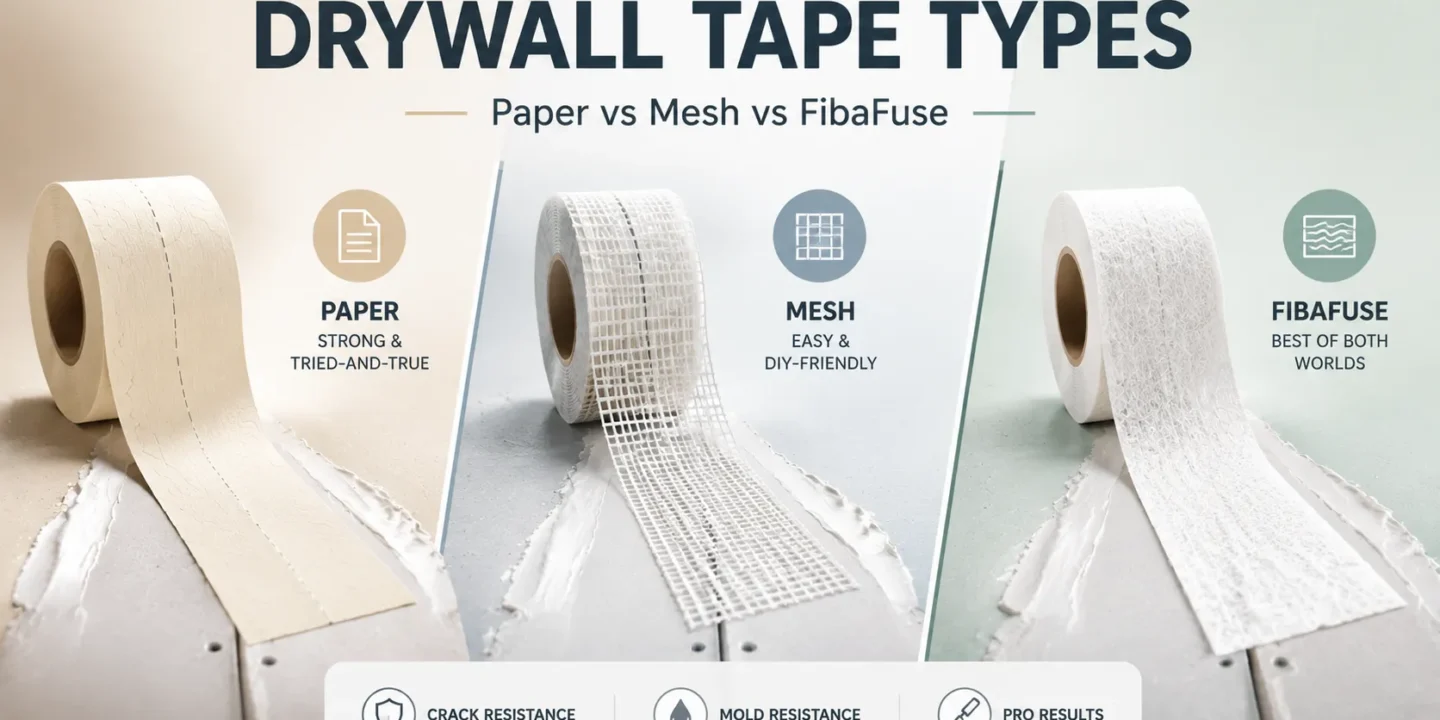



Every article about drywall tape ends the same way: “it comes down to personal preference.” That’s not an answer; it’s a shrug.
The truth is that for inside corners, paper tape isn’t just preferable. It is the correct choice.For cement board to drywall transitions, mesh tape isn’t preferable because it is actually required.And for long flat seams where professionals want the best of both worlds, there’s a third option most DIYers have never heard of: FibaFuse.
This article covers all three types clearly — what each one actually is, why the compound pairing rule matters more than most people realize, and a joint-type decision matrix that tells you which tape belongs where.
Key Takeaways
- Paper tape remains the professional standard for flat seams and inside corners because it is inelastic and prevents long-term structural cracking.
- Fiberglass mesh requires setting compound for the first coat to prevent the tape from stretching and cracking the finish as it dries.
- FibaFuse offers the best of both worlds by providing the mold resistance of fiberglass with the crack resistance and slim profile of paper tape.
- Use paper tape for all inside corners since mesh lacks the factory crease needed to create a sharp, straight 90 degree angle.
- Always use fiberglass mesh at transitions between drywall and cement board because the alkaline chemistry in cement will eventually dissolve paper fibers.
- Drywall finishing standards published by ASTM International and GA-214 recommend tape systems based on joint movement, moisture exposure, and finish level requirements.
- Temperature swings, framing shrinkage, and seasonal humidity changes all increase stress on drywall seams, making inelastic tape systems more reliable for long-term crack prevention.
The Three Types: What They Are and How They Actually Work
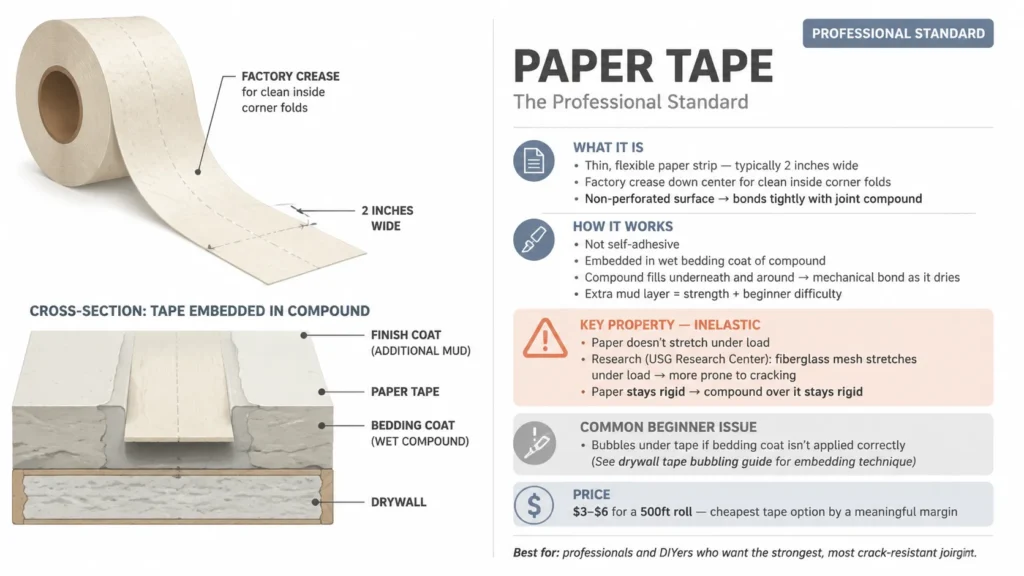
Paper Tape
Paper tape is a thin, flexible strip — typically 2 inches wide — with a factory crease running the full length down the center. While it is the professional standard, handling it efficiently requires a specific set of essential drywall tools like a high-quality taping knife and a mud pan to ensure a smooth, bubble-free application.
It’s not self-adhesive. You have to embed it in a wet bedding coat of compound first using a properly sized drywall taping knife to ensure even pressure. The mud fills beneath and around the tape, creating a mechanical bond when it dries. That extra layer of mud under the tape is both its main strength and the thing that trips up beginners — if you don’t apply the bedding coat evenly, you get bubbles or voids underneath.
The key structural property of paper tape is that it’s inelastic. It doesn’t stretch. Research from the USG Gypsum Construction Handbook found that fiberglass mesh tape joints are more prone to cracking than paper tape joints precisely because mesh stretches under load even after compound has been applied over it. Paper doesn’t move. The compound over it stays rigid. That’s why it produces a better long-term result on structural joints.
Cost: $3–$6 for a 500 ft roll. The cheapest option by a significant margin.
Fiberglass Mesh Tape
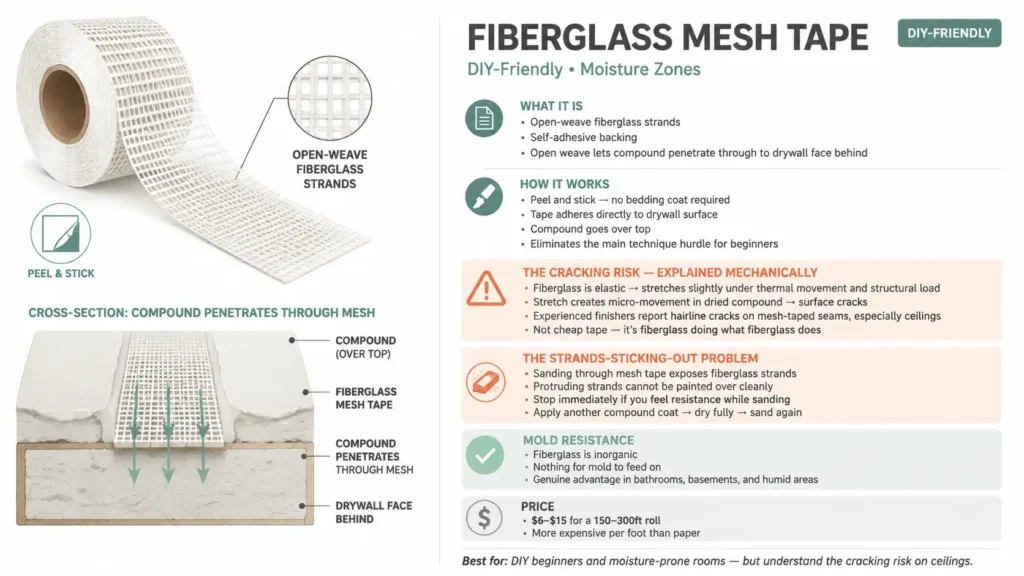
Fiberglass mesh tape is what most DIYers reach for first, and understandably so. It’s self-adhesive — you stick it directly to the drywall surface and apply compound over it. No bedding coat, no embedding technique to learn. For someone doing a repair on a weekend, that’s a genuine advantage.
The open-weave construction allows compound to penetrate through the mesh and bond to the drywall face underneath, which is how it achieves adhesion without a bedding coat.
Here’s the problem, and this is something most buyer guides skim over: fiberglass is elastic. It stretches slightly under thermal movement and structural load. That micro-movement translates into hairline cracks in the dried compound above it over time. Experienced finishers on Drywall Talk have noted this pattern repeatedly — mesh tape cracking along seams, particularly on ceilings where movement is more pronounced.
Ceiling assemblies are particularly vulnerable because lumber moisture loss, roof loading, and attic temperature cycling create continuous movement across long horizontal seams.
There’s also a secondary failure mode that never gets mentioned in buyer guides: sanding through mesh tape. If your sandpaper hits the tape surface, fiberglass strands are exposed and protrude from the finished surface. You can’t paint over them cleanly. If this happens, stop sanding immediately, apply another coat of compound over the area, and let it dry fully before continuing.
The one area where mesh tape has a genuine edge: moisture resistance. Fiberglass is inorganic — there’s no organic material for mold to grow on. In wet areas specialized moisture-resistant drywall options are used, that matters significantly for the longevity of the wall assembly.
Fiberglass mesh is also commonly specified around tile backer boards, shower surrounds, and high-humidity utility rooms because Portland cement products maintain high alkalinity that degrades cellulose-based paper products over time.
Cost: $6–$15 for a 150–300 ft roll. More expensive per linear foot than paper.
FibaFuse (Fiberglass Mat Tape)
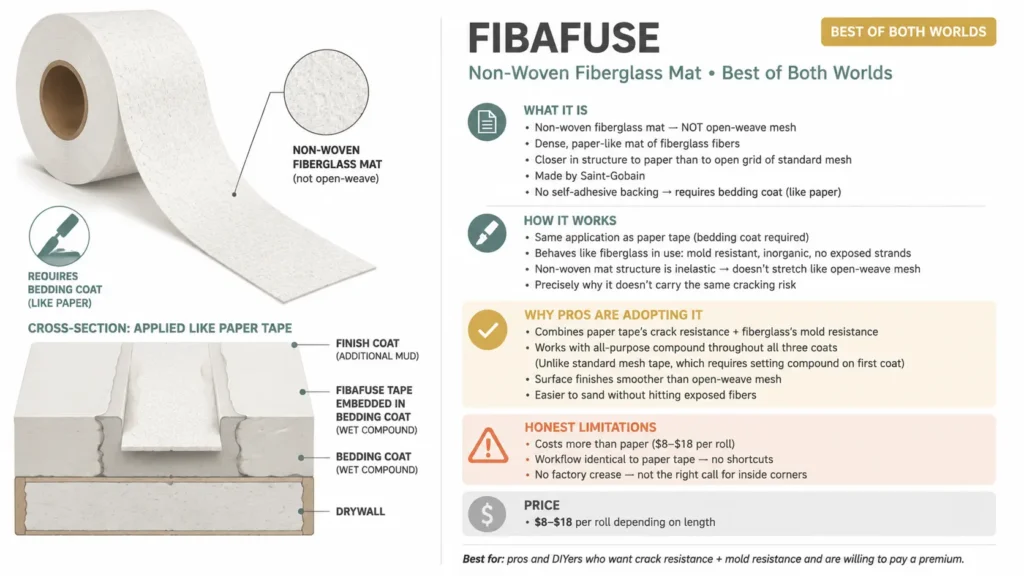
FibaFuse is the option most consumer articles don’t cover at all, and it’s worth understanding why pros are increasingly choosing it.
Made by Saint-Gobain, FibaFuse is a non-woven fiberglass mat — not an open-weave mesh, which is a meaningful distinction. It looks and handles like paper tape: no self-adhesive backing, requires a bedding coat, same workflow and installation technique. But it’s made of fiberglass, so it shares mesh tape’s mold resistance.
The reason it doesn’t crack the way open-weave mesh does comes down to structure. The non-woven mat is inelastic — the fibers are bonded into a dense, paper-like sheet rather than woven into a stretchy grid. No stretch means no micro-movement in the dried compound above it. It behaves like paper tape structurally while being inorganic like mesh tape.
FibaFuse also works with all-purpose compound throughout all coats, which mesh tape does not (more on this in the next section). The surface it produces is smoother than mesh — easier to sand, easier to feather to a flat finish.
Many professional finishers now use FibaFuse in Level 5 drywall finishing systems because the thinner profile and smooth feathering characteristics reduce visible seam telegraphing under critical lighting conditions.
Limitations: It costs more than paper ($8–$18 per roll depending on length), it has the same workflow complexity as paper tape (bedding coat required), and it doesn’t have a factory crease, so it’s still not the right choice for inside corners.
It’s a genuine upgrade over both options in the right application — particularly bathrooms, basements, and whole-home installs in humid climates.
The Compound Pairing Rule: Why Mesh Tape Needs Hot Mud
This is the section most articles skip, or they mention the rule without explaining why it exists. That gap matters, because people who use the wrong compound with mesh tape almost always blame the tape instead of the pairing.
Paper tape: All-purpose (AP) compound throughout all three coats. No restriction. AP compound dries by evaporation — it shrinks slightly, but paper is inelastic so there’s no tape movement to translate into surface cracking.
FibaFuse: Same as paper tape. AP compound is fine throughout. The non-woven mat is inelastic, so the slight shrinkage of AP compound doesn’t cause movement or cracking.
Fiberglass mesh tape — first coat must be setting compound: This is where the chemistry matters. Setting compound (also called hot mud, sold as Durabond 45, Easy Sand 90, etc.) cures by chemical reaction rather than evaporation. It’s exothermic — it generates heat as it sets. Crucially, it doesn’t shrink as it hardens.
All-purpose compound shrinks as moisture evaporates. When AP compound is applied over elastic fiberglass mesh on that first coat, the shrinkage pulls the fiberglass strands slightly. That micro-tension creates hairline cracks in the dried mud surface above. This is the root cause of the mesh tape cracking problem — not a defective tape, not poor application, but the wrong compound for the first coat.
Setting compound creates a rigid, dimensionally stable bridge over the mesh before any AP compound touches it. Once that first coat has fully cured and locked the mesh in place, second and third coats of AP compound are fine. The rigid base prevents the mesh from flexing.
The practical consequence of getting this wrong: cracking within months. The practical fix is straightforward — setting compound on coat one, AP compound on coats two and three. That’s all.
Joint-Type Decision Matrix: Right Tape for Every Seam
This is the information that should end the “paper vs mesh” debate. The right tape isn’t about preference — it’s about what the joint requires.
| Joint Type | Recommended Tape | Reason |
| Tapered flat seams (new construction) | Paper or FibaFuse | Strongest long-term; no cracking risk on high-load seams |
| Butt joints (untapered factory ends) | Paper or FibaFuse | High-movement joint; elastic mesh increases cracking risk |
| Inside corners | Paper tape only | Factory crease folds cleanly into 90° corners; mesh has no crease and creates uneven corners |
| Outside corners | Corner bead (metal or vinyl) | Neither tape type needed |
| Ceiling seams | Paper or FibaFuse | More structural movement than walls; mesh cracking risk is highest here |
| Small patch repair (fist-size or smaller) | Mesh tape | Self-adhesive makes it fastest for small areas; cracking risk is low on small repairs |
| Large patch repair (bigger than a fist) | Paper or FibaFuse | Larger repairs need inelastic strength for long-term stability |
| Bathroom walls and humid areas | FibaFuse | Mold resistance of fiberglass + crack resistance of paper; best of both |
| Cement board to drywall transition | Fiberglass mesh | Mortar and cement dissolve paper tape over time; mesh is unaffected |
| Wide gaps over ⅛” between panels | Mesh prefill, then paper | Embed mesh in setting compound to bridge the gap; apply paper tape over the top for the final tape layer |
| Overhead repairs (water-damaged ceiling, solo work) | Mesh tape | Self-adhesive eliminates the need to hold tape while working overhead |
The cement board row is worth highlighting because it’s genuinely critical and barely mentioned anywhere. Alkaline chemistry in cement and mortar dissolves paper tape fibers over time. Any joint where drywall meets cement board — common at tiled bath and shower surrounds — requires fiberglass mesh. Understanding the differences between cement board and drywall is vital here, as using the wrong tape at this transition will cause the joint to fail.
The professional hybrid approach: Experienced finishers don’t pick one tape and use it everywhere. The standard approach is paper for corners and long flat seams, mesh for small repairs and tight spots where self-adhesion saves time. Using both on the same project isn’t inconsistency — it’s using the right tool for each specific joint.
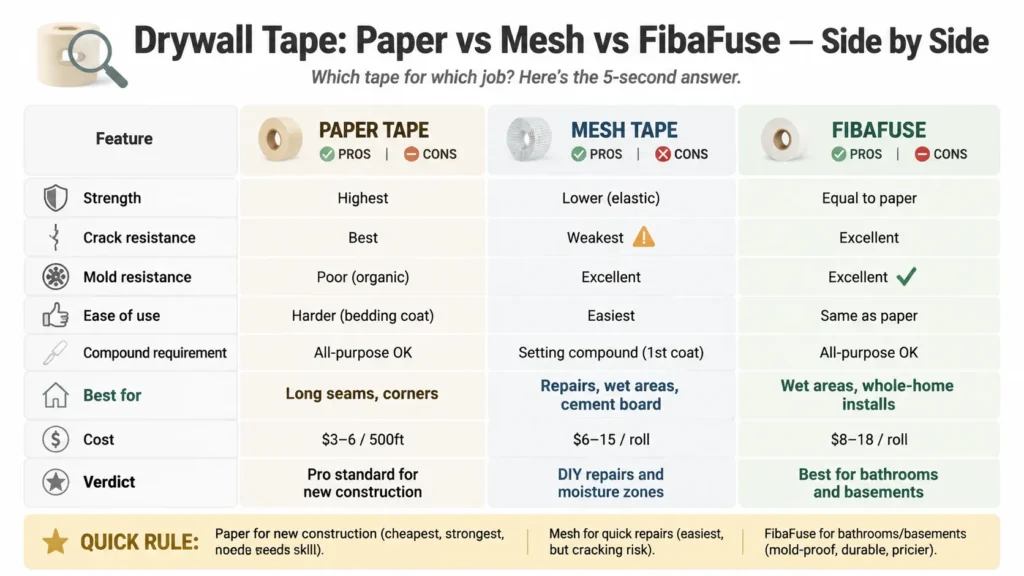
Side-by-Side Comparison: All Three Types at a Glance
| Paper Tape | Fiberglass Mesh | FibaFuse | |
| Crack resistance | Best | Weakest | Excellent |
| Mold resistance | Poor (organic) | Excellent | Excellent |
| Ease of use | Harder (bedding coat required) | Easiest (self-adhesive) | Same as paper |
| Compound (first coat) | All-purpose fine | Setting compound required | All-purpose fine |
| Best applications | Long seams, all corners | Small repairs, wet-area transitions, cement board | Bathrooms, basements, humid-climate installs |
| Cost | $3–$6 / 500 ft | $6–$15 / roll | $8–$18 / roll |
| Pro verdict | Standard for new construction | Repairs and cement board transitions | Best upgrade for moisture-prone areas |
The table tells a clear story. Mesh tape earns its place in two specific situations — small repairs where self-adhesion saves real time, and cement board transitions where it’s the only option. Paper tape is the professional default for new construction precisely because it’s inelastic, cheap, and produces the most stable long-term joint. FibaFuse sits above both for installations where moisture resistance matters but you still want paper tape’s crack-resistance profile.
4 Tape Mistakes That Cause Joint Failures
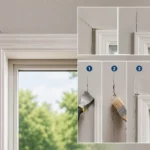
Using all-purpose compound over mesh tape on the first coat
AP compound shrinks as it dries. Over elastic fiberglass mesh, that shrinkage creates micro-tension that cracks the surface. This isn’t a possibility — it’s a near-certainty over time. Setting compound on the first coat is non-negotiable with mesh tape. AP compound for second and third coats only once the setting compound base is fully cured.
Using mesh tape on inside corners
Mesh tape has no factory crease. It can’t fold cleanly into a 90° corner — it gets pushed into the void and produces a crooked, uneven surface. Paper tape at inside corners, every time. There’s no situation where mesh tape belongs in an inside corner.
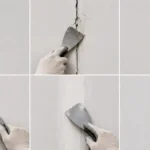
Sanding through mesh tape
This one catches a lot of people off guard. Once sandpaper hits mesh tape, exposed fiberglass strands protrude from the surface and won’t paint over smoothly. If you’ve sanded too deep, stop, apply a fresh coat of compound over the area, let it dry fully, then sand lightly. Don’t try to push through it.
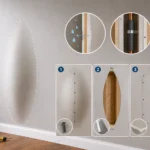
Using paper tape on cement board or mortar bed transitions
The alkaline chemistry of cement and mortar breaks down paper tape fibers over time. At any junction between drywall and cement board — shower surrounds, tub decks, tile backers — fiberglass mesh or FibaFuse is the correct tape. Paper tape at that joint will degrade and fail regardless of how well it was applied. See the cement board vs drywall guide for more on transition joint details.
Product Picks: What to Actually Buy
These recommendations are based on what professionals consistently specify, not marketing claims.
Paper tape — USG Sheetrock Brand Joint Tape. The industry standard. 500ft roll, $3–$6. This is what professionals use. There’s no meaningful reason to buy anything else for paper tape.
Mold-resistant paper tape — Saint-Gobain FibaFuse Paperless. For wet rooms where you want paper tape properties but with mold-inhibiting additives built in. $8–$12 per roll.
Mesh tape — FibaTape Mold-X10. The most commonly specified mesh tape among professionals who use mesh. Self-adhesive, strong fiberglass weave, explicitly mold-resistant. $8–$14 per roll. If you’re buying mesh tape, this is a solid choice.
FibaFuse fiberglass mat tape — Saint-Gobain FibaFuse. The non-woven fiberglass mat, not open weave. Combines paper strength with fiberglass mold resistance. Works with all-purpose compound throughout. $10–$18 per roll. The right pick for bathrooms, basements, and whole-home installs in humid climates.
Frequently Asked Questions
What is the best type of drywall tape?
For most new construction work on dry rooms, paper tape is the best choice. It’s the cheapest, the most crack-resistant, and what professional finishers use as their default. For moisture-prone rooms like bathrooms and basements, FibaFuse is worth the extra cost. Mesh tape is best suited for small repairs and cement board transitions specifically.
Is paper or mesh tape better for drywall?
Paper tape is stronger and more crack-resistant for structural joints like long seams and corners. Mesh tape is easier to apply and holds a genuine advantage in moisture resistance and at cement board transitions. The better choice depends entirely on the joint type — not personal preference and not skill level alone.
Can you use mesh tape on inside corners?
No. Mesh tape has no factory center crease, so it can’t fold cleanly into a 90° inside corner. It gets pushed into the void and creates an uneven, crooked finish. Paper tape is the only correct choice for inside corners — the factory crease is specifically designed for this.
Do I need special compound for mesh tape?
Yes. The first coat over fiberglass mesh tape must be setting compound (hot mud), not all-purpose compound. All-purpose compound shrinks as it dries by evaporation, which pulls the elastic fiberglass strands and causes the dried surface to crack. Setting compound cures by chemical reaction rather than evaporation — it doesn’t shrink, so it creates a rigid, stable base over the mesh. Second and third coats can be all-purpose compound once the setting compound base has fully cured.
What is FibaFuse drywall tape?
FibaFuse is a non-woven fiberglass mat tape made by Saint-Gobain. Unlike standard fiberglass mesh tape, it has no self-adhesive backing and requires a bedding coat — it installs exactly like paper tape. The non-woven mat structure makes it inelastic (like paper) while retaining fiberglass’s mold resistance. It works with all-purpose compound throughout and produces a smoother surface than open-weave mesh. It’s the preferred option for bathrooms, basements, and humid-climate installs.
Why does my mesh tape keep cracking?
Almost certainly a compound pairing problem. If all-purpose compound was used on the first coat over mesh tape, shrinkage as the AP compound dried pulled the elastic fiberglass strands, and those micro-movements cracked the surface above. The fix is setting compound on the first coat — it cures chemically and doesn’t shrink. Using the right types of joint compound for each phase of the job is critical; if you used setting compound correctly and are still seeing cracks, the mesh tape may be on a high-movement joint where an inelastic tape like paper or FibaFuse would perform better
Can I use paper tape in a bathroom?
Paper tape can be used in bathrooms on drywall surfaces, but it is organic and can support mold growth in consistently wet or humid conditions. The EPA provides guidance on mold remediation and prevention, noting that moisture control is the key to preventing mold in building materials. For full bathroom installs — especially shower-adjacent walls — FibaFuse is the better choice because it combines paper tape’s crack resistance with fiberglass’s inherent mold resistance.
The Verdict
First-time DIYer finishing a dry room: use paper tape. It’s harder to apply than mesh, but it’s cheaper, more crack-resistant, and produces a better long-term result. The embedding technique is learnable.
DIYer doing repairs: mesh tape for small patch jobs, FibaFuse for a full wet-room installation. Don’t use mesh for anything larger than a fist-sized repair if you want it to hold long-term.
Experienced finisher: paper for long seams and inside corners, mesh for small repairs and cement board transitions. The hybrid approach isn’t a compromise — it’s the right approach.
The underlying rule is simple: let the joint type decide which tape you use, not the learning curve. Corners need paper. Cement board transitions need mesh. Bathrooms and basements deserve FibaFuse. Everything else is paper unless there’s a specific reason to deviate.


Elena Hart is the founder and lead writer of Better Home Pro. She writes about drywall, home repair, and practical DIY home improvement topics, focusing on clear, useful information that helps homeowners make better decisions. Her work combines firsthand experience, manufacturer documentation, industry resources, and careful research to create content that is accurate, practical, and easy to understand. Through Better Home Pro, Elena aims to simplify complex home improvement topics and provide guidance that is genuinely helpful to homeowners and DIYers.







No Comments