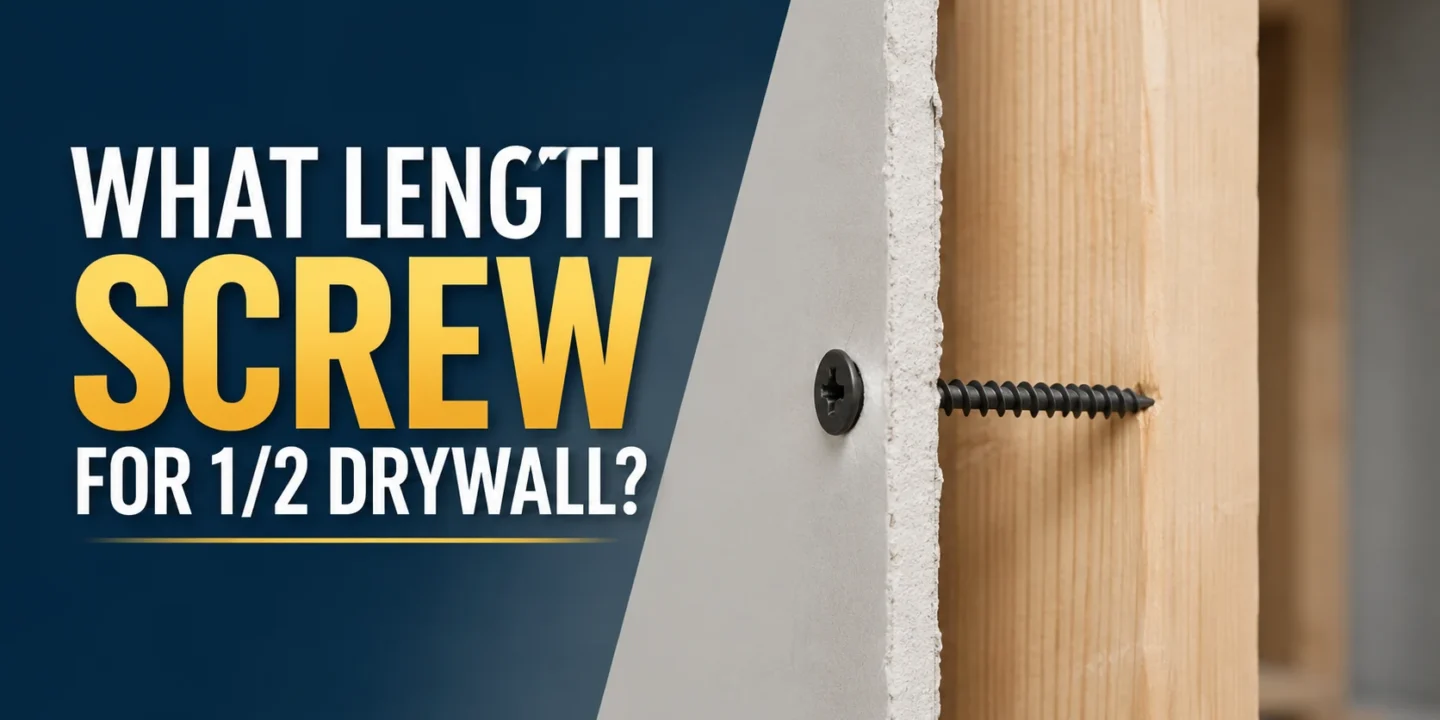



For standard 1/2-inch drywall on wood studs, use 1-1/4 inch coarse-thread drywall screws. For 1/2-inch drywall on light-gauge metal studs, use 1-1/4 inch fine-thread drywall screws. For ceilings, repairs, or situations where you need a little extra penetration depth, 1-5/8 inch screws are a reasonable choice.
That covers the majority of jobs, but our comprehensive drywall screw sizing guide provides a wider breakdown if you find yourself working with multiple material thicknesses on a single job site.
Everything below explains why, and when the answer changes.
Key Takeaways:
- Standard 1/2-inch drywall on wood or metal studs requires 1-1/4 inch screws to achieve the necessary 3/4-inch penetration depth.
- Wood framing requires coarse-thread screws for grip, while metal studs require fine-thread screws to cut through light-gauge steel without stripping.
- Ceiling installations benefit from 1-5/8 inch screws for extra embedment depth to securely resist constant gravitational downward pull.
- Screws longer than 1-5/8 inches increase driving effort and risk puncturing hidden electrical wires or plumbing pipes behind the framing.
- Double-layer drywall installations require 1-5/8 inch or longer screws to fully clear the 1-inch material thickness and bite into studs.
Quick Answer: Best Screw Length for 1/2-Inch Drywall
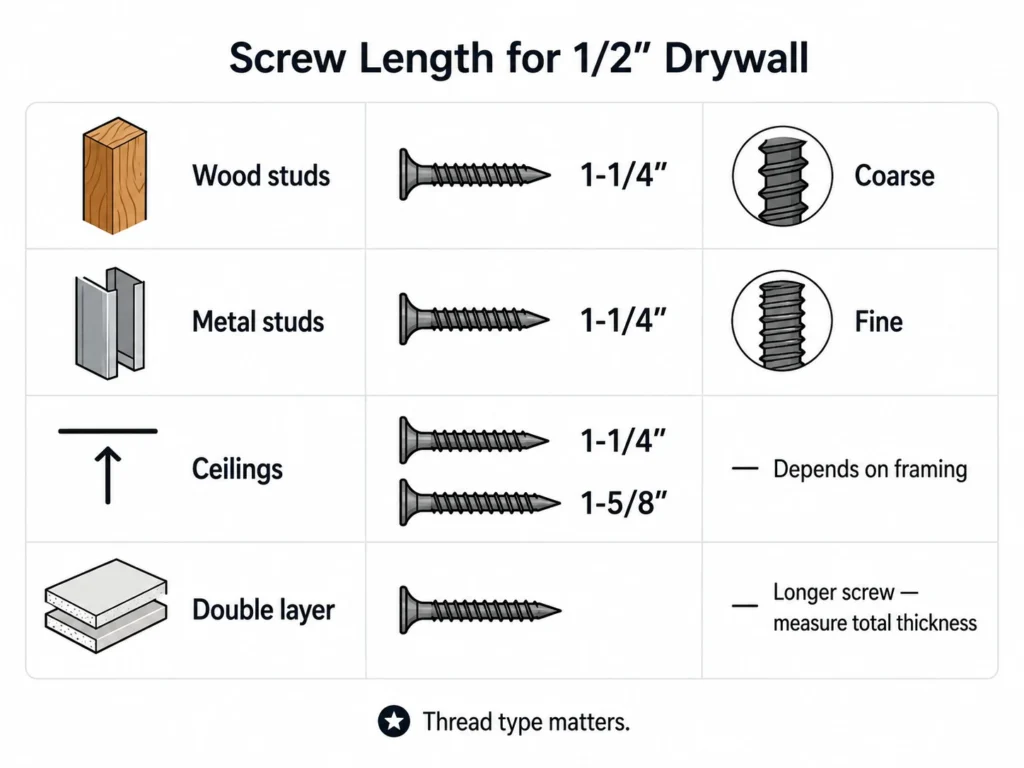
| Application | Best Screw Length | Thread Type |
| 1/2″ drywall to wood studs | 1-1/4″ | Coarse thread |
| 1/2″ drywall to metal studs | 1-1/4″ | Fine thread |
| 1/2″ drywall on ceilings | 1-1/4″ or 1-5/8″ | Depends on framing |
| Double-layer drywall | Longer screws required | Depends on total thickness |
Why 1-1/4 Inch Screws Are Usually Correct
A lot of people assume that longer screws hold better. For drywall, that logic does not really apply.
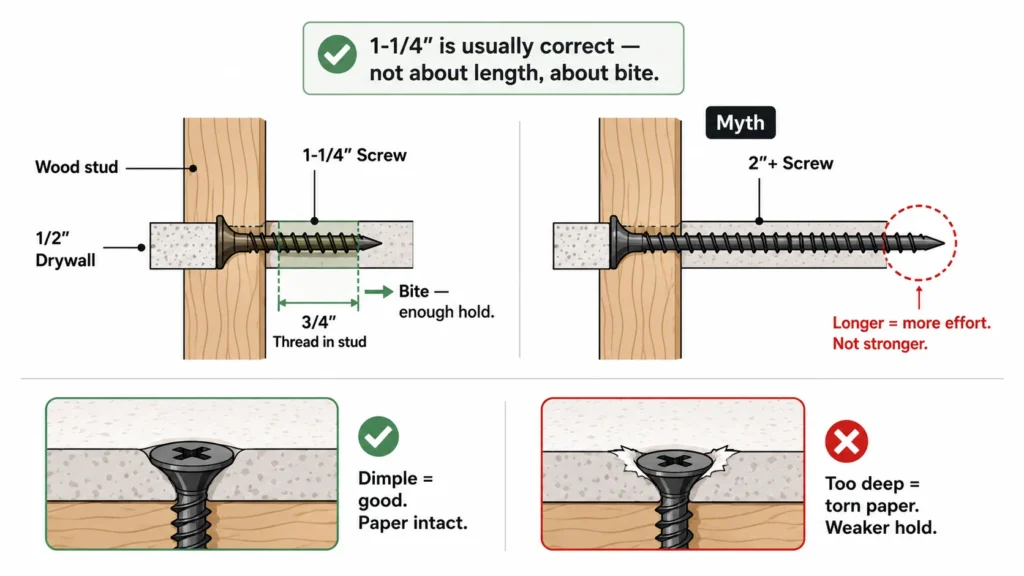
The goal is to pass through the drywall and get adequate bite into the framing behind it. With 1/2-inch drywall, a 1-1/4 inch screw does exactly that. After penetrating the panel, roughly 3/4 of an inch of screw thread engages the stud. That is enough holding power for a wall that is not going anywhere.
Going longer than necessary does not make the connection stronger in any meaningful way. The screw head still sits in the same spot, the panel still presses against the framing, and you have just added driving time and margin for error. In normal wall framing, extra length is extra effort without a real payoff.
The screw head also matters. A properly driven drywall screw should create a slight dimple in the paper face without breaking through it. That dimple allows the compound to cover the head cleanly. Drive it too deep and you tear the paper, weakening the hold at that point.
Wood Studs vs Metal Studs: The Length Is Similar, the Thread Is Different
Both applications typically call for 1-1/4 inch screws, but the screw you reach for is not the same one.
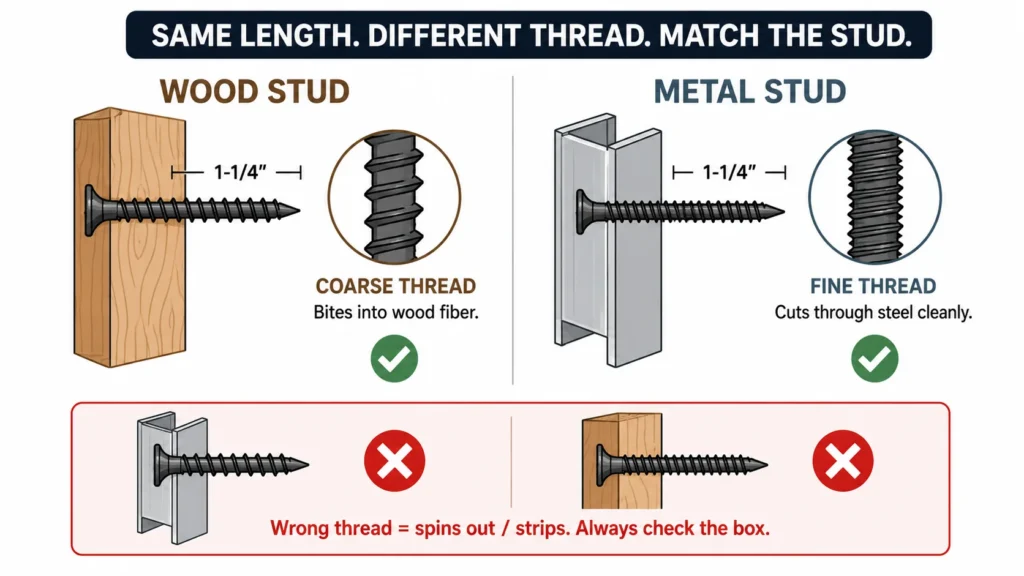
Wood studs need coarse-thread drywall screws. The wider thread pitch bites into wood fiber efficiently and pulls the panel tight without requiring much torque.
Metal studs need fine-thread drywall screws. Light-gauge steel does not have wood grain to grab, so the finer thread cuts through the metal more cleanly. Run a coarse-thread screw into a metal stud and it tends to spin out or strip instead of seating properly.
This is a mistake that shows up on job sites more often than you would think. The screws look similar, the length is the same, but grabbing the wrong box means your panels are not holding the way they should. Always check the thread type before you start.
Should You Use 1-5/8 Inch Screws for 1/2 Drywall?
In certain situations, yes. But it is not the default recommendation for standard wall work.
Use 1-5/8 inch screws when:
- You are hanging drywall on ceilings and want a bit more embedment depth for peace of mind
- The framing is slightly uneven or the studs are not perfectly plumb, creating minor gaps between panel and framing
- You are doing patch or repair work over an existing surface where you cannot fully control the substrate
- Local specs or your contractor’s standard practice calls for it
A 1-5/8 inch screw is not wrong in most situations, but for a standard wall with flat, well-aligned wood or metal framing, it is more than you need. Buying 1-1/4 inch screws for walls and keeping a box of 1-5/8 inch on hand for ceilings and repairs is a practical approach.
What Happens If the Screw Is Too Short?
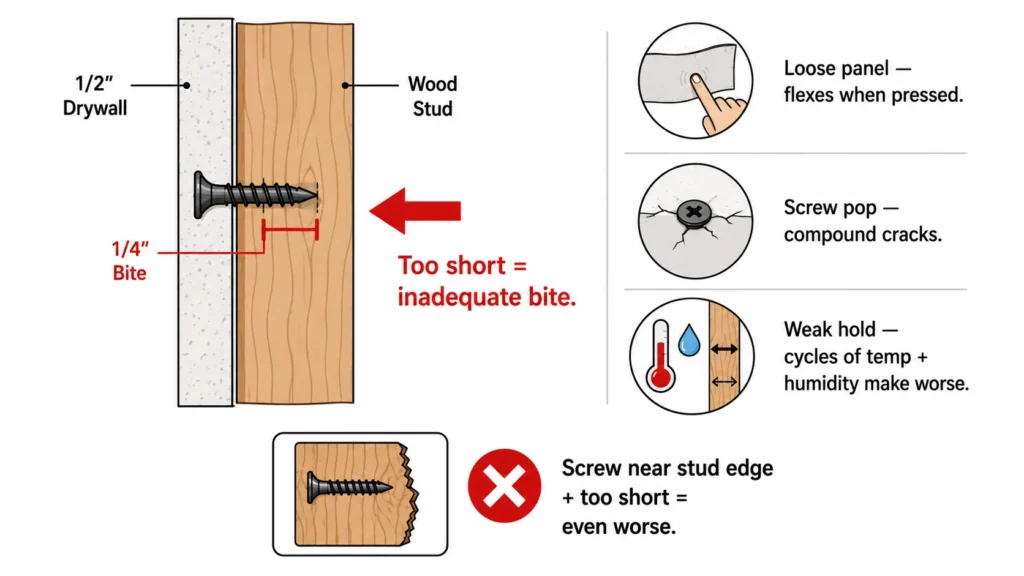
A screw that does not get adequate bite into the framing will not hold the panel reliably over time.
Short screws can cause:
- Loose panels that flex slightly when pressed
- Screw pops as the panel shifts and the screw head pushes forward through the compound
- Weak holding power that becomes more noticeable as temperature and humidity cycles cause the framing to move
Screw pops are one of the more common drywall complaints in finished rooms. They often trace back to screws that did not get deep enough into the stud, or to screws that were driven into the edge of a stud rather than the center. Short screws make both problems worse.
What Happens If the Screw Is Too Long?
This is where experience matters, because many DIYers assume that going longer is playing it safe. It is not.
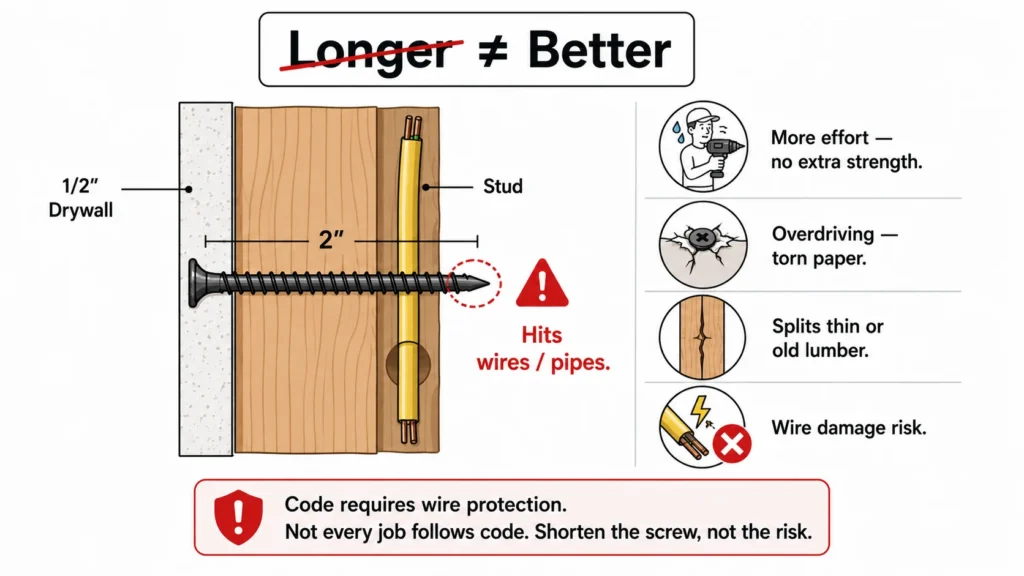
Longer screws create real problems:
- More driving effort with no improvement in holding strength
- Higher risk of hitting wires, pipes, or other materials behind the framing
- Increased chance of overdriving, where the screw punches through the paper face instead of dimpling it
- Potential splitting in thinner or older lumber
In walls with electrical wiring run through bored holes in the studs, a 2-inch screw going through 1/2-inch drywall can reach far enough to be a concern. Code requires wiring to be set back or protected, but not every framing job was done carefully. Sticking with the appropriate length is just good practice.
Screw Length for 1/2 Drywall on Ceilings
Ceiling installations deserve their own consideration because the load works differently. Gravity is pulling the panel down, and the screws carry that weight constantly rather than just resisting lateral forces like a wall.
For ceilings, 1-1/4 inch screws are still commonly used and work well when the framing is solid and properly spaced. Many installers prefer 1-5/8 inch screws on ceilings for the extra embedment depth, and that is a reasonable call, particularly on 16-inch or 24-inch on-center framing where panels span longer distances between fasteners.
What matters as much as screw length on a ceiling is fastening pattern. Screws too far apart let panels sag or separate at the seams over time. Standard practice is screws every 12 inches in the field for ceilings, compared to every 16 inches on walls. When calculating how many screws per sheet you will actually need, getting that pattern right does more for the long-term performance of a ceiling than going up a quarter-inch in screw length.
Before estimating screw quantities, it’s helpful to know exactly how many drywall panels your project requires. Our drywall planning tool estimates sheet counts based on room dimensions, helping you budget materials more accurately and avoid unnecessary waste.
Screw Length for Double Layers or Drywall Over Existing Drywall
As soon as you add total material thickness, the screw length calculation changes.
Two layers of 1/2-inch drywall combined are 1 inch thick. To get the same 3/4-inch penetration into the stud that a single-layer installation provides, you need a screw that clears 1 inch of material and still bites deep enough. That points toward 1-5/8 inch or longer depending on exact thickness.
For drywall installed directly over existing drywall (common in renovations and soundproofing assemblies), measure the total material the screw needs to pass through before choosing length. There is no single answer because old drywall thicknesses vary, and in some cases you may be going through two layers plus a layer of resilient channel or furring.
This is worth getting right. A screw that bottoms out in the existing layer without reaching the framing is holding almost nothing. Check total thickness, add at least 5/8 inch for stud penetration, and round up to the next available screw length if needed.
For more on how drywall thickness affects fastener choices, the types of drywall guide covers how different panel thicknesses are used in different applications.
Final Recommendation
For most standard 1/2-inch drywall wall jobs, buy 1-1/4 inch drywall screws. Choose coarse-thread for wood studs and fine-thread for metal studs. Keep a box of 1-5/8 inch screws available if you are working on ceilings, repairs, or any assembly where you are going through more than a single layer.
Do not overthink it. The right screw length for 1/2-inch drywall is not the longest one on the shelf. It is the one that clears the panel and gets solid, consistent bite into the framing behind it.
If you are not sure what tools you need beyond screws, the essential drywall tools list covers everything from screw guns to corner bead applicators.


Elena Hart is the founder and lead writer of Better Home Pro. She writes about drywall, home repair, and practical DIY home improvement topics, focusing on clear, useful information that helps homeowners make better decisions. Her work combines firsthand experience, manufacturer documentation, industry resources, and careful research to create content that is accurate, practical, and easy to understand. Through Better Home Pro, Elena aims to simplify complex home improvement topics and provide guidance that is genuinely helpful to homeowners and DIYers.







No Comments