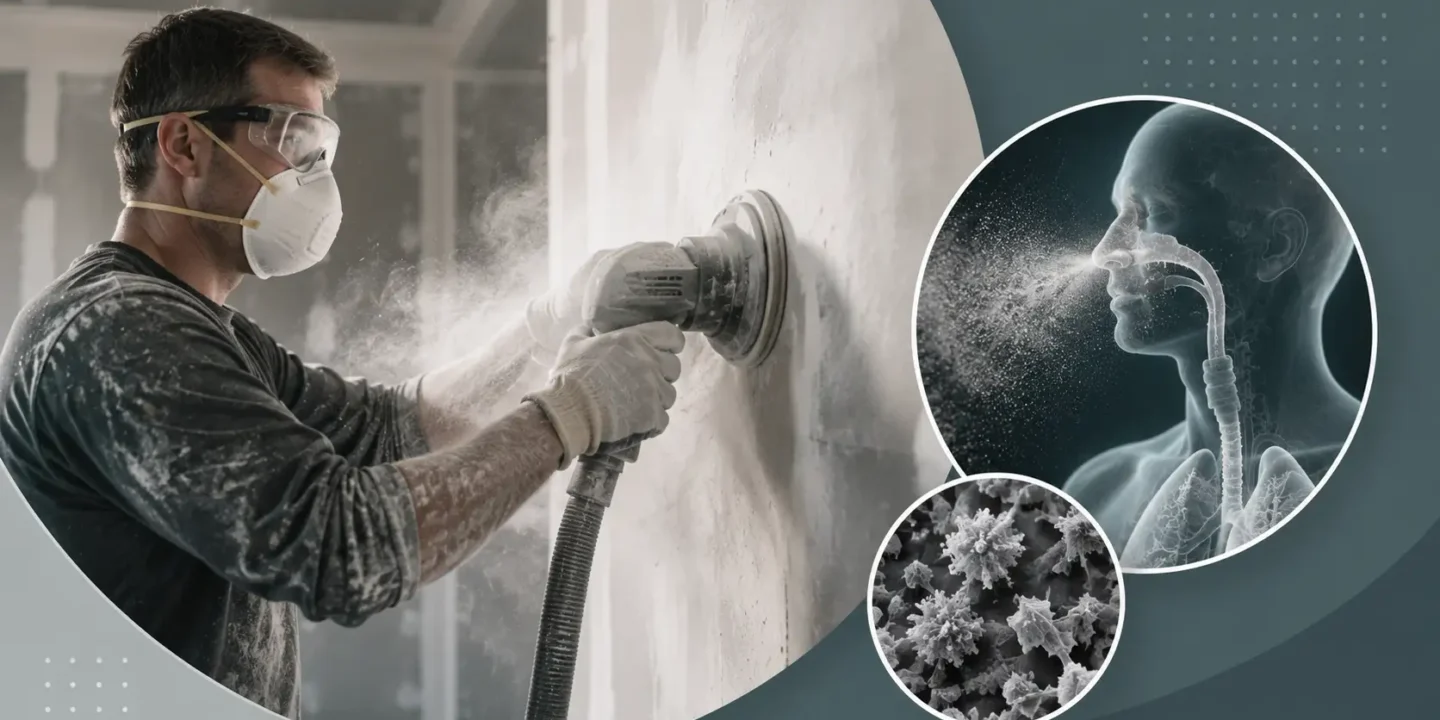



Brief exposure to drywall dust is uncomfortable, but for most healthy adults, it’s not an immediate health danger. The dust irritates your nose, throat, and airways, and that irritation usually clears up within a few hours to a day. What actually determines whether your exposure was harmless or worth taking seriously comes down to three things: how long you were exposed, how enclosed and poorly ventilated the space was, and whether the materials involved contained additives like silica. A single afternoon of drywall sanding in a room with open windows is a very different situation than weeks of daily exposure inside a sealed room without proper ventilation or respiratory protection.
Key Takeaways:
- Brief drywall dust exposure causes temporary nose and throat irritation but rarely leads to lasting health harm for healthy adults.
- Joint compounds sometimes contain crystalline silica, which can cause permanent lung scarring through repeated occupational inhalation.
- Sanding aerosolizes fine dust that stays suspended longer, making it more hazardous to your lower lungs than cutting drywall panels.
- Working in a sealed room spikes particle concentrations quickly, making outward fan ventilation essential to lower actual inhalation.
- Symptoms like coughing or throat rawness should clear within 48 hours, while lingering wheezing or shortness of breath requires medical evaluation.
Why Drywall Dust Irritates Your Body
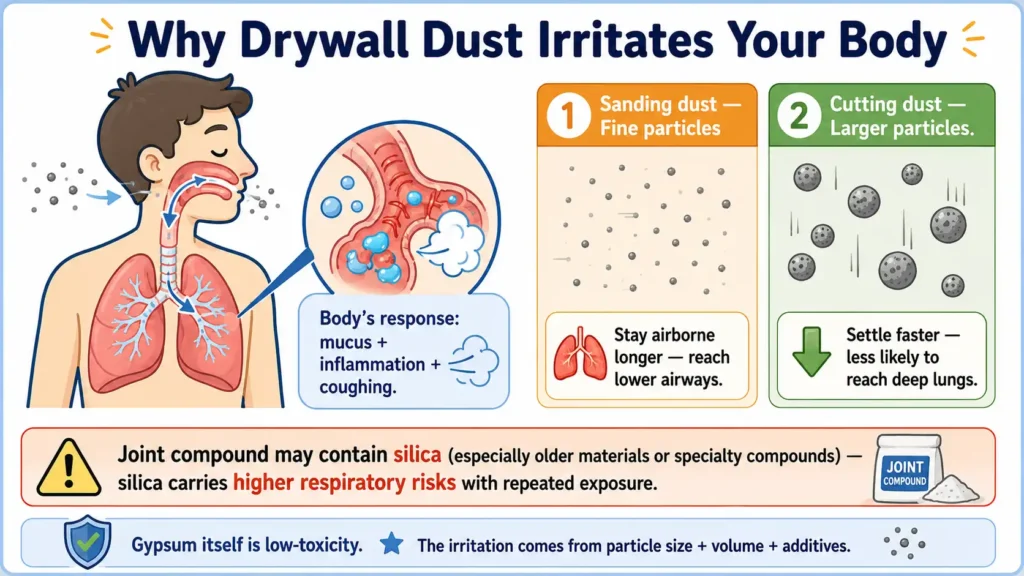
Drywall is primarily made from gypsum, a mineral compound that’s considered low-toxicity on its own. But the dust it produces during sanding or cutting is another matter. The particles are fine enough to get past your nose and throat and reach your lower airways. When they do, your respiratory system treats them as an irritant and responds accordingly: mucus production increases, airways become inflamed, and your body tries to clear the particles out through coughing.
Joint compound adds another layer. Depending on the brand and formulation, some joint compound types contain additives like talc, limestone, or silica depending on the formulation and intended use. Silica is where health professionals pay closer attention. Crystalline silica, found in certain building materials, carries well-documented respiratory risks with repeated exposure. Not every drywall product contains it in significant amounts, but if you’re working with older materials, specialty compounds, or cutting through installed drywall, the risk profile changes somewhat.
Sanding creates the highest exposure because it aerosolizes the dust into fine, suspended particles that hang in the air longer. Simply cutting drywall panels produces larger particles that settle faster and are less likely to reach your lower lungs.
How Much Exposure Is Actually Dangerous?
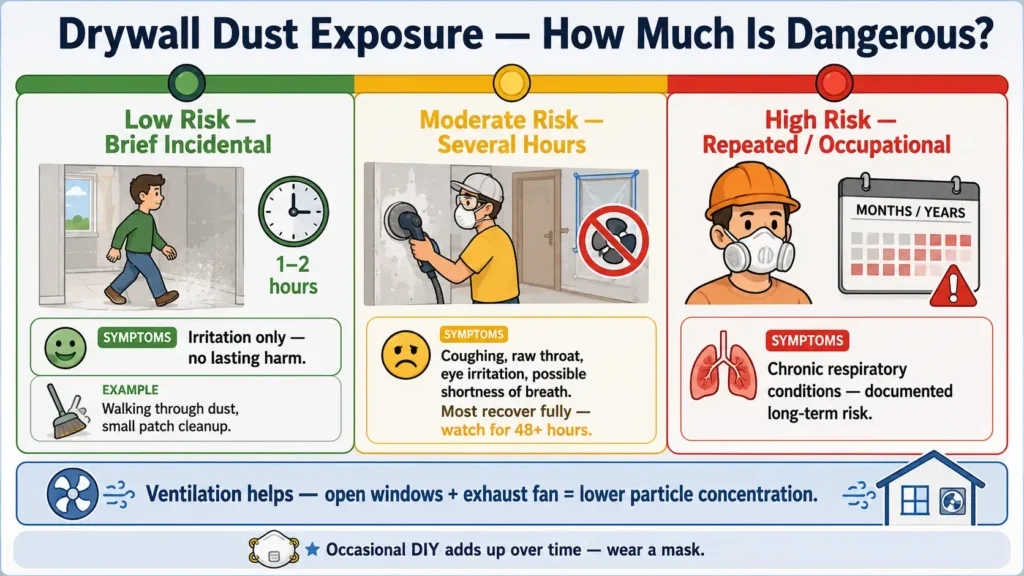
Risk isn’t binary. It scales with exposure duration, concentration, and frequency.
Brief incidental exposure — walking through a dusty room, being present while someone sands nearby for an hour or two, or cleaning up after a small patch job — is generally considered low-risk for people without pre-existing lung conditions. Irritation is common and expected. Lasting harm from a single brief encounter is unlikely.
Several hours in a poorly ventilated space is where the concern starts to grow. If you spent a full day sanding in a room with no airflow, windows closed, and no mask, you inhaled a significantly higher concentration of particles. Your lungs were working against a sustained load, not a momentary spike. You’d likely feel it: persistent coughing, a raw throat, eye irritation, and possibly mild shortness of breath. Most healthy people recover fully, but if those symptoms linger past 48 hours or worsen instead of improving, that’s worth evaluating.
Repeated occupational exposure over months or years is where genuine long-term damage becomes a documented risk. Drywall finishers, sanders, and construction workers who spend daily shifts in dusty environments without consistent respiratory protection are in a different category entirely. This population faces measurable increases in chronic respiratory conditions. Occasional DIY exposure doesn’t put you in that group, but repeated drywall renovation projects done without protection add up more than most people realize.
Ventilation matters significantly. A dusty room with two open windows and a fan exhausting air to the outside is meaningfully safer than the same room sealed shut. Airflow dilutes particle concentration and reduces the time suspended dust stays in your breathing zone.
Symptoms That Suggest More Than Mild Irritation
Most drywall dust exposure produces symptoms that resolve on their own. Irritated eyes, a scratchy throat, sneezing, and a mild cough are typical responses that usually clear within hours.
The following symptoms suggest your body is struggling more than usual and deserve closer attention:
- Persistent coughing that continues or worsens after 24 to 48 hours
- Wheezing or a noticeable change in how your breathing sounds
- Chest tightness that doesn’t ease after leaving the dusty environment
- Shortness of breath doing activities that normally wouldn’t cause it
- Fever developing after exposure (could indicate an inflammatory or infection response)
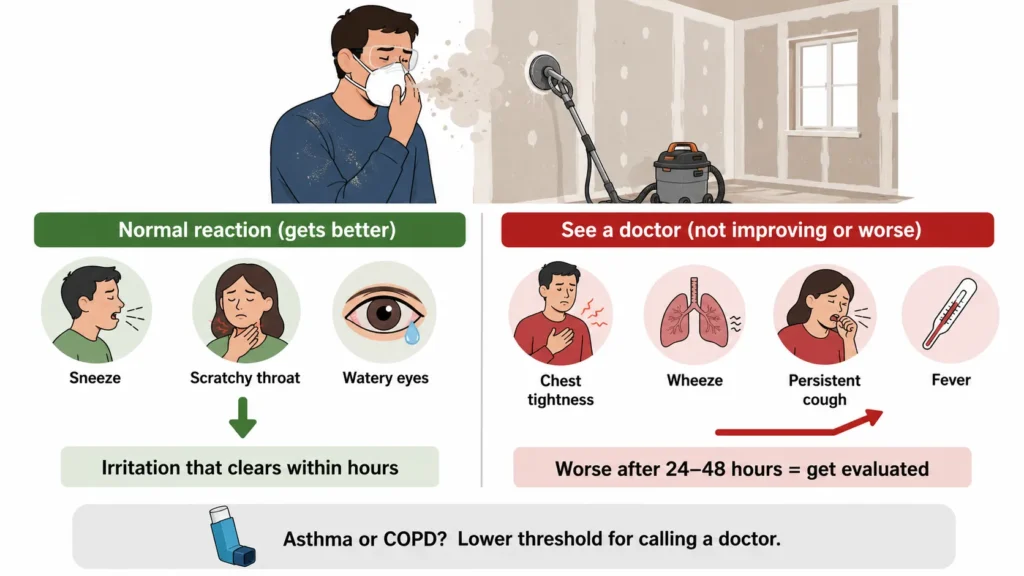
The important distinction is whether symptoms are tracking in the right direction. Mild irritation that gradually improves is your body doing its job. Symptoms that stay the same or get worse after you’re out of the dust are the signal to stop monitoring at home and get evaluated.
People with asthma, COPD, or other existing respiratory conditions should set a lower threshold for seeking care. Drywall dust can trigger flare-ups in sensitive airways, and what’s a minor nuisance for someone healthy can be a real problem for someone whose lungs are already compromised.
Why Closed Rooms Feel So Much Worse
If you’ve ever sanded in a basement or a bathroom drywall renovation with the door closed, you’ve experienced this firsthand. The dust doesn’t go anywhere. It recirculates every time air moves through the room, settles on surfaces briefly, and gets kicked back into the air with the slightest disturbance.
In a sealed room, fine particle concentration builds to levels that an outdoor environment or even a moderately ventilated interior space would never reach. Your body processes the same amount of dust in the first ten minutes that it might encounter over a full day of outdoor work. This is why ventilation isn’t just a comfort factor; it’s a direct determinant of how much you actually inhaled.
Opening windows and positioning a fan to push air outward (rather than just circulate it) can make a meaningful difference in real exposure levels.
Long-Term Risks From Repeated Exposure
For people who do occasional home renovation work, long-term risk is relatively low if they take reasonable precautions. The concern is for those who sand or demo drywall regularly without protection.
Chronic exposure to high dust concentrations can cause persistent bronchitis, reduced lung capacity, and in cases involving silica-containing materials, a condition called silicosis. Silicosis is an irreversible scarring of lung tissue that develops from repeated silica inhalation. It’s a well-documented occupational disease among miners, sandblasters, and some construction workers. It’s not something that develops from a single dusty weekend project, but it’s a realistic risk for anyone who works around silica-containing drywall materials repeatedly without a proper respirator.
The practical takeaway for DIYers: one renovation isn’t going to give you silicosis. But if you’re redoing multiple rooms, doing this kind of work several times a year, or regularly involved in drywall finishing professionally, respiratory protection isn’t optional.
What To Do After Breathing in Drywall Dust
If you’ve already been exposed, the steps are straightforward.
Get into fresh air immediately if you haven’t already. Breathing cleaner air allows your airways to start clearing. Drink water. Staying hydrated helps your mucous membranes flush particles more effectively.
Nasal rinsing with a saline solution can help clear particles from your nasal passages, particularly if you were in a heavily dusty environment. It’s a simple step that most people skip but often helps with upper airway irritation.
Avoid smoking or secondhand smoke in the hours following exposure. Your airways are already irritated, and additional chemical exposure will slow recovery.
Clean the space properly before spending more time in it. Dry sweeping stirs dust back into the air; damp mopping or using a vacuum with a HEPA filter is more effective at actually removing it.
Monitor your symptoms over the next 24 to 48 hours. Most irritation resolves on its own within that window.
When to Seek Medical Attention
Seek medical evaluation if:
- Breathing difficulty doesn’t improve after leaving the dusty area
- Chest tightness persists or worsens over several hours
- You develop wheezing you haven’t had before
- Symptoms are still present and unimproved after 48 hours
- You have asthma, COPD, or another respiratory condition and notice any change in your baseline
- You develop a fever within a day or two of heavy exposure
Most people reading this article had a single uncomfortable exposure and are wondering whether they need to worry. The honest answer is: probably not, if your symptoms are mild and improving. But if something feels off, or your exposure was prolonged and intense, getting checked costs very little and rules out anything worth catching early.


Elena Hart is the founder and lead writer of Better Home Pro. She writes about drywall, home repair, and practical DIY home improvement topics, focusing on clear, useful information that helps homeowners make better decisions. Her work combines firsthand experience, manufacturer documentation, industry resources, and careful research to create content that is accurate, practical, and easy to understand. Through Better Home Pro, Elena aims to simplify complex home improvement topics and provide guidance that is genuinely helpful to homeowners and DIYers.











No Comments