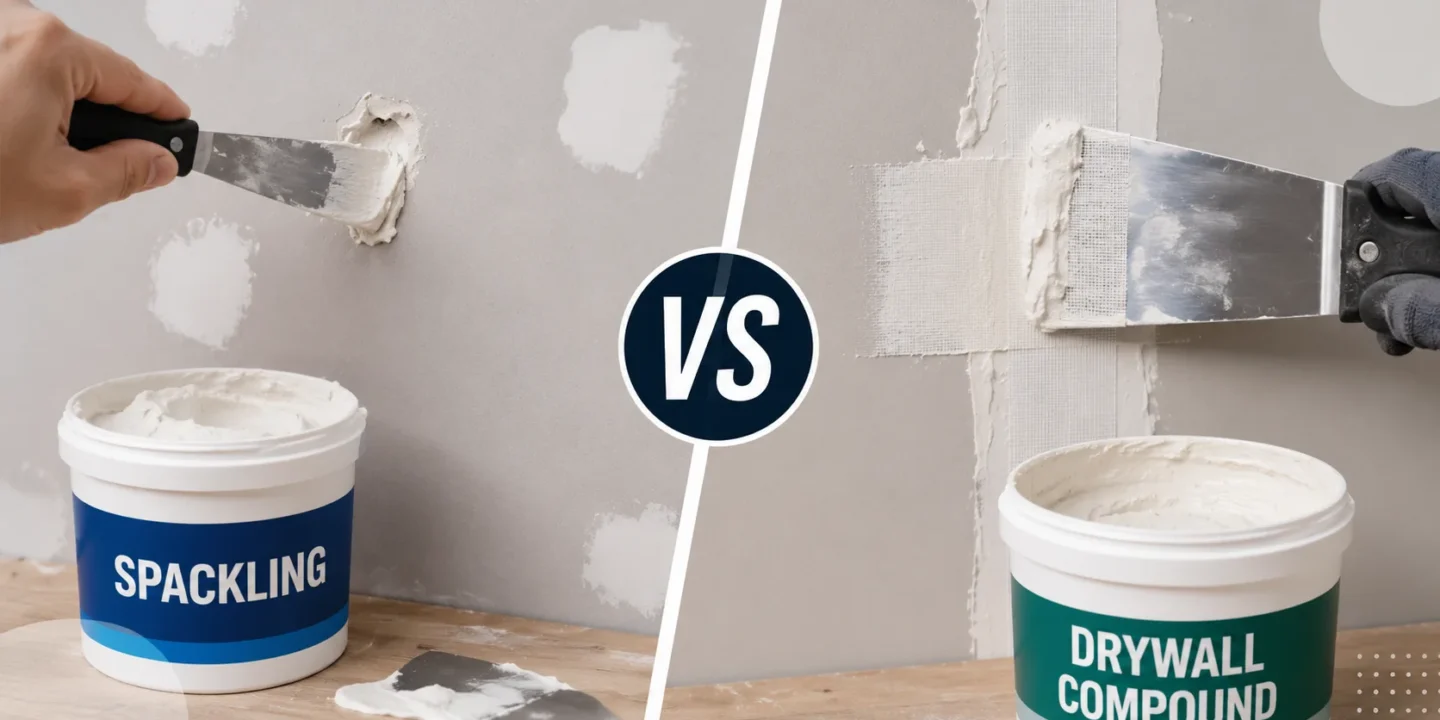



No, spackling and drywall compound are not the same product, even though they look similar on the shelf and both get used to fix walls. The core difference comes down to what each one is built to do. Spackling is formulated for small, localized repairs like nail holes and minor dents. Drywall compound is designed for taping seams, larger patches, and finishing work across bigger surfaces. They may feel similar out of the container, but they behave differently once you apply them, and using the wrong one for the job tends to cause problems.
Key Takeaways
- Spackling is formulated for nail holes and small dents, while drywall compound is built for taping seams and larger patches.
- Spackle dries within 30 minutes to two hours, making it the right choice for rapid, same-day cosmetic wall repairs.
- Joint compound takes up to 24 hours per coat to dry and shrinks as it cures, requiring multiple thin applications.
- Joint compound excels at feathering edges over large areas, whereas spackling cannot blend smoothly across wide surfaces.
- Using spackling to tape a wall seam will fail because it lacks the adhesion needed to embed drywall tape properly.
What Is Spackling?
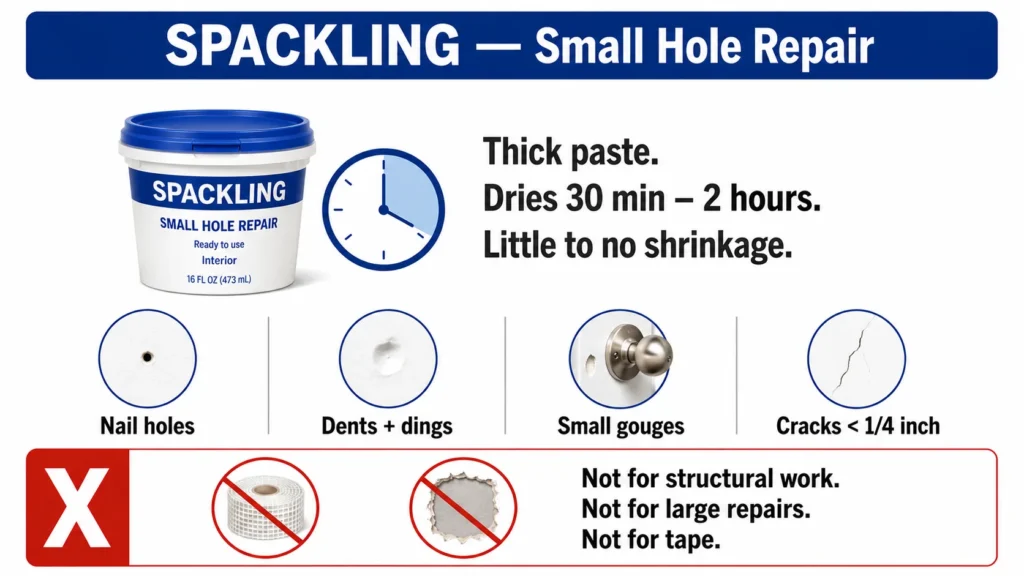
Spackling is a repair compound specifically made for small wall fixes. It has a thicker, paste-like consistency and is designed to fill holes quickly without a lot of fuss.
The biggest practical advantage is drying speed. Most standard spackle dries in 30 minutes to a couple of hours depending on temperature and hole size, which makes it ideal when you need to patch, sand, and paint in the same day. It also shrinks very little as it dries, so a single application usually fills a nail hole flush without needing a second coat.
Common uses include:
- Nail holes and small screw holes
- Minor wall dents or dings
- Small gouges from furniture or doorknobs
- Surface cracks less than a quarter-inch wide
Spackling is not designed for structural work or large repairs. It fills small voids well, but it does not bond to mesh tape or feather out smoothly over large areas the way joint compound does.
What Is Drywall Compound?
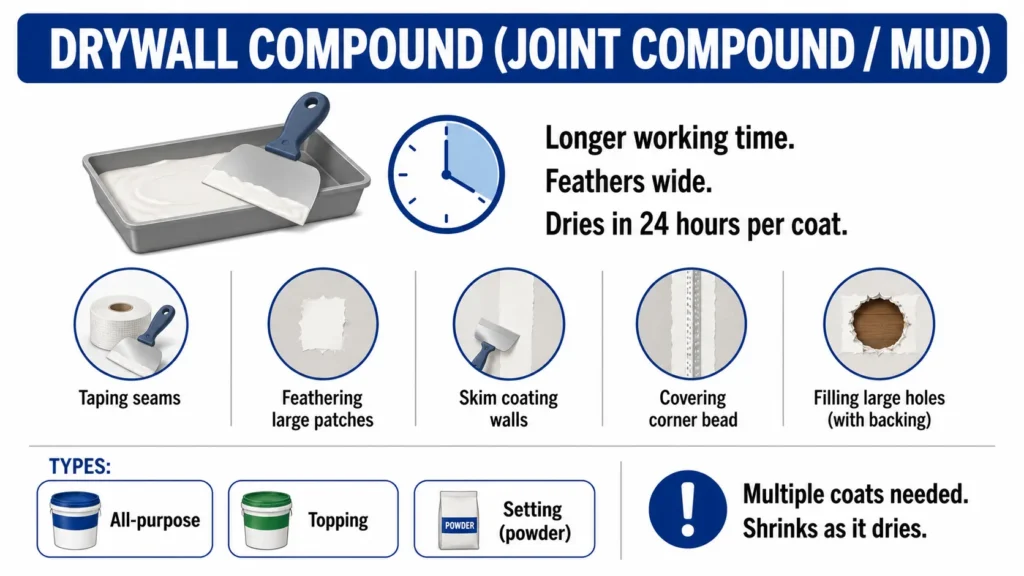
Drywall compound, often called joint compound or “mud,” is a broader-purpose finishing material used throughout the drywall finishing process for seams, patches, and skim coats.. It is the standard product used during drywall installation for embedding tape over seams, covering screw dimples, and applying finish coats before painting.
Unlike spackling, joint compound has a longer working time. It stays workable on the wall for a while, which makes it easier to feather out over a wide area and blend into surrounding surfaces. That extended open time is essential when you are skimming a large patch or taping a seam that runs several feet down a wall.
It does take significantly longer to dry, often 24 hours per coat, and it requires multiple coats for most applications because it shrinks as moisture evaporates.
Common uses include:
- Taping drywall seams
- Feathering large patches
- Skim coating walls
- Covering corner bead
- Filling large holes with backing support
Joint compound comes in several types: all-purpose, topping compound, and setting compound (which is powder-based and hardens through a chemical reaction rather than drying). Each has slightly different characteristics, but they are all fundamentally different from spackling.
The Real Difference Between Them
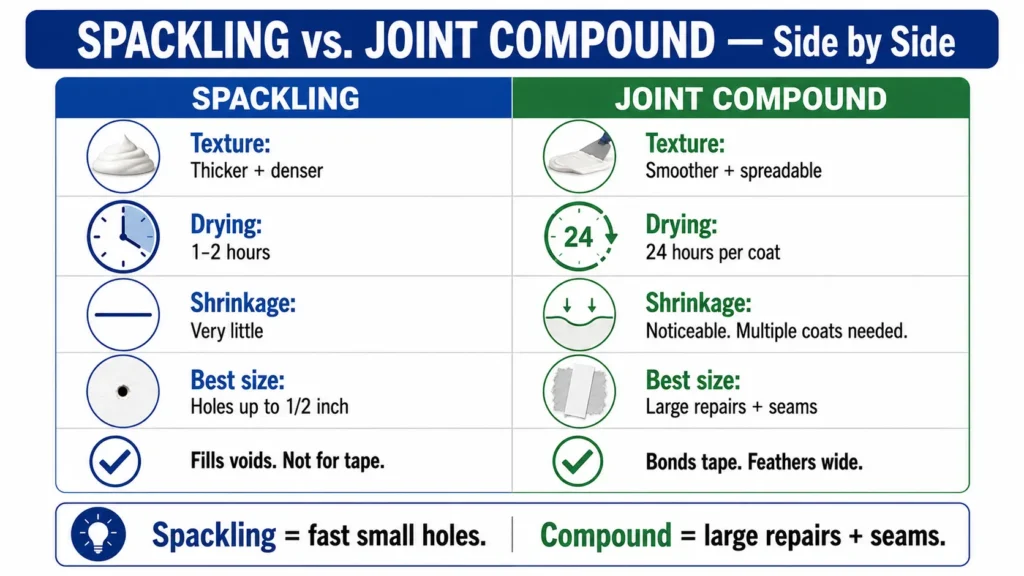
While both products are used to repair drywall, they behave very differently once you start applying, sanding, and painting them. The table below breaks down the practical differences that matter most during real-world repairs:
| Feature | Spackling | Joint Compound |
| Texture | Thicker and denser | Smoother and more spreadable for feathering |
| Drying Time | Fast drying — often ready within 1–2 hours for small repairs | Slow drying — usually needs about 24 hours per coat |
| Shrinkage | Very little shrinkage | Noticeable shrinkage as moisture evaporates |
| Sandability | Sands fine for small holes but can feel slightly harder | Sands smoother over large areas and blends better |
| Strength & Bond | Designed to fill small voids only | Bonds well to drywall tape and large repair areas |
| Best Repair Size | Best for holes up to about 1/2 inch | Better for larger patches, seams, and skim coating |
Can You Use Them Interchangeably?
Sometimes, but not always, and the substitution usually goes one direction more reliably than the other.
Using spackling for a nail hole instead of joint compound works fine. The repair will hold, dry fast, and look good after painting. That is probably the most common situation where someone grabs whichever product is already open and gets a good result.
Going the other direction is where things get tricky. Using joint compound for a small nail hole is not ideal. It shrinks as it dries, so you may end up with a small depression that needs a second coat. It also takes much longer to dry because standard drywall compound is designed for extended working time instead of rapid same-day repairs.
The situations where substitution genuinely fails:
- Using spackling to tape a seam: It will not work. Spackling does not have the consistency or adhesion to embed tape properly, and it will likely crack or peel over time.
- Using spackling for a large patch: IIt may crack, and feathering drywall edges smoothly becomes much harder once the repair spreads across a larger wall area.
- Using joint compound where fast drying matters: If you are working in a space that needs to be painted the same day, joint compound will not cooperate.
The general rule that holds up in practice: if the hole is small and you need it done quickly, spackling is the right call. If the repair involves tape, covers a larger area, or requires feathering into surrounding drywall, reach for joint compound.
Which One Should You Use for Common Repairs?
Here is how the choice shakes out for the repairs most homeowners actually deal with:
Nail holes and small screw holes: Spackling, without question. One application, let it dry, sand lightly, paint. Done in a couple of hours.
Small dents or dings: Spackling again. The thicker consistency fills these well and holds flush.
Large hole patch (using a backing patch or mesh kit): Joint compound. You will need multiple coats, and you want the ability to feather the edges over a wider area.
Drywall seam or tape repair: Joint compound only. Spackling cannot do this job.
Skim coating: Joint compound. This is its primary application and spackling is not designed for it at all.
Texture repair: Depends on the size. Small texture fixes around a patch can sometimes be done with spackle as a base. Larger texture work requires joint compound.
Why Some DIY Repairs Fail
Most failed wall repairs come down to a few consistent mistakes that are easy to avoid once you know what causes them.
Applying too much product at once. Both spackling and joint compound work best in thin layers. Loading up a deep repair with too much material at once usually creates shrinkage cracks and uneven drying across the patch. Better to apply two thin coats than one thick one.
Sanding before the product is fully dry. This is especially common with joint compound. If it still looks slightly darker or feels even slightly soft, it is not ready. Sanding wet compound drags and tears instead of smoothing.
Using lightweight spackling for anything larger than a nail hole. Lightweight spackling is fine for what it says on the label, but some people assume lighter means better and try to use it for larger repairs. It shrinks more and does not hold up as well in bigger voids.
Using joint compound where quick drying is needed. If you apply joint compound on a Friday afternoon and try to sand and paint Saturday morning, there is a real chance it is still wet in the center of the patch, especially in a basement or bathroom. The repair will look fine until you touch it with sandpaper and realize it is still soft underneath.
Quick Rule of Thumb
If you are standing in the hardware store trying to decide, this is the simplest way to think about it:
Small cosmetic fixes on finished walls: spackling. Nail holes, small dents, minor surface damage.
Seams, taping, large patches, and finishing new drywall: joint compound.
When in doubt about repair size, go with joint compound. It is more forgiving on larger surfaces and can handle more situations. The main trade-off is drying time, and for most repairs that is a reasonable one to accept.


Elena Hart is the founder and lead writer of Better Home Pro. She writes about drywall, home repair, and practical DIY home improvement topics, focusing on clear, useful information that helps homeowners make better decisions. Her work combines firsthand experience, manufacturer documentation, industry resources, and careful research to create content that is accurate, practical, and easy to understand. Through Better Home Pro, Elena aims to simplify complex home improvement topics and provide guidance that is genuinely helpful to homeowners and DIYers.






No Comments