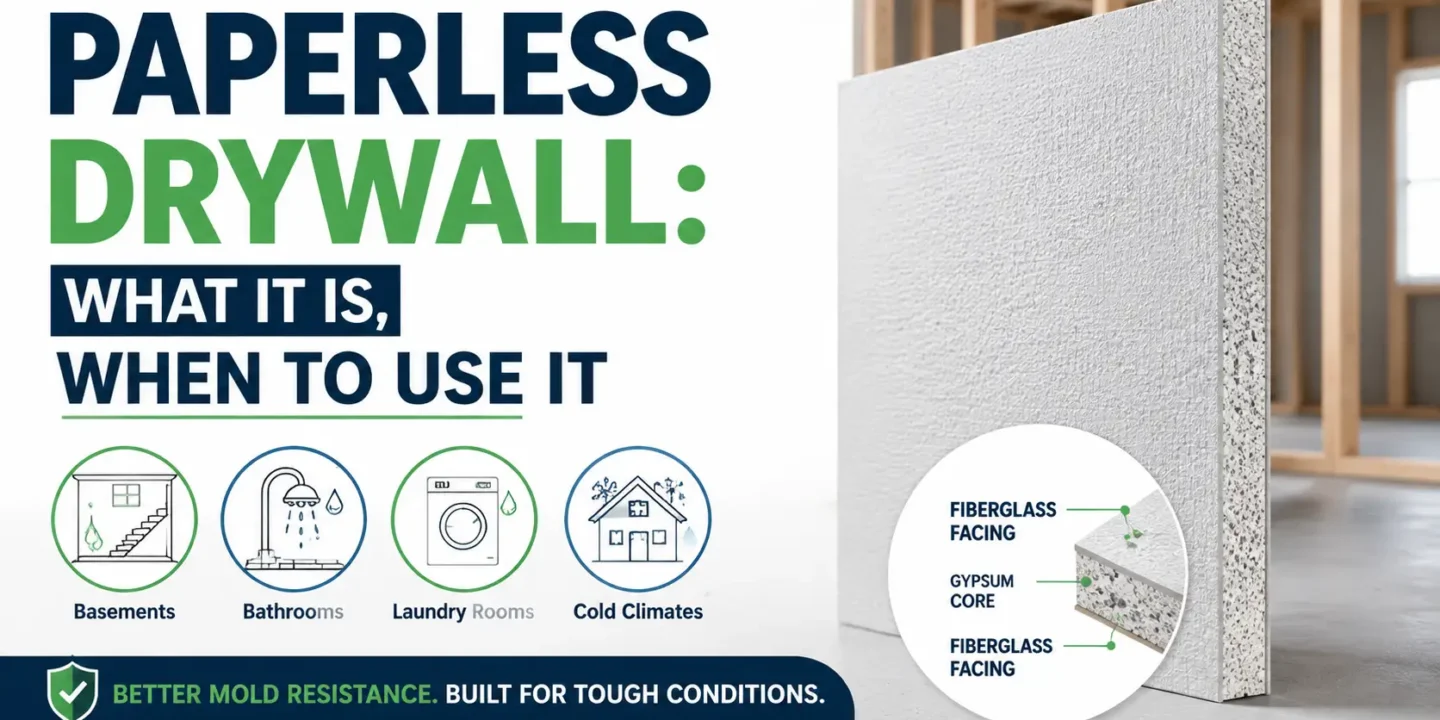



Mold needs four things to grow: oxygen, water, warmth, and an organic food source. Standard drywall’s paper facing is that food source, and it’s sitting inside your bathroom walls right now.
Paperless drywall solves this at the material level. By replacing paper facing with a fiberglass mat, it removes mold’s food source entirely. No paper, no organic material, no feast. It’s the logical evolution of moisture-resistant drywall, and it outperforms green board and purple board in every high-humidity application.
This article covers what paperless drywall actually is, where it belongs in your home, where it doesn’t make sense, and the one finishing quirk that catches DIYers off guard every time. If you’re choosing between types of drywall for a moisture-prone room, this is the complete picture.
Key Takeaways
- Unlike green or purple boards which both use organic paper facings — paperless drywall replaces paper with fiberglass mat. Since mold requires cellulose to grow, this inorganic facing provides the highest possible mold resistance, scoring a perfect 10/10 on the ASTM D3273 mold resistance test
- Fiberglass mats have a visible, porous texture that standard paint cannot hide. To achieve a professional, smooth finish, a full skim coat of joint compound must be applied across the entire board surface, not just the seams.
- Because basements are prone to persistent humidity and seasonal moisture swings, paperless drywall is the superior choice over paper-faced products. It provides cement-board-level mold protection while remaining finishable and paintable like standard walls.
- To maintain the mold-resistant integrity of the system, installers must use fiberglass mesh tape instead of paper tape. Using paper tape reintroduces the organic food source that paperless drywall was specifically designed to eliminate.
- While paperless drywall is highly moisture-resistant and carries a 12-month weather-exposure warranty for new construction, it is not waterproof. It is designed for high-humidity areas but should never be used in “wet zones” like shower surrounds, which still require cement board.
What Is Paperless Drywall?
To understand what makes paperless drywall different, you need to understand what standard drywall actually is — and where it fails.
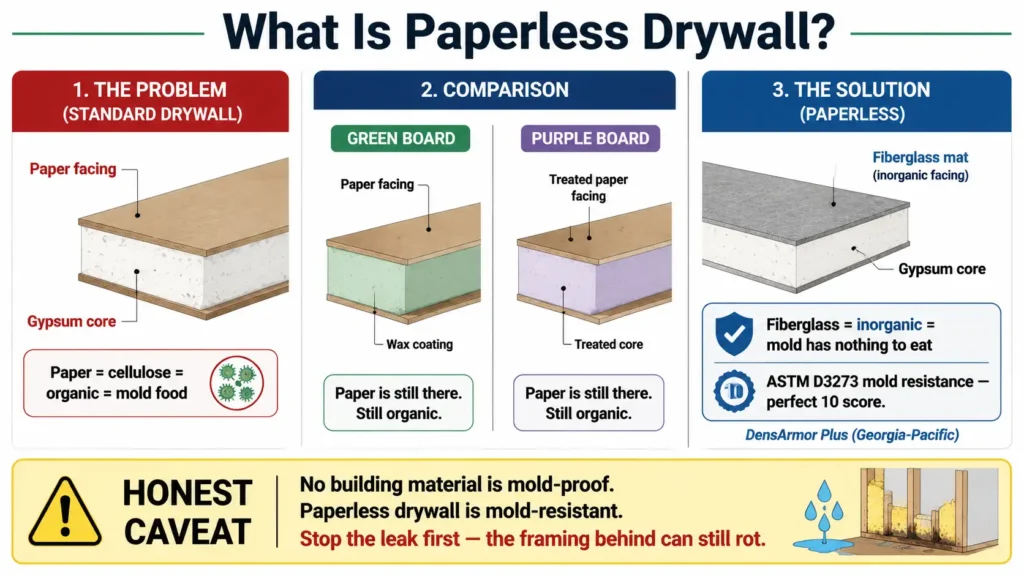
Standard drywall: A gypsum core wrapped in paper facing on both the front and back. Gypsum itself is relatively inorganic, but the paper is not. Paper is cellulose — organic material — and it’s exactly what mold needs to establish a colony. Introduce moisture, and the paper facing becomes a feeding ground.
Green board: The same paper-over-gypsum construction is found in green board, but with a wax treatment on the paper facing to repel surface moisture. The paper is still there. It’s still organic. The wax slows things down but doesn’t eliminate the underlying problem.
Purple board: Moisture and mold-resistant additives are worked into the gypsum core, and the paper facing gets a treatment as well. As noted in our breakdown of purple board vs. green board, this is a genuine improvement in protection — but the paper facing remains. Organic material is still present.
Paperless drywall: The paper is gone entirely. The facing — front and back — is replaced with a fiberglass mat. Fiberglass is inorganic. Mold has nothing to eat.
Most paperless drywall products also incorporate a moisture-resistant gypsum core, so you’re getting the inorganic facing and a hardened core. The result is a product that scores a perfect 10 on the ASTM D3273 mold resistance test — the highest rating the test can produce.
One honest caveat: no building material is mold-proof. Paperless drywall is mold-resistant. If you have a persistent leak or chronic standing water, the framing behind the drywall will still rot. Control moisture at the source first. Paperless drywall handles the residual humidity and vapor that moisture-control measures can’t fully eliminate.
Also known as: fiberglass-faced drywall, fiberglass mat gypsum board. The most widely known brand is DensArmor Plus by Georgia-Pacific.
Comparison Table: Paperless vs The Alternatives
| Feature | Standard | Green Board | Purple Board | Paperless |
| Facing material | Paper | Wax paper | Paper (treated core) | Fiberglass mat |
| Mold resistance | Poor | Limited | Good | Best |
| Moisture resistance | None | Moderate | Good | Good |
| ASTM D3273 score | Low | Low–Med | High | 10/10 (max) |
| Finish difficulty | Easy | Easy | Easy | Moderate (skim coat needed) |
| Cost per panel | $12–$20 | $14–$18 | $15–$60 | $20–$35 |
| Availability | Everywhere | Everywhere | Most stores | Specialty / pro supply |
| GREENGUARD certified | Some | Some | Yes | Yes (Gold) |
That availability row is the one most comparison guides leave out — and it’s the one that actually affects your project timeline.
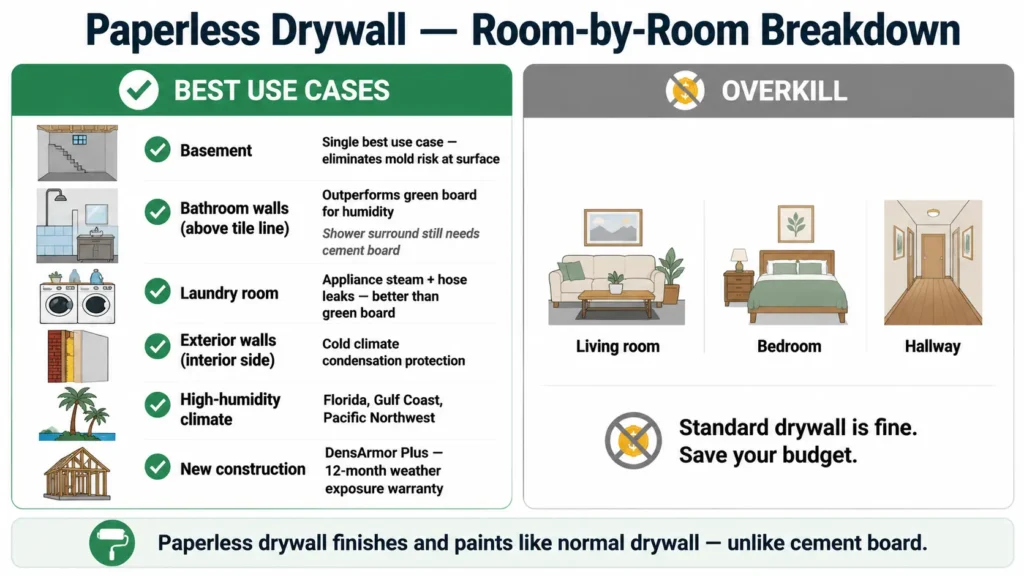
Where to Use It: Room-by-Room Breakdown
This is what most homeowners came to find out. Here’s where paperless drywall earns its premium — and where it’s simply overkill.
Basements
The single best use case for paperless drywall. Basements deal with persistent humidity, seasonal moisture swings from the surrounding soil, and often inadequate ventilation. Paper-faced drywall in a finished basement is a long-term mold risk. Fiberglass facing eliminates mold risk at the wall surface better than any drywall option except cement board — and unlike cement board, paperless drywall can be finished and painted like a normal wall.The EPA Mold Course Chapter 2 explains how moisture migrates through foundation walls and why basements consistently breed hidden mold behind wall surfaces
Bathroom Walls (Above the Tile Line)
Behind the toilet, above the shower tile line, and around the vanity—anywhere moisture vapor is present but direct water contact isn’t—is where paperless drywall definitively outperforms green board. While it handles humidity well, for the shower surround itself, the cement board vs. drywall debate ends: you still need cement board or an approved equivalent to handle direct, sustained water exposure.
Laundry Rooms
Appliance steam plus the occasional hose leak creates sustained moisture exposure. Paperless drywall substantially reduces long-term mold risk compared to green board in a room that most homeowners don’t give a second thought until there’s a problem.
Interior Side of Exterior Walls
An underrated application. In cold climates especially, the interior face of exterior walls can experience condensation when warm interior air meets the cold wall cavity. If insulation isn’t managing this perfectly — and it often isn’t — the drywall sees moisture. Paperless board here is a smart, low-cost upgrade during a renovation.The Energy.gov insulation guide explains condensation risk on exterior walls in detail.
High-Humidity Climate Homes
In Florida, along the Gulf Coast, in the Pacific Northwest — any region with chronically high ambient humidity — paperless drywall is worth considering even in living areas. Standard drywall in a coastal home deals with moisture levels it was never designed to handle over decades.
New Construction Before Weather-Tight Enclosure
DensArmor Plus carries a warranty for up to 12 months of weather exposure during construction — a significant advantage for builders in wet climates whose projects may sit open longer than planned.
Living Rooms, Bedrooms, Hallways in Dry Climates
Overkill. Standard drywall is the right product for dry interior areas. Save the premium for where moisture is actually a risk.
The Finishing Quirk Nobody Warns You About
This is the section that will save your project. Almost no article explains this upfront and every DIYer who installs paperless drywall without knowing it ends up with a wall that looks wrong and doesn’t know why.
The Texture Problem
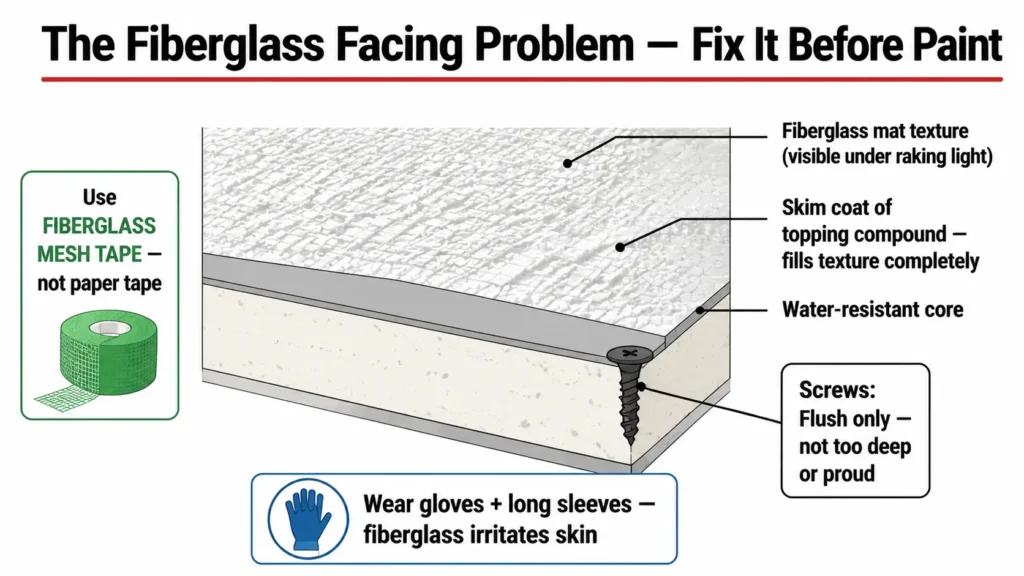
Paper-faced drywall has a smooth surface. Fiberglass mat does not. The fiberglass facing on paperless drywall has a fine but real texture — you can see and feel it. When you apply joint compound over it, that texture telegraphs through the dried mud, especially under raking or glancing light. Without addressing it, the finished wall looks rough, bumpy, and unprofessional — even with multiple coats of paint.
This isn’t a product defect. It’s just how fiberglass mat works. You need to account for it.
The Fix: Skim Coating
After taping and your first coat of mud at the seams, skim coat the entire board surface — not just the seams — with drywall topping compound. A thin, even layer dragged across the face fills the fiberglass texture and creates a smooth, paint-ready surface. It adds a step and some drying time. It is not technically difficult. It’s just a step most guides never mention.
Tape Choice Matters
Use fiberglass mesh tape at the seams. If you use paper tape — the kind that comes standard with most drywall finishing kits — you’re reintroducing an organic food source directly onto a board you chose specifically because it’s paperless. Use the mesh.
Longer Drying Time Between Coats
Paper facing absorbs moisture from joint compound, which actually helps it dry faster. Fiberglass doesn’t. Budget 20–30% more time between coats than you’re used to. Don’t rush it — compound that isn’t fully dry will cause cracking and adhesion failure.
Screw Dimpling Is Trickier
Fiberglass facing is harder and more resistant than paper. Screws may not dimple cleanly on the first drive. Use a screw gun with a proper clutch depth setting, and check each dimple by hand before mudding — a screw that’s proud of the surface will create a bump that shows through the finish. A screw set too deep can break the facing, reducing its integrity.
Skin Irritation
Fiberglass is an irritant — the same as fiberglass insulation batts. When cutting and handling paperless drywall, wear long sleeves, gloves, and a dust mask. Don’t rub your eyes during or after cutting. It’s not dangerous in the way silica dust is, but it’s uncomfortable enough to take seriously.
Cost and Availability
Cost
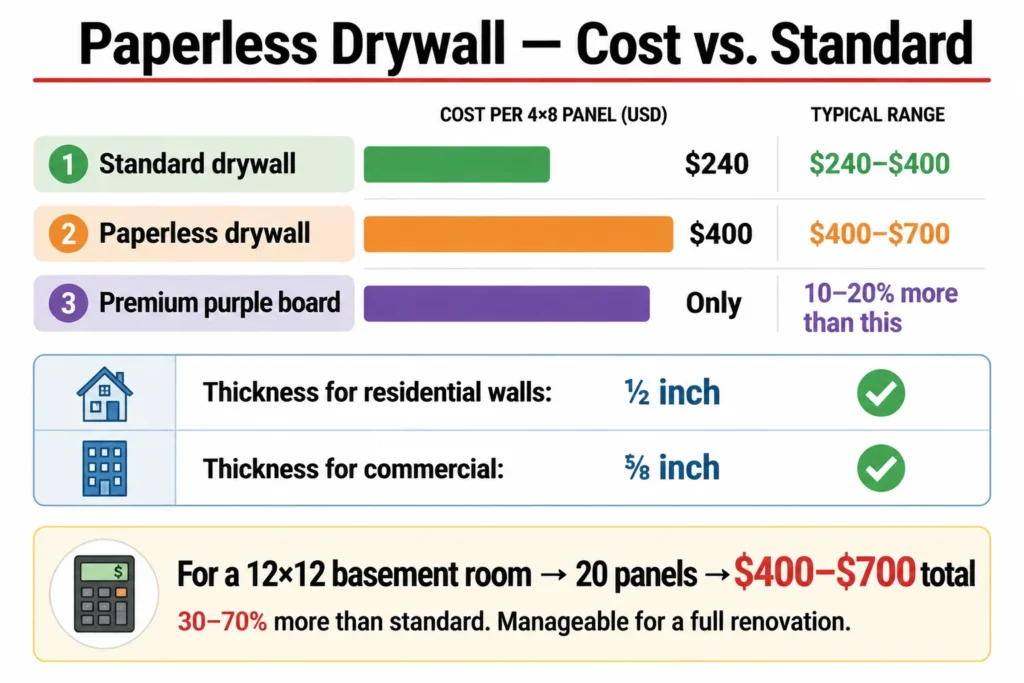
Paperless drywall runs $20–$35 per 4×8 panel depending on brand and thickness. That’s roughly 30–70% more than standard drywall, but only 10–20% more than premium purple board — the product most homeowners are comparing it against when they’re serious about moisture protection.
For a 12×12 basement room needing approximately 20 panels, expect $400–$700 in material versus $240–$400 for standard drywall. The premium is real. It’s also manageable in the context of a full room renovation.
Thickness: ½” is standard for residential wall applications. ⅝” is more common in commercial supply. Confirm what your local supplier stocks in ½” before you plan the project.
Availability — The Practical Problem
Paperless drywall is primarily a commercial construction product. Home Depot and Lowe’s may carry it in some markets, but it’s frequently not on the shelf. Don’t plan a project start date around picking it up the morning you need it.
Your best options:
- Home Depot / Lowe’s Pro Desk: Ask specifically about special ordering DensArmor Plus or equivalent. Lead time varies by location.
- Commercial building supply houses: Specialty drywall suppliers serve contractors regularly and typically stock paperless board. A Google search for “drywall supply [your city]” will find them.
- Online contractor suppliers: Some manufacturers and distributors offer contractor-level ordering with delivery.
Practical rule: Order 2–3 weeks before your project start date. Don’t assume availability. This single planning step will save you a significant headache.
Paperless vs Purple Board vs Cement Board: Which Level of Protection Do You Need?
Here’s the decision framework most homeowners are really looking for.
Green board / Purple board Best for moderate humidity — kitchens, half-baths, laundry rooms in dry climates. Easy to finish. Available everywhere. For the majority of damp-but-not-wet rooms in most homes, purple board is the right answer. Don’t overcomplicate it.
Paperless drywall Best for basements, bathroom walls above the tile line, high-humidity climate homes, and interior faces of exterior walls in cold climates. The best mold resistance available in a product that still finishes and paints like standard drywall. Requires skim coating. Harder to source. Worth the extra steps in the right applications.
Cement board Best for shower surrounds, tub walls, and floor tile underlayment — anywhere there is direct, sustained water contact. Cannot be painted or finished — must be tiled or covered. Not a drywall substitute for finished walls. Building code requires it (or an approved equivalent) for shower wet areas in most US jurisdictions.
Standard drywall Best for all dry interior areas — bedrooms, living rooms, hallways. Most cost-effective product for the right rooms. Never use in moisture-prone areas.
Paperless drywall sits in the sweet spot between purple board and cement board — better mold resistance than any paper-faced product, without the installation constraints of cement board. It’s the right upgrade when purple board isn’t quite enough and cement board is more than you need.
Indoor Air Quality and GREENGUARD Gold Certification
Here’s a benefit most competing articles completely ignore.
Most paperless drywall products — including DensArmor Plus — carry GREENGUARD Gold certification. GREENGUARD Gold is an independent standard that tests building materials for low VOC (volatile organic compound) emissions. VOCs off-gas from building materials into your indoor air for months or years after installation. Lower VOC content means healthier indoor air quality — especially relevant in enclosed spaces like basements and bedrooms where ventilation is limited.
Standard drywall and green board are not always GREENGUARD Gold certified. For families with asthma, allergies, or young children — and for anyone finishing a basement room where air circulation is limited — this certification is a genuine, meaningful advantage. The UL explanation of GREENGUARD certification tiers down exactly what Gold certification requires and why it matters for enclosed spaces.
FAQS
What is paperless drywall made of? Paperless drywall has a gypsum core — the same as standard drywall — but the paper facing is replaced with a fiberglass mat on both sides. In most products, the core also includes moisture-resistant additives. The fiberglass facing is fully inorganic, which is what eliminates mold’s food source at the wall surface.
Is paperless drywall waterproof? No. Paperless drywall is moisture-resistant and mold-resistant — not waterproof. It handles humidity, vapor, and occasional dampness significantly better than any paper-faced drywall. But it is not appropriate for direct water contact. In shower surrounds and tub walls, you still need cement board or an approved waterproof backer.
Is paperless drywall better than green board? Yes, in every meaningful category. Paperless drywall has higher mold resistance (fiberglass facing vs. wax-treated paper), a better ASTM D3273 score, and comparable or better moisture resistance. The only trade-offs are finish difficulty (skim coating required) and availability. For any serious moisture-prone application, paperless drywall is the better product.
Can paperless drywall be used in a shower? No — not in the wet zone. The shower surround (the walls that receive direct water from the showerhead) requires cement board or an approved equivalent like fiber cement board or foam backer board systems. Paperless drywall is appropriate for bathroom walls above the tile line or outside the direct wet zone, but not as a tile backer in the shower itself.
How do you finish paperless drywall? The process is similar to standard drywall but requires one additional step: after taping seams and applying your first coat of mud, skim coat the entire board surface — not just the seams — with drywall topping compound. This fills the fiberglass mat texture and creates a smooth, paint-ready surface. Use fiberglass mesh tape (not paper tape) at seams, and budget 20–30% more drying time between coats.
Where can I buy paperless drywall? Paperless drywall is primarily a commercial construction product and isn’t reliably stocked at big-box stores. Your best options are: asking at the Pro Desk at Home Depot or Lowe’s for a special order (allow 1–2 weeks), sourcing from a commercial drywall supply house in your area, or ordering through a contractor-level online supplier. Plan 2–3 weeks ahead — do not assume it will be on the shelf the day you need it.
The Bottom Line
Paperless drywall is the best mold-resistant drywall that still finishes and paints like a normal wall. Its fiberglass facing eliminates mold’s food source entirely — something no paper-faced product, including purple board, can claim. The ASTM D3273 perfect score isn’t marketing; it reflects a fundamentally different material.
Use it in basements, bathroom walls above the tile line, laundry rooms, high-humidity climates, and the interior faces of exterior walls in cold climates. Skip it in dry rooms where standard drywall is perfectly adequate.
The one trade-off is real: skim coating the entire surface is required for a smooth finish. It’s not difficult — it’s just an extra step you need to plan for. Know it going in and your results will be excellent. Ignore it and you’ll spend a weekend wondering why the wall looks wrong.


Elena Hart is the founder and lead writer of Better Home Pro. She writes about drywall, home repair, and practical DIY home improvement topics, focusing on clear, useful information that helps homeowners make better decisions. Her work combines firsthand experience, manufacturer documentation, industry resources, and careful research to create content that is accurate, practical, and easy to understand. Through Better Home Pro, Elena aims to simplify complex home improvement topics and provide guidance that is genuinely helpful to homeowners and DIYers.



No Comments