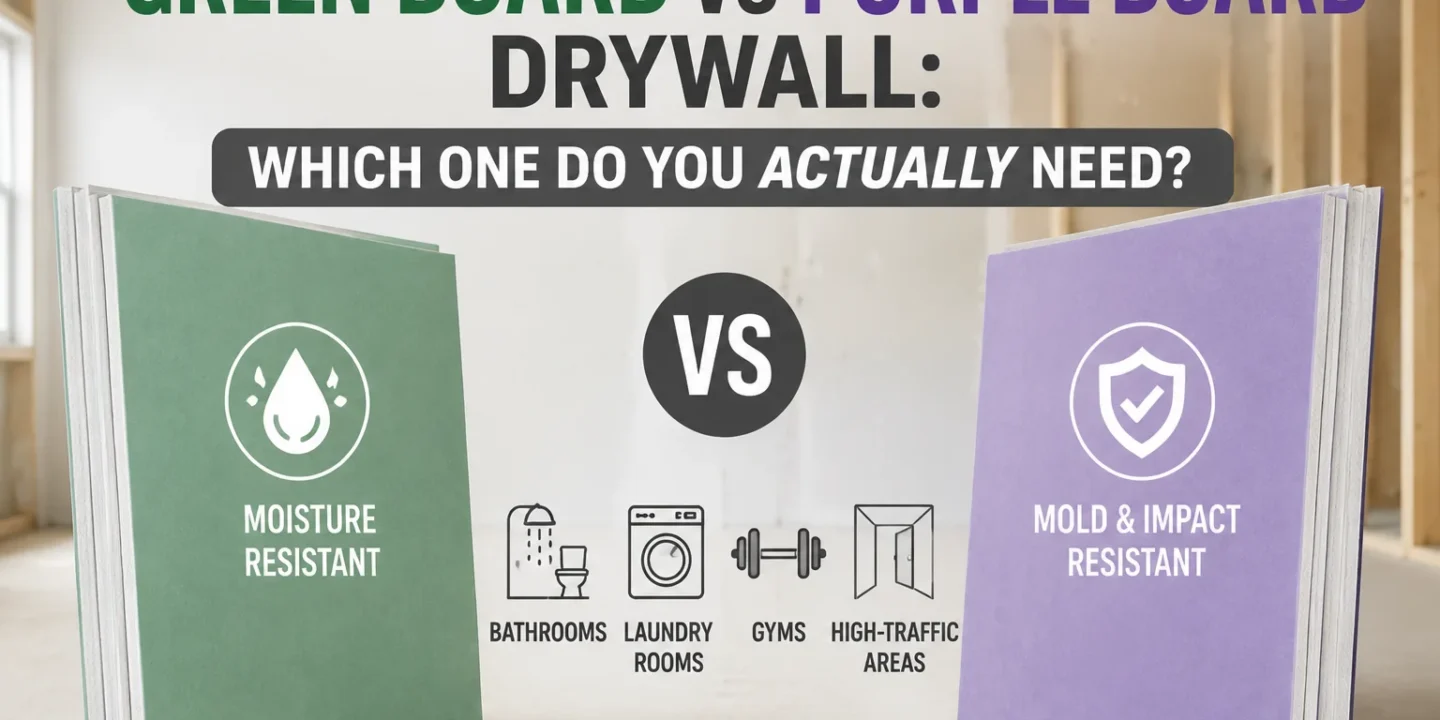



Green board resists moisture. Purple board resists moisture and mold. That one difference changes everything depending on your room.
Pick the wrong one and you could be looking at a mold remediation bill that runs anywhere from $500 to $6,000 — for a mistake that costs $35 to $60 to avoid upfront. This guide gives you a room-by-room verdict, a real cost comparison, and the exact situations where green board is genuinely the smarter call.
Here’s the honest version: purple board isn’t always worth the extra money. We’ll tell you when it is and when it isn’t.
Want context on all your drywall options first? See our complete guide to types of drywall.
At a Glance: Green Board vs Purple Board
| Feature | Green Board | Purple Board |
| Moisture resistance | Yes | Yes (stronger) |
| Mold & mildew resistance | No | Yes |
| Impact / scuff resistance | No | Yes (some product lines) |
| Fire resistance | Basic | Yes (some products) |
| GREENGUARD certified | No | Gold certified |
| Cost per panel | $12–$20 | $15–$60 |
| Best for | Moderate humidity rooms | High humidity + mold risk areas |
| Can touch water directly | No | No (use cement board for that) |
That last row matters. Neither product is waterproof. For shower surrounds or any area with sustained water contact, you need cement board — full stop. The TCNA Handbook for Tile Installation specifies exactly which substrates are acceptable for wet-area tile applications.
What Is Green Board Drywall?
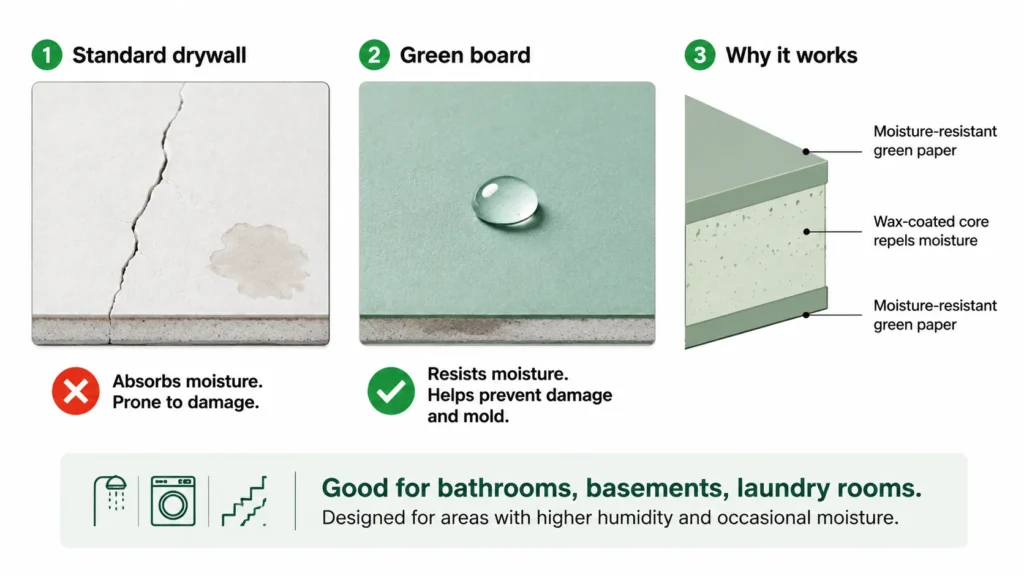
Green board is the original moisture-resistant drywall option — it was the only choice before purple board existed. The core is standard gypsum, but the paper facing is treated with wax, which is what gives it moisture resistance (and its distinctive green color).
What green board handles well: ambient humidity, steam from showers, occasional splashes near sinks.
What green board cannot do: resist mold growth once moisture breaches the facing. The paper itself is an organic material, which means it can harbor mold if it stays wet long enough. It’s also not rated for ceiling applications — the weight of the gypsum under prolonged humidity can cause sagging.
Cost: $12–$20 per 4×8 panel.
The wax coating on the facing is a barrier, not a seal. Once moisture reaches the gypsum core, there’s nothing stopping mold from taking hold — especially in rooms with poor ventilation. The EPA’s Mold Course (Chapter 2) explains exactly how mold colonizes organic building materials like paper-faced drywall — the science behind why green board’s facing is its weak point
What Is Purple Board Drywall?
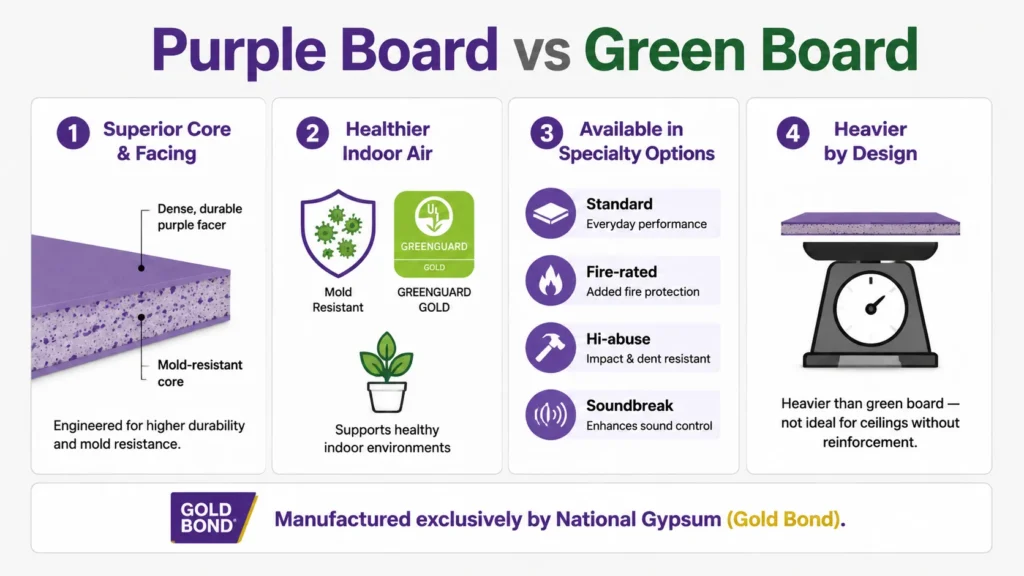
Purple board is made exclusively by National Gypsum under the PURPLE™ brand (Gold Bond Building Products). Unlike green board, the gypsum core itself contains mold-inhibiting additives — purple board is engineered to resist mold even if moisture penetrates the facing.
Where green board uses a wax-treated paper facing to keep moisture out, purple board assumes some moisture will eventually get through and engineers the core to resist mold even when that happens. The facing is also moisture-treated (denser than green board’s), but the real protection runs through the entire panel.
Purple board is GREENGUARD Gold Certified, meaning it’s been tested for indoor air quality — a meaningful advantage over green board in living spaces.
Product lines available:
- Standard purple board (moisture + mold resistance)
- Fire-rated (adds fire resistance for specific code requirements)
- Hi-abuse (adds impact and scuff resistance for high-traffic areas)
- Soundbreak (acoustic performance — see our soundproof drywall guide)
Cost: $15–$25/panel for standard; $40–$60/panel for specialty lines.
One practical note: purple board is heavier than green board. For ceiling applications, you may need a helper or reinforced framing. Check product specs before ordering.
The Real Differences (Beyond the Surface Answer)
Most articles stop at “purple board has mold resistance.” Here’s why that actually matters in real-world terms.
Green Board: The Paper Problem
Green board’s paper facing is organic material. When moisture breaches the wax coating — which happens gradually in poorly ventilated bathrooms, basements, or anywhere with humidity swings — and that moisture lingers for 24 to 48 hours, mold can begin colonizing the paper surface. You won’t see it immediately. By the time it’s visible, it’s already behind your tile or paint.
This is the failure mode that catches homeowners off guard. Green board works under normal conditions. The problem is that “normal conditions” in a bathroom or basement aren’t what green board was designed for.
Purple Board: Defense in Depth
Purple board’s treated gypsum core uses inorganic mold inhibitors embedded throughout the panel. Even if moisture penetrates the facing, the core actively resists mold colonization. In climates with significant humidity swings — the Gulf Coast, Pacific Northwest, basement-heavy Midwest — this isn’t a minor feature. It’s the difference between a 10-year wall and a 3-year remediation.
Additional Differences Worth Knowing
Durability: Purple board’s hi-abuse product line resists dents, scuffs, and scratches in a way green board doesn’t. For high-traffic areas like hallways, mudrooms, or kids’ rooms, this is the real selling point — not moisture resistance.
Ceiling use: Green board is NOT recommended for ceilings. Purple board is ceiling-safe (verify with the specific product spec sheet). This alone makes purple board the default choice in many applications.
Waterproofing — neither qualifies: If you’re anywhere near a shower surround, directly behind tile in a wet area, or in contact with standing water risk, you need cement board. See our cement board vs drywall guide for where that line is.
Room-by-Room Verdict
This is the section most drywall articles don’t get right. Not every room needs purple board. Here’s an honest breakdown.
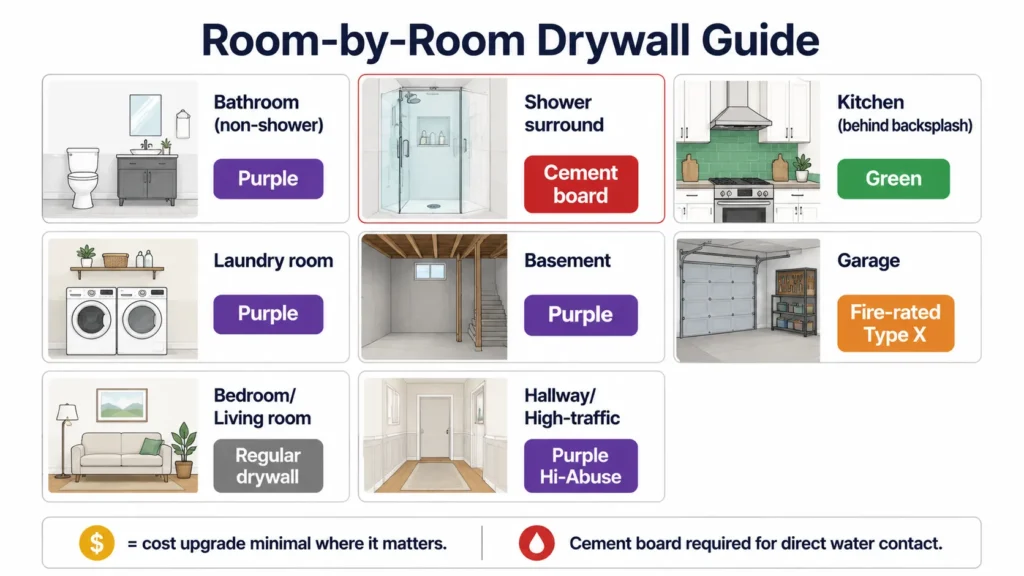
Bathroom walls (non-shower) → Purple board. Constant humidity and typically poor ventilation make mold risk real. The upgrade costs $2–5 more per panel. ASHRAE Standard 62.2 sets minimum exhaust ventilation requirements for bathrooms — if your fan doesn’t meet them, purple board’s mold resistance becomes even more critical
Shower surround / behind tile → Neither. Use cement board. Both green and purple board will eventually fail with prolonged direct water contact. Don’t compromise here.
Kitchen (behind backsplash) → Green board is fine for most kitchens. Occasional splashes, not constant humidity. The exception: a poorly ventilated kitchen with a lot of steam cooking — in that case, upgrade to purple.
Laundry room → Purple board. Appliance leaks happen. Washing machines and dryers create a moisture environment that green board isn’t well-suited for, and the cost difference is minimal for a small room.
Basement → Purple board, always. Basements are the single highest mold-risk environment in most homes. Humidity migrates through foundation walls, ventilation is poor, and moisture events (flooding, condensation) are common. Green board is not adequate here.
Garage → Neither moisture-resistant option needed, typically. Use fire-rated Type X drywall. IRC Section R302 specifies the fire-separation requirements for attached garages.
Bedroom / living room → Regular drywall. There’s no moisture concern. Don’t spend money you don’t need to.
Hallways / high-traffic areas → Purple hi-abuse board if budget allows. The selling point here isn’t moisture resistance — it’s the impact resistance of the hi-abuse product line. Worth it in homes with kids, pets, or heavy foot traffic.
Cost Comparison: Is Purple Board Worth the Extra Money?
Let’s use real numbers, not just per-panel costs.
Standard 12×12 bathroom (approximately 12 panels):
- Green board at $12–$20/panel = $145–$240
- Purple board (standard) at $15–$25/panel = $180–$300
- Difference: $35–$60
Now consider that a single mold remediation job costs $500–$6,000. The upgrade to purple board in a standard bathroom is cheap insurance by any measure.
Where costs jump significantly: Specialty purple board lines — fire-rated, hi-abuse, soundbreak — run $40–$60/panel. That’s a different product for a different use case, not an apples-to-apples comparison with standard green board.
Full home perspective: If you’re doing a full remodel and upgrading to standard purple board in all recommended areas (bathrooms, basement, laundry), the total upcharge for most homes comes in under $1,000. For the mold protection you’re buying, most homeowners find that reasonable.
When green board wins on value: A half-bath (toilet and sink only, no shower, good ventilation) in a dry climate is a genuinely legitimate use case for green board. The savings are real, the risk is low. This is where green board earns its place.
Installation Differences
Both products are installed with standard drywall tools — no special equipment, no different technique. Here’s what you’ll actually notice:
- Purple board is heavier. Get a helper for ceiling applications. Don’t attempt ceiling installs solo.
- Green board is NOT for ceilings. Purple board is ceiling-safe — check your specific product spec to confirm.
- Both tape, mud, and finish identically to regular drywall.
- Purple board’s GREENGUARD Gold certification holds with standard joint compound and tape — no special finishing products required.
- One important detail on tape: In high-humidity areas, skip paper tape and use fiberglass mesh tape instead. Paper tape is itself organic and can be a mold vector in joints. The extra $5–$10 for a roll of mesh tape is worth it.
FAQ
What is the difference between green board and purple board drywall? Both are moisture-resistant, but green board only protects the surface via a wax-treated paper facing. Purple board contains mold-inhibiting additives in the gypsum core itself, meaning it resists mold growth even if moisture penetrates the facing. Purple board also comes in fire-rated, impact-resistant, and acoustic product lines.
Is purple board drywall waterproof? No. Purple board resists moisture and mold, but it is not waterproof. For shower surrounds, direct tile wet areas, or anywhere with sustained water contact, use cement board. Neither green nor purple board is appropriate for those applications.
Can you use green board in a shower? No. Green board is not rated for direct water contact and will eventually fail in a shower surround. Cement board is the correct product for shower walls and any area where tiles will be in direct contact with water.
Is purple board worth the extra cost? In bathrooms, basements, and laundry rooms — yes, without question. The $35–$60 premium for a standard bathroom is minor compared to a mold remediation job starting at $500. In low-risk areas like bedrooms or well-ventilated kitchens, the upgrade isn’t necessary.
Where should you NOT use green board? Basements, laundry rooms, shower surrounds, and ceilings. Green board is also not a good choice in climates with significant humidity fluctuation, or in any space with poor ventilation and regular moisture exposure.
Who makes purple board drywall? Purple board is made exclusively by National Gypsum under the brand name PURPLE™ (Gold Bond Building Products). It’s not a generic category — if you see “purple board” on a spec, it refers specifically to National Gypsum’s product line.
The Verdict
Choose purple board for: bathrooms, basements, laundry rooms, and any humid climate application. The mold resistance built into the core justifies the cost in every one of these environments.
Green board is a smart choice for: kitchens with good ventilation, half-baths with no shower, and moderate-humidity rooms where you’re watching the budget. In the right scenario, it’s the genuinely correct call — not a compromise.
Neither replaces cement board in shower surrounds or direct wet areas. Don’t try to substitute. For a full breakdown of every drywall type and where each one belongs, see our complete drywall guide →. If you’re working in a wet area, also check our cement board vs drywall guide and our full moisture-resistant drywall guide →.


Elena Hart is the founder and lead writer of Better Home Pro. She writes about drywall, home repair, and practical DIY home improvement topics, focusing on clear, useful information that helps homeowners make better decisions. Her work combines firsthand experience, manufacturer documentation, industry resources, and careful research to create content that is accurate, practical, and easy to understand. Through Better Home Pro, Elena aims to simplify complex home improvement topics and provide guidance that is genuinely helpful to homeowners and DIYers.







No Comments