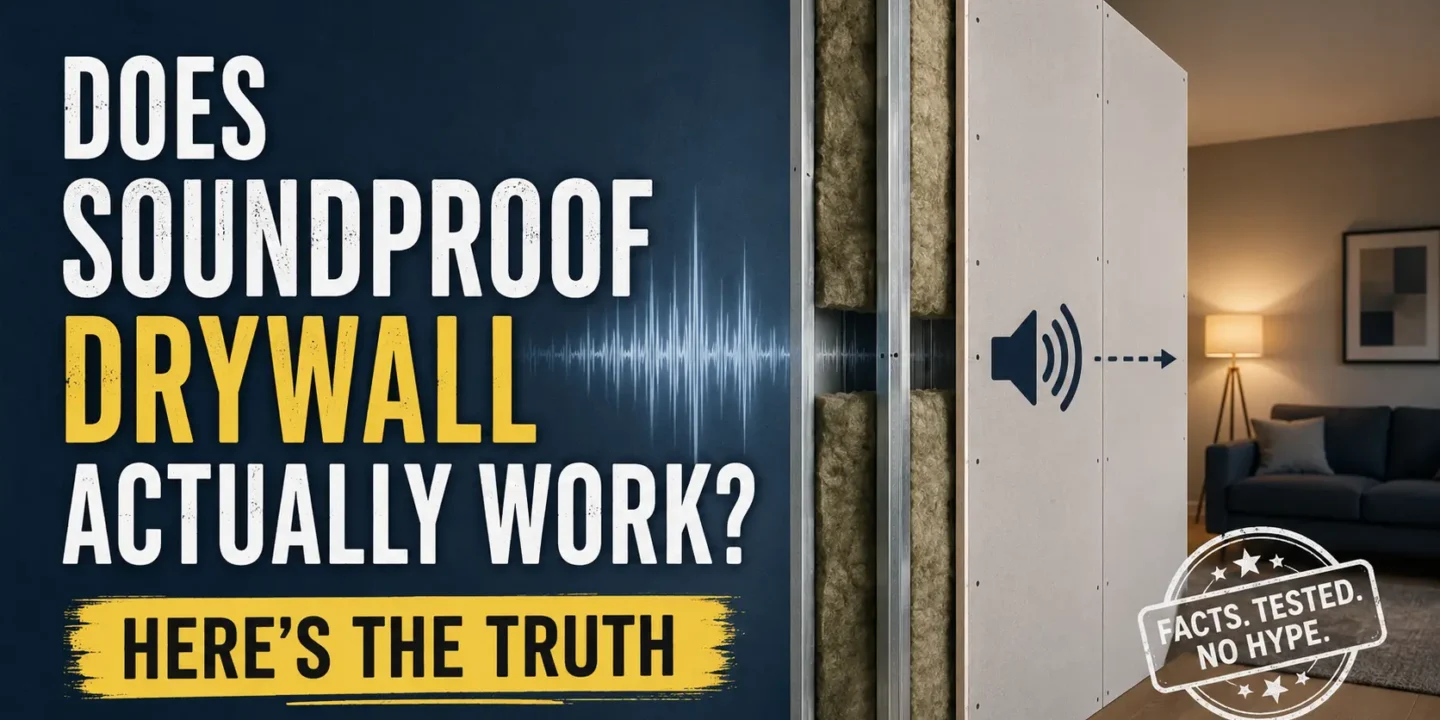



Short answer — yes, soundproof drywall works. But most people buy it expecting silence and get disappointment instead.
That gap between expectation and reality is what this guide is here to close. We’ll cover how soundproof drywall actually works, what STC ratings mean in plain English, a full cost breakdown, and — most importantly — the situations where it’s worth every cent and the ones where you’d be throwing money away.
We’re not here to sell you a product. We’re here to help you make the right call for your specific situation.
Key Takeaways:
- Soundproof drywall works by sandwiching a viscoelastic polymer layer between gypsum sheets; this layer acts as a shock absorber, converting sound energy into trace amounts of heat rather than allowing it to vibrate through the wall.
- This product is highly effective at blocking airborne noise (voices, TV, music) but will not stop impact noise (footsteps or vibrations from above), which requires physical decoupling from the building’s structure to solve.
- A Sound Transmission Class (STC) rating of 50 is the ideal target for most home offices and bedrooms, roughly halving the perceived loudness of a standard wall and making loud speech virtually inaudible.
- It is most cost-effective for home theaters, music rooms, and shared apartment walls, but for larger projects on a budget, using “Green Glue” between two layers of standard drywall offers similar performance at a fraction of the price.
- Due to its high density, soundproof drywall is significantly heavier to install and can slightly weaken Wi-Fi or cell signals, which should be accounted for during the planning phase of a smart home or office.
What Is Soundproof Drywall and How Does It Work?
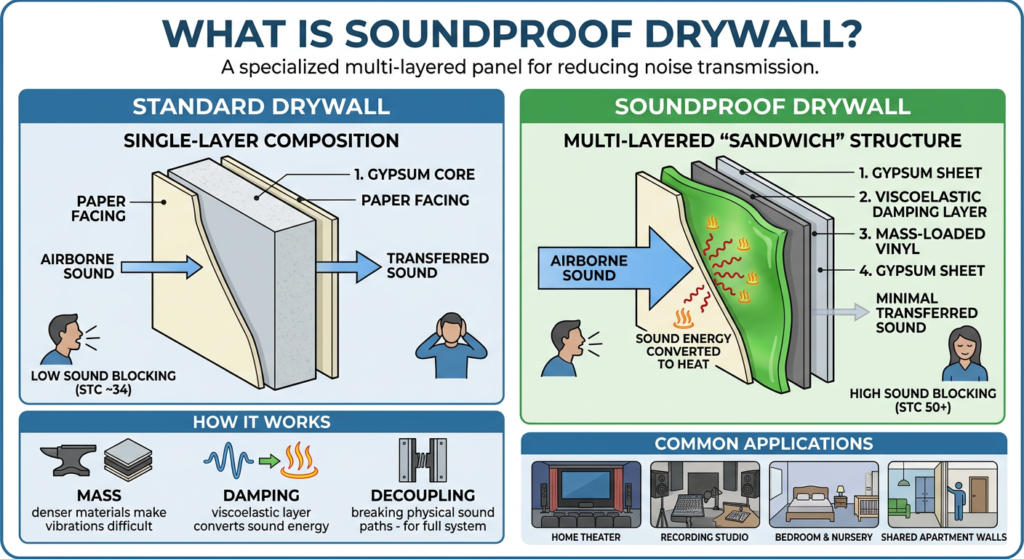
Regular drywall is simple: rigid gypsum sandwiched between two layers of paper. Sound waves hit it, the panel vibrates, and that vibration travels straight through to the other side. It does the job of dividing rooms, but it offers minimal noise resistance on its own.
Soundproof drywall — also called acoustic drywall — adds one critical ingredient: a viscoelastic polymer layer bonded between multiple gypsum sheets. When sound waves hit the panel, instead of vibrating freely, that polymer layer converts sound energy into a tiny amount of heat through molecular friction. The result is dramatically less noise transmission.
Three principles drive the performance:
- Mass — denser panels are harder for sound energy to move through
- Damping — the polymer layer absorbs and dissipates vibration
- Decoupling — separate material layers interrupt the sound path
Once installed, soundproof drywall looks completely identical to regular drywall. There’s no aesthetic trade-off — you tape, mud, and paint it exactly the same way.
The most widely known brand is QuietRock, which comes in several versions rated for different performance levels. It’s not the only option on the market, but it’s the benchmark most comparisons use.
Think of it like a car with extra cabin insulation. The car still moves, but road noise doesn’t pass through the cabin the same way. The engine is doing the same work — the difference is in what the materials absorb before it reaches you.
STC Ratings Explained in Plain English
STC stands for Sound Transmission Class. It’s the standard rating system used to measure how well a wall or panel blocks airborne sound. The higher the STC number, the better the sound blocking. The ratings are defined and maintained by ASTM International Standard E413 — the authoritative testing specification used by every drywall manufacturer.
Here’s the key thing to understand: every 10 STC points roughly halves the perceived loudness. Going from STC 30 to STC 40 isn’t a small improvement — it’s a dramatic one.
| STC Rating | What You Hear | Typical Setup |
| 25–30 | Normal speech clearly audible | Single layer standard drywall |
| 33–35 | Loud speech audible | Standard ½” drywall on wood studs |
| 42–45 | Loud speech faint | Double drywall + insulation |
| 50–55 | Loud music faint | Soundproof drywall (QuietRock 510) |
| 60–65 | Most sounds blocked | Soundproof drywall + decoupling + insulation |
| 80+ | Near silence | Professional studio build |
Key takeaway: For a typical bedroom or home office, STC 50 is your sweet spot. Anything above that requires a full wall system — decoupling, insulation, and soundproof drywall working together — not just swapping out the panels.
The One Thing Soundproof Drywall Cannot Fix
| Read This Before You Buy This is the section most articles skip — and it’s the reason so many people feel ripped off after buying soundproof drywall. Understanding the difference between airborne and impact noise will save you hundreds or thousands of dollars. |
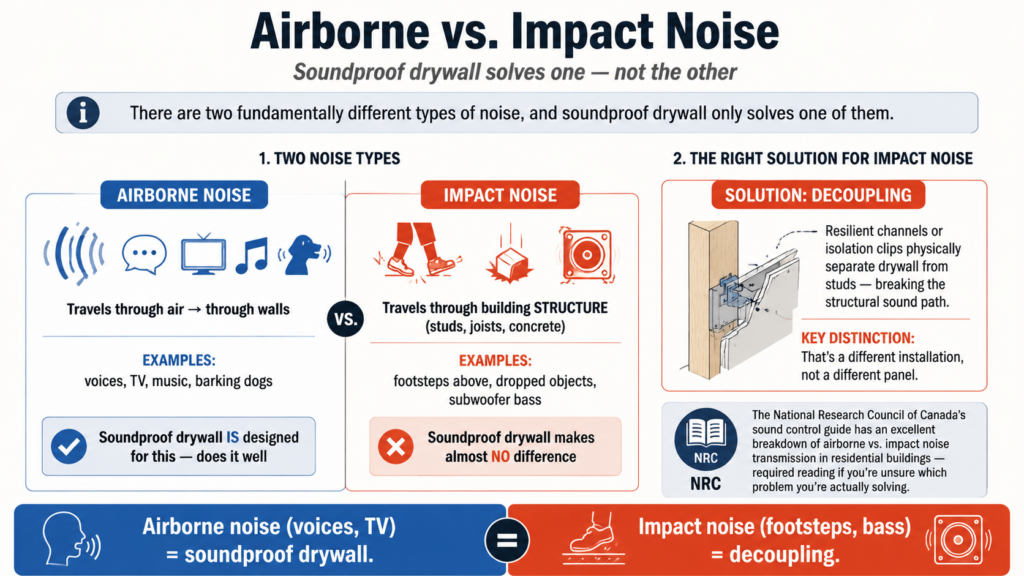
There are two fundamentally different types of noise, and soundproof drywall only solves one of them.
Airborne noise — voices, TV, music, barking dogs — travels through the air and then through your walls. This is exactly what soundproof drywall is designed to stop. It does this well.
Impact noise — footsteps above you, dropped objects, bass from a subwoofer — travels through the building’s structure itself. The sound energy moves through the studs, joists, and concrete before it ever reaches your drywall.
Soundproof drywall makes almost no difference for impact noise. The National Research Council of Canada’s sound control guide has an excellent breakdown of airborne vs. impact noise transmission in residential buildings — required reading if you’re unsure which problem you’re actually solving.
The right solution for impact noise: decoupling. Resilient channels or isolation clips physically separate the drywall from the studs, breaking the structural sound path. That’s a different installation, not a different panel.
Soundproof Drywall Cost Breakdown — Is It Worth It?
High commercial intent deserves real numbers. Here’s what you’ll actually spend:
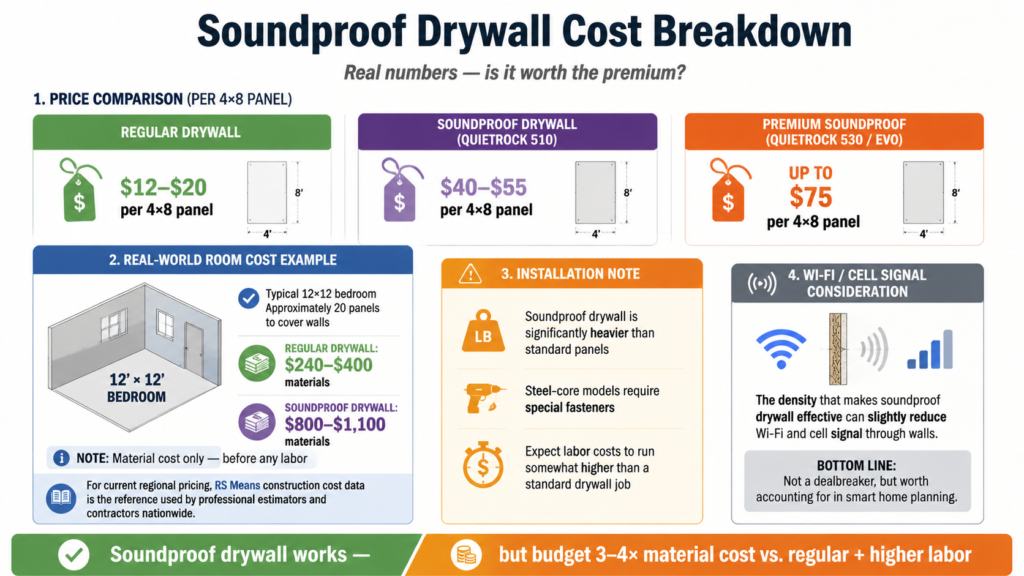
- Regular drywall: $12–$20 per 4×8 panel
- Soundproof drywall (QuietRock 510): $40–$55 per panel
- Premium soundproof drywall (QuietRock 530, EVO): up to $75 per panel
Real-world room cost: A typical 12×12 bedroom requires approximately 20 panels to cover the walls. At standard drywall prices, that’s $240–$400 in materials. With soundproof drywall, you’re looking at $800–$1,100 — material cost only, before any labor. For current regional pricing, RS Means construction cost data Industry cost database is the reference used by professional estimators and contractors nationwide.
Installation note: soundproof drywall is significantly heavier than standard panels, and steel-core models require special fasteners. Expect labor costs to run somewhat higher than a standard drywall job.
One minor consideration: the density that makes soundproof drywall effective can slightly reduce Wi-Fi and cell signal through walls. Not a dealbreaker, but worth accounting for in smart home planning.
The Honest Verdict: When It’s Worth It and When It Isn’t
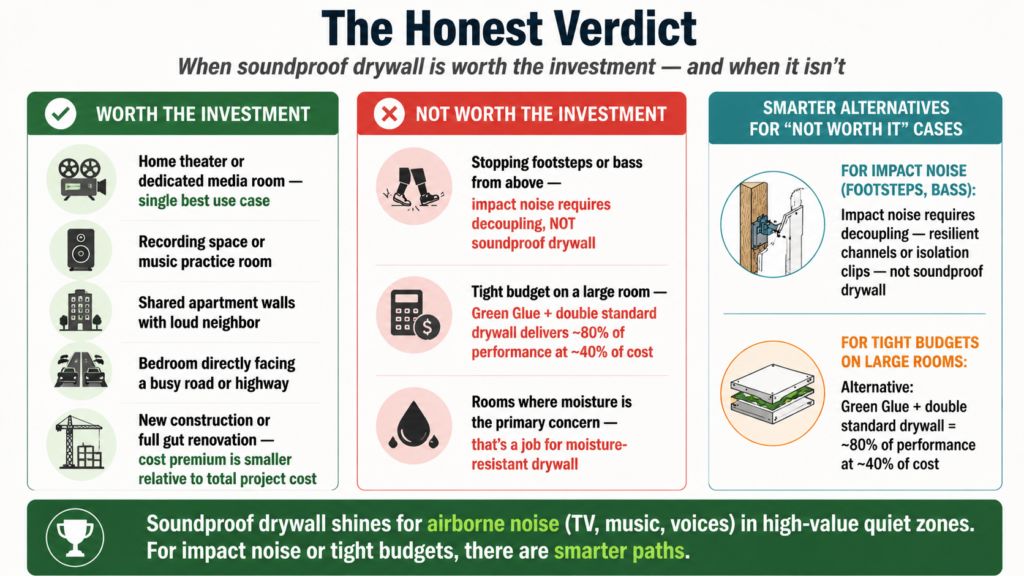
Worth the investment:
- Home theater or dedicated media room — this is the single best use case for soundproof drywall
- Recording space or music practice room
- Shared apartment walls with a loud neighbor
- Bedroom directly facing a busy road or highway
- New construction or full gut renovation — the cost premium is smaller relative to total project cost
Not worth the investment:
- Stopping footsteps or bass from above — impact noise requires decoupling, not soundproof drywall
- Tight budget on a large room — Green Glue plus double standard drywall delivers roughly 80% of the performance at about 40% of the cost
- Rooms where moisture is the primary concern — that’s a job for moisture-resistant drywall
Alternatives That Might Work Better for Your Situation
This is where most guides fail you. Recommending only soundproof drywall when cheaper or more effective solutions exist isn’t honest advice — it’s a sales pitch. Before choosing an alternative, it’s worth understanding how each option fits within the broader types of drywall available. Here are the real alternatives:
Here are the real alternatives:
Double Standard Drywall
Two layers of regular ½” or ⅝” drywall stacked together. Cheap, straightforward, and genuinely effective as a first step. Adds mass without complexity. Expect an STC improvement of roughly 6–8 points. Best budget starting point before exploring anything else.
Green Glue + Double Drywall
Green Glue is a viscoelastic damping compound applied between two sheets of standard drywall. It converts sound vibration into heat — the same principle as the polymer layer in soundproof drywall, but you apply it yourself at a much lower material cost. This combination can reach STC 50–55, matching higher-end soundproof drywall panels at significantly lower cost. For most residential projects, this is the smartest value option available.
Resilient Channels or Isolation Clips
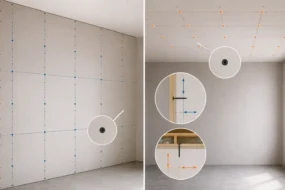
These are the right tool for impact noise. Resilient channels are metal strips that hold drywall slightly away from the studs, physically decoupling it from the structure. Sound energy can’t travel through what isn’t touching. More complex to install correctly, but essential if footsteps or bass are the problem.
Mass Loaded Vinyl (MLV)
A dense, flexible vinyl membrane installed inside the wall cavity. Works well as an additional mass layer, especially in retrofit situations where opening the wall fully isn’t practical. Combines effectively with standard or soundproof drywall for a high-performance system.
| Method | STC Improvement | Cost Range | Best For |
| Double standard drywall | +6–8 STC | $ | Budget mass addition |
| Green Glue + double drywall | +10–15 STC | $$ | Best cost-performance ratio |
| Resilient channels / isolation clips | +8–12 STC | $$ | Impact noise, footsteps |
| Mass Loaded Vinyl (MLV) | +8–10 STC | $$–$$$ | Combined wall systems |
| Soundproof drywall (QuietRock) | +15–20 STC | $$$ | Shared walls, home theaters |
Room-by-Room: When to Use Soundproof Drywall
Quick guide for the most common scenarios:
- Home theater — Yes. The best use case. Worth every dollar.
- Master bedroom (street noise or neighbor noise) — Yes, if budget allows. Green Glue alternative worth serious consideration.
- Home office (Zoom calls, shared walls) — Yes for shared walls. Overkill for quiet exterior walls.
- Shared apartment wall — Yes. This is exactly the problem it was designed to solve.
- Kids’ music room or practice space — Yes, but combine with decoupling for meaningful impact noise reduction.
- Bathroom — No. Moisture-resistant green board drywall is the right product for wet areas.
- Garage — No. Fire-resistant Type X drywall is the code-required choice for garage walls.
Frequently Asked Questions
Does soundproof drywall actually work?
Yes — for airborne noise like voices, TV, and music. Soundproof drywall with a viscoelastic core can achieve STC ratings of 50–65, which represents a dramatic reduction in perceived noise. It does not significantly reduce impact noise like footsteps, which require decoupling solutions instead.
What is the best soundproof drywall?
QuietRock 510 is the most widely used and well-documented option for residential applications, offering an STC rating around 50–53 on its own. The QuietRock 530 and EVO models provide higher performance for more demanding applications. That said, Green Glue combined with double standard drywall often delivers comparable results at lower cost.
How much does soundproof drywall cost?
Soundproof drywall panels (QuietRock 510) typically cost $40–$55 per 4×8 sheet, compared to $12–$20 for standard drywall. For a 12×12 bedroom requiring roughly 20 panels, expect $800–$1,100 in material costs alone, versus $240–$400 for regular drywall. Labor may run higher due to panel weight.
Can soundproof drywall block footsteps?
No — and this is the most important thing to understand before buying. Footsteps are impact noise, which travels through the structure of the building itself. Soundproof drywall addresses only airborne noise. For footsteps and similar impact sounds, you need resilient channels or isolation clips to physically decouple the drywall from the structure.
Is QuietRock worth the money?
In the right situation, yes. If you’re building a home theater, treating a shared apartment wall, or adding soundproofing during a full renovation, QuietRock justifies its cost premium. In a tight-budget scenario or a large room, Green Glue plus double drywall delivers most of the benefit at a fraction of the cost.
What is a good STC rating for a bedroom?
STC 50 is the practical target for a bedroom where you want meaningful noise reduction. At that level, loud music becomes faint and normal conversation becomes inaudible. Achieving STC 50+ in a bedroom typically requires either soundproof drywall or Green Glue with double drywall, combined with insulation in the wall cavity.
Can I install soundproof drywall over existing drywall?
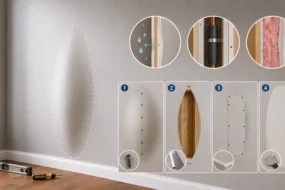
Yes. Adding soundproof drywall over existing panels is a viable retrofit option that avoids a full wall teardown. You lose a small amount of room depth, and you’ll need longer fasteners, but it’s a practical approach for renters who own their space or homeowners who want to avoid major demolition. Green Glue between the existing surface and the new panel maximizes the performance of this approach.
The Bottom Line
Soundproof drywall works — reliably and significantly — for airborne noise. If voices, music, or TV bleed is your problem, acoustic drywall or a Green Glue system will make a real difference. It’s well worth the cost for home theaters, shared walls, and bedrooms near noise sources.
It does nothing meaningful for impact noise like footsteps. If that’s your problem, decoupling is the solution — resilient channels or isolation clips, not a different drywall panel.
For most people who aren’t doing a full renovation: Green Glue plus double standard drywall is the smarter budget choice, delivering around 80% of the performance of premium soundproof drywall at roughly 40% of the material cost. If you’re already tearing out walls for a remodel, that’s when the upgrade to QuietRock makes the most financial sense.


Elena Hart is the founder and lead writer of Better Home Pro. She writes about drywall, home repair, and practical DIY home improvement topics, focusing on clear, useful information that helps homeowners make better decisions. Her work combines firsthand experience, manufacturer documentation, industry resources, and careful research to create content that is accurate, practical, and easy to understand. Through Better Home Pro, Elena aims to simplify complex home improvement topics and provide guidance that is genuinely helpful to homeowners and DIYers.









No Comments