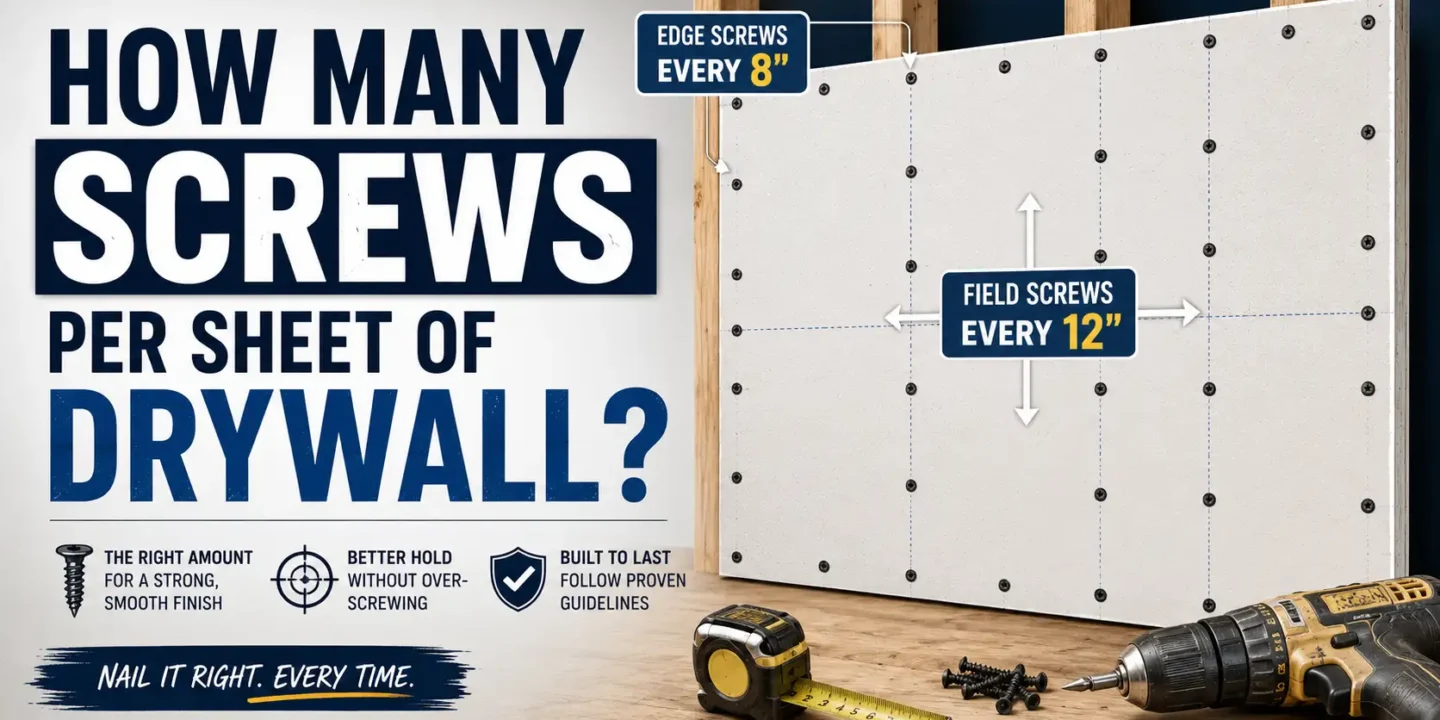



For a standard 4×8 sheet of drywall on a wall, you’ll typically use 28 to 36 screws. Most installations land around 32 screws per sheet when studs are spaced 16 inches on center. Ceilings require more, usually 36 to 44 screws, because the drywall is fighting gravity and needs tighter fastening.
Those numbers aren’t fixed. Stud spacing, ceiling vs. wall, drywall thickness, and whether you’re using construction adhesive all shift the count. The rest of this article explains exactly how.
Key Takeaways:
- Standard 4×8 wall sheets with 16-inch stud spacing require 28 to 36 screws, while ceilings need 36 to 44 screws to fight gravity.
- Space screws every 8 inches along perimeter edges and keep them at least 3/8 inch from the edge to prevent the gypsum core from cracking.
- Interior field screws should be spaced 12 inches apart on walls, but tighten that spacing to every 8 inches on ceilings to prevent sagging.
- Driving a screw too deep tears the structural paper face and makes the fastener useless; the screw head should sit just below the surface.
- Using construction adhesive on studs reduces the required screw count by 30% to 40% and minimizes future fastener pops.
Standard Screw Count for a 4×8 Sheet of Drywall
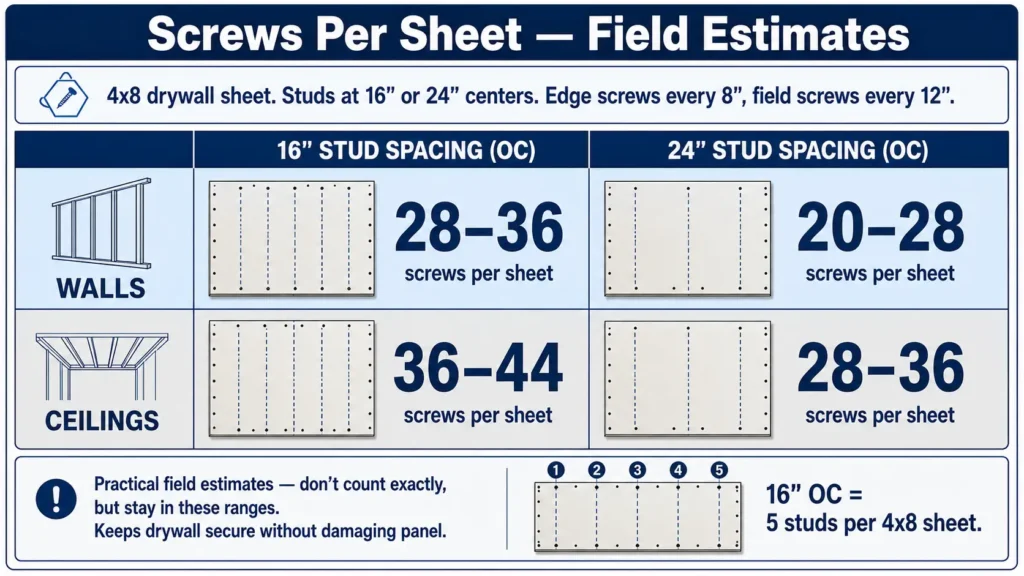
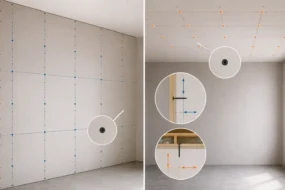
On a typical wall with studs at 16 inches on center, a 4×8 sheet hits 5 studs across its span (including both edges). Screws along the edges go every 8 inches, and screws in the field go every 12 inches. That works out to roughly:
- Walls at 16″ stud spacing: 28 to 36 screws per sheet
- Walls at 24″ stud spacing: 20 to 28 screws per sheet
- Ceilings at 16″ spacing: 36 to 44 screws per sheet
- Ceilings at 24″ spacing: 28 to 36 screws per sheet
These are practical field estimates. You won’t count out exactly 32 screws every time, but staying within these ranges keeps the drywall secure without damaging the panel.
Why the Number of Screws Changes
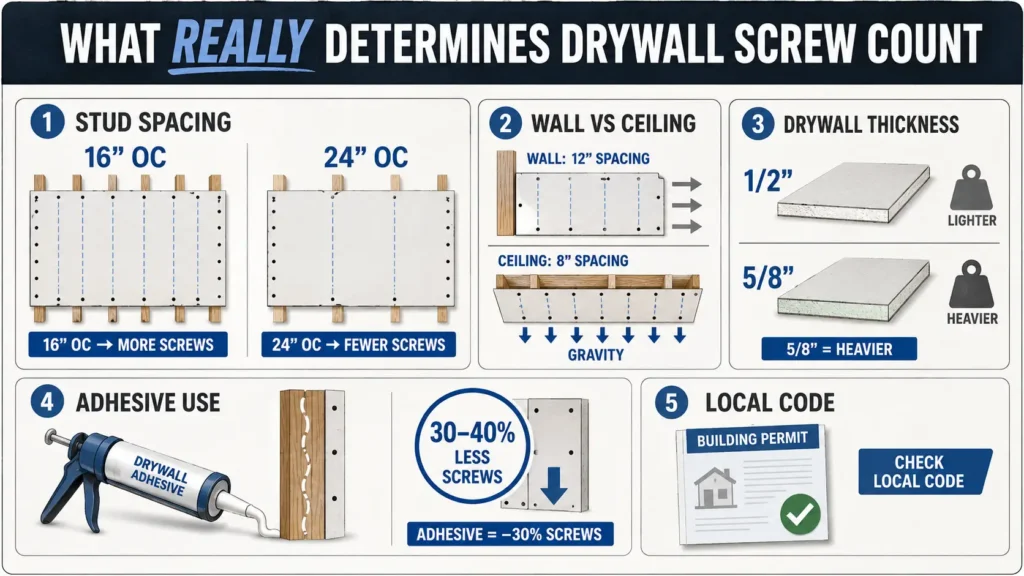
The “just use 32 screws” answer floats around a lot. The problem is it assumes every installation is the same. Here’s what actually moves the number.
Stud spacing. This is the biggest factor. At 16 inches on center, you have more attachment points across a sheet, which means more screws. At 24 inches, studs are farther apart, so each stud carries a bigger load with fewer total fasteners.
Walls vs. ceilings. Ceiling drywall needs tighter spacing because it’s fighting gravity across its full face. The standard field spacing drops from 12 inches to 8 inches on ceilings, which adds a meaningful number of screws per sheet.
Drywall thickness. Thicker panels, like 5/8-inch type X, are heavier. When you’re installing these overhead or on tall walls, some installers add a few extra screws as insurance, particularly along the edges.
Adhesive use. When contractors apply construction adhesive to the studs before hanging drywall, the screw count can drop by 30 to 40 percent. The adhesive handles most of the holding strength, and screws just hold the sheet flat while it cures. If you’re going this route, follow the adhesive manufacturer’s guidance rather than standard screw spacing.
Local code. Some jurisdictions have specific fastener requirements for walls in certain areas, like around fireplaces or in high-humidity rooms. Worth checking before you start.Your local building department can provide the specific code requirements for your area, or you can reference the International Residential Code (IRC) Section R702 for the baseline standards most jurisdictions adopt.
Recommended Screw Spacing
The spacing logic is simple once you separate edges from field.
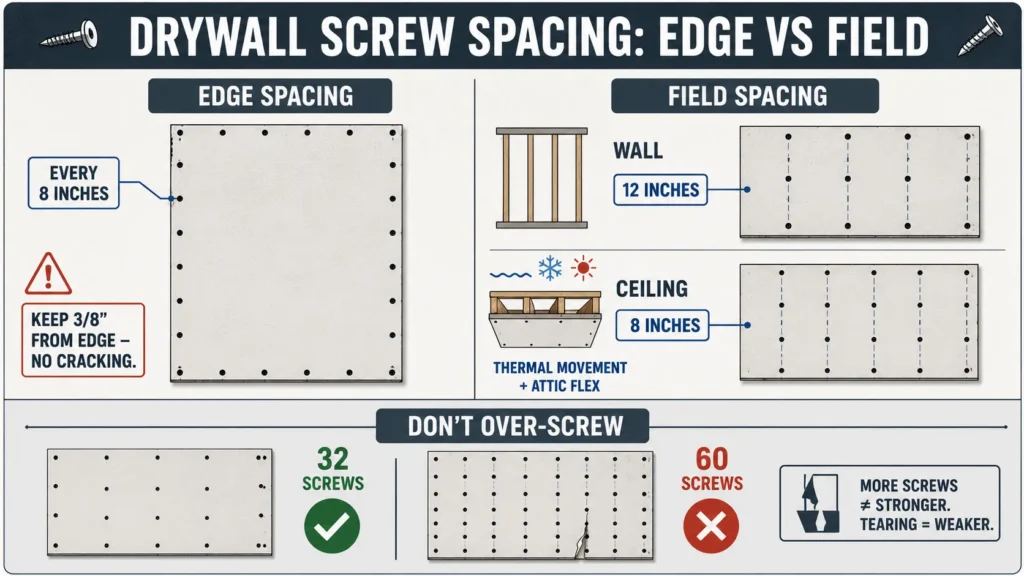
Edge spacing: Screws along the perimeter of the sheet should land every 8 inches. Keep them at least 3/8 inch from the edge of the panel to avoid cracking the gypsum core.
Field spacing: Interior screws, meaning anything not on the edge, go every 12 inches on walls. On ceilings, tighten that to every 8 inches.
The reason ceilings require closer field spacing isn’t just about weight. Over time, thermal movement and humidity changes in the attic above can cause ceiling drywall to flex slightly. Tighter fastening reduces how much that movement translates into visible waves or popped screws.
One thing worth knowing: over-screwing is a real problem, not just unnecessary work. Too many screws in a tight area tear the paper face and break the gypsum core, which weakens the panel instead of strengthening it. A sheet of drywall held together with 60 screws is not stronger than one with 32. It’s likely weaker in spots.
Common Drywall Screw Mistakes
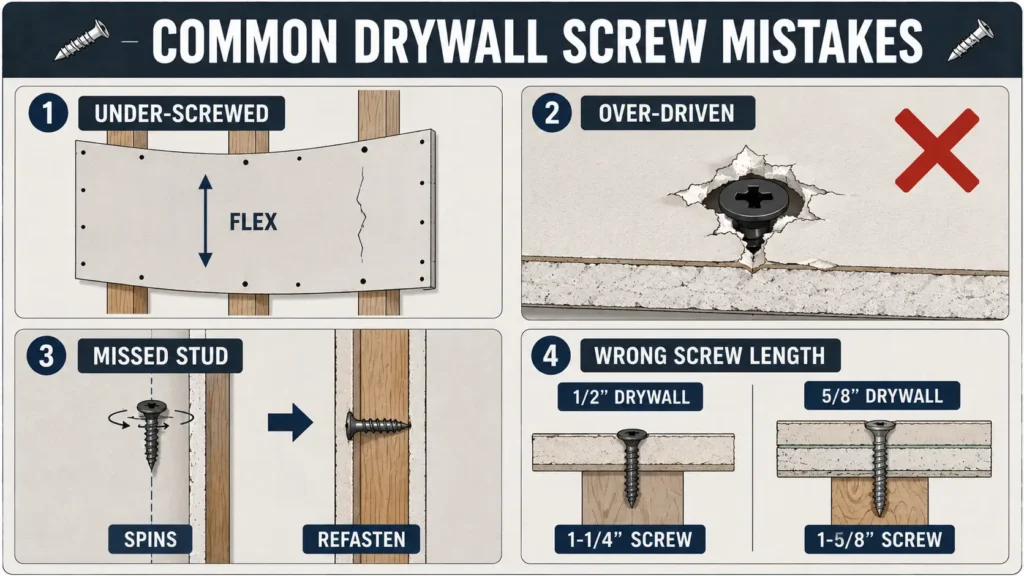
Under-screwing. Skipping screws to save time is the most common mistake on DIY jobs. Without enough fasteners, the drywall flexes when someone leans against it, cracks appear at seams, and screws pop as the panel shifts. It’s not always obvious right away, which is why some people assume their tape job caused the cracks.
Over-driving screws. A screw set too deep breaks the paper face of the drywall. That paper is structural. Once it’s torn, that fastener is basically useless because it has nothing solid to hold against. The dimple should be just below the surface, not punched through it. A screw gun with a depth setter makes this much easier than a drill. Learn why a drywall screw gun vs drill matters for consistent dimpling.
Missing studs. This happens more on older homes where framing isn’t perfectly consistent. If a screw goes in and spins freely, it didn’t catch wood. Pull it, find the stud, and refasten. Leaving spinning screws in place and covering them with joint compound is asking for problems later.
Wrong screw length. For 1/2-inch drywall, use 1-1/4 inch coarse-thread screws into wood studs. For 5/8-inch panels, go with 1-5/8 inch. Using screws that are too short means minimal bite into the stud and poor holding strength.
Screw Count Estimates for Entire Rooms
If you’re planning material quantities, these rough estimates help.
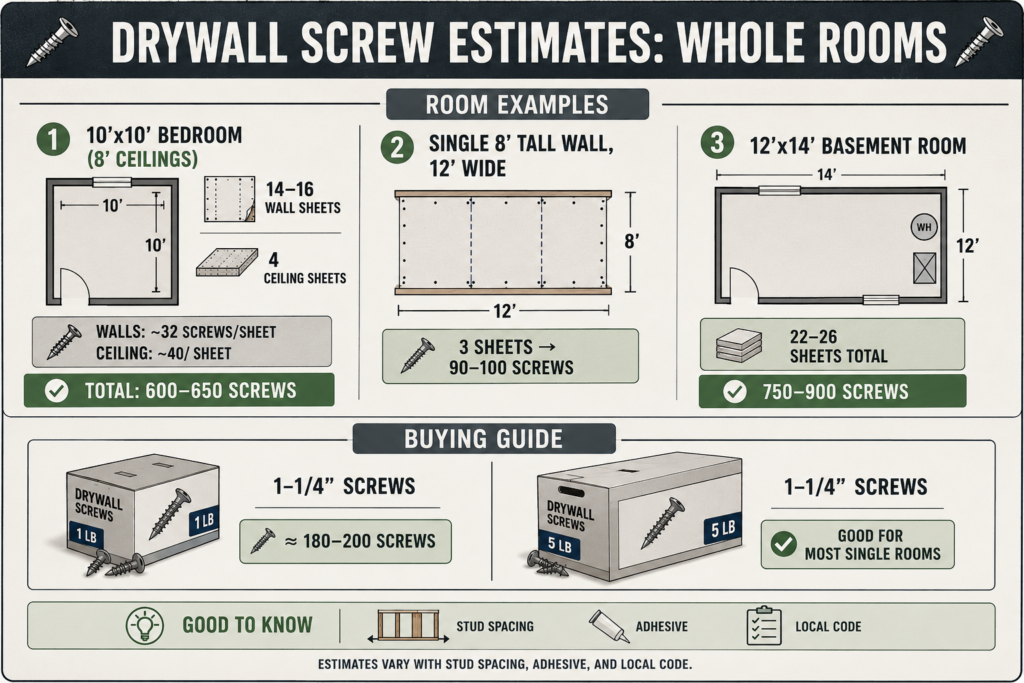
A 10×10 bedroom with 8-foot ceilings uses around 14 to 16 sheets for walls and 4 sheets for the ceiling. At an average of 32 screws per wall sheet and 40 for ceiling sheets, that’s roughly 600 to 650 screws for the whole room.
A single 8-foot wall, 12 feet wide takes about 3 sheets. Expect to use around 90 to 100 screws.
A small basement room, 12×14 feet might need 22 to 26 sheets total depending on ceiling height and openings. Budget around 750 to 900 screws.
For buying purposes, a 1-pound box of 1-1/4 inch drywall screws holds roughly 180 to 200 screws. A 5-pound box gets you through most single-room projects comfortably.
Drywall Nails vs. Screws
Nails were standard for decades and some old-timers still use them. The problem is nail pops. Wood framing dries and shrinks after the house is finished, and nails tend to back out over time. Screws thread into the wood and stay put much better.
Screws are also easier to adjust. If a sheet shifts slightly while you’re setting it, backing out a screw and repositioning takes seconds. Pulling a nail without damaging the panel is a different story.
Modern drywall work is almost entirely screws. Nails still show up occasionally in repairs or when someone is working with what they have, but for new installations, there’s no real reason to use them.
The table below provides a detailed side-by-side comparison of drywall nails vs. screws:
| Factor | Drywall Nails | Drywall Screws | Why It Matters |
| Fastening Method | Smooth shank driven into framing | Threaded fastener that bites into wood or metal studs | Threaded screws create a stronger long-term hold |
| Holding Power | Moderate | High | Screws resist movement as framing expands and contracts |
| Risk of Pops | High risk of nail pops over time | Low risk of screw pops when installed correctly | Shrinking lumber can push nails outward |
| Long-Term Stability | Can loosen as wood dries | Remains secure for years | Important for preventing visible wall defects |
| Installation Adjustment | Difficult to remove cleanly | Easy to back out and reposition | Helpful when aligning drywall sheets |
| Damage During Removal | Often damages drywall paper or surface | Minimal surface damage in most cases | Reduces repair work during installation |
| Compatibility With Modern Standards | Rare in modern professional work | Industry-standard fastening method | Most contractors now use screws almost exclusively |
| Best Framing Compatibility | Primarily wood framing | Works with both wood and metal framing | Screws are more versatile across framing types |
| Speed of Installation | Faster with a hammer but less precise | Slightly slower manually, fast with screw guns | Drywall screw guns improve installation speed |
| Recommended Use Today | Small repairs or temporary fixes | All new drywall installations | Screws provide better durability and reliability |
| Overall Performance | Outdated for most projects | Best overall choice | Better holding strength and fewer future issues |
Frequently Asked Questions
How many screws for ceiling drywall? Plan on 36 to 44 screws per 4×8 sheet at 16-inch stud spacing, or 28 to 36 screws at 24-inch spacing. Tighter field spacing of 8 inches rather than 12 is the standard recommendation.
Can you use too many screws in drywall? Yes. Overloading a section with screws tears the paper face and damages the gypsum core. More screws don’t equal more strength past a certain point.
What size drywall screws should I use? For 1/2-inch drywall into wood studs, use 1-1/4 inch coarse-thread screws. For 5/8-inch panels, use 1-5/8 inch. For metal studs, switch to fine-thread screws of the same lengths.
Do professionals use glue and screws together? Yes, on a lot of jobs. Adhesive on the stud face reduces screw count and minimizes squeaks and fastener pops. It’s more common on walls than ceilings, but some contractors use it both places. The tradeoff is that demolition or repair later becomes more difficult.


Elena Hart is the founder and lead writer of Better Home Pro. She writes about drywall, home repair, and practical DIY home improvement topics, focusing on clear, useful information that helps homeowners make better decisions. Her work combines firsthand experience, manufacturer documentation, industry resources, and careful research to create content that is accurate, practical, and easy to understand. Through Better Home Pro, Elena aims to simplify complex home improvement topics and provide guidance that is genuinely helpful to homeowners and DIYers.







No Comments