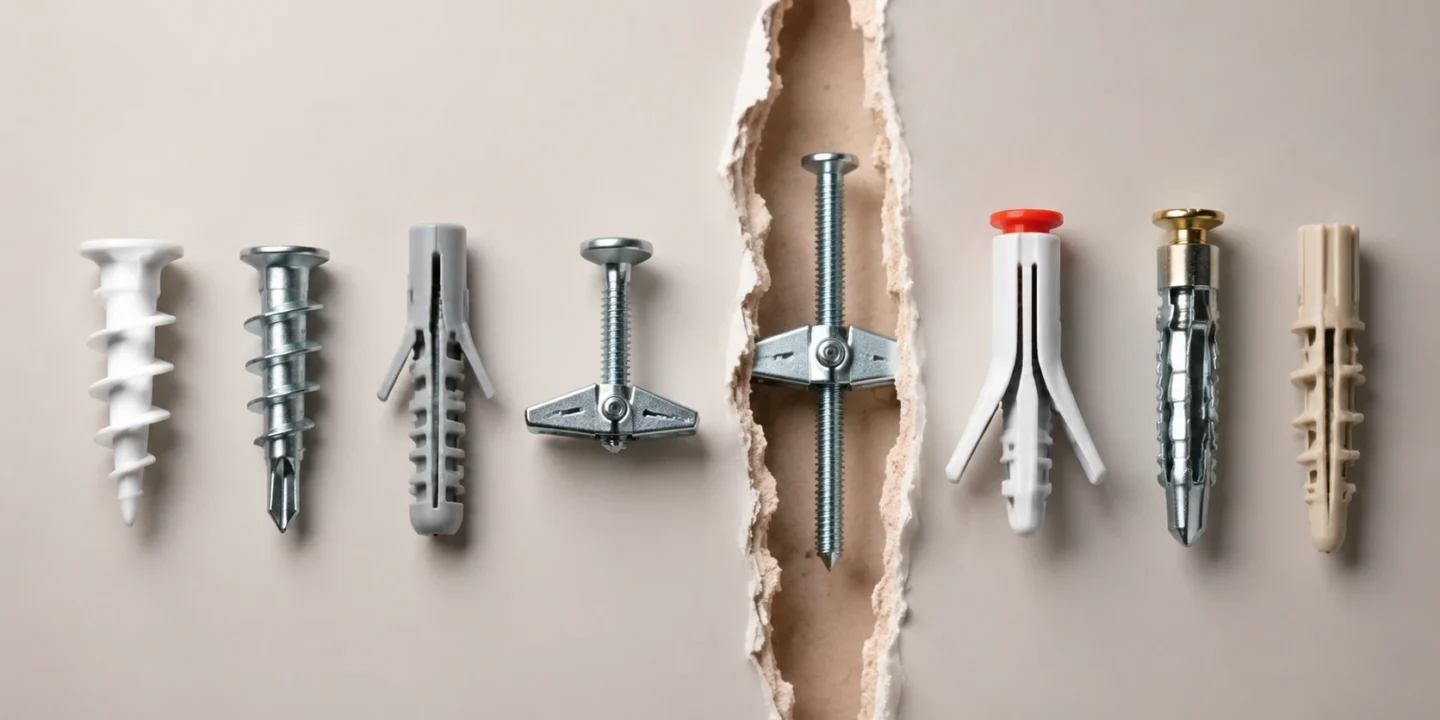



Standard half-inch drywall can hold about 5 lbs with a screw alone before the gypsum core crumbles. That’s enough for a small picture frame and nothing else. Anchors solve this by spreading load across a wider surface area or gripping the drywall from both sides – depending on the type you’re using.
Before you buy anything, there’s one thing worth knowing upfront: weight ratings on anchor packaging are not real-world numbers. They assume perfect installation in half-inch drywall with a straight-down static load. Most people hanging things don’t have all three of those conditions. The actual capacity is often significantly lower, especially on ceilings and when loads aren’t perfectly vertical.
This guide covers how anchors actually work, honest weight ratings for each type, an item-by-item decision matrix so you know exactly which anchor to buy for a specific job, a dedicated ceiling section that most guides skip entirely, and a removal guide for when you eventually redecorate.
Key Takeaways
- Packaging weight ratings show the absolute failure point, so professionals apply a two-times safety factor to calculate the actual working load.
- Outward pulling tensile forces reduce anchor capacity by 30% to 50% compared to standard downward pulling shear force ratings.
- Self-drilling threaded anchors offer the fastest and most reliable general-purpose grip for common 25 to 75 lb wall-hanging tasks.
- Snap toggles match the high capacity of traditional wing toggles but feature a permanent metal channel that allows for hardware reusability.
- Ceiling applications change the physics to pure tensile load, cutting an anchor’s rated wall capacity by roughly half.
How Anchors Actually Work – Shear vs Tensile, and Why Ratings Lie
Gypsum is a soft mineral. A single screw driven into drywall concentrates all the load stress onto a tiny point of contact, and that contact point crumbles under any real weight. Anchors address this in two ways: toggle-style anchors spread load across a wider area behind the panel, while threaded anchors grip the board through lateral friction across a longer surface area.
Understanding the difference between shear force and tensile force matters a lot here, and most homeowner guides skip it entirely.
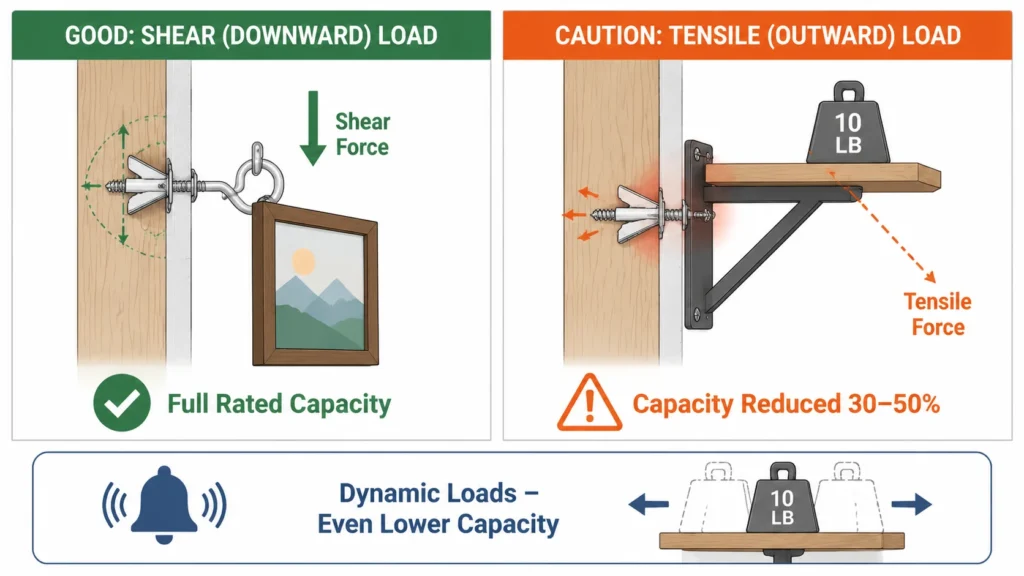
Shear force is load pulling straight down along the wall face – a picture frame hanging on a hook is a shear load. Most anchor weight ratings are calculated with shear force only.
Tensile force is load pulling directly away from the wall – a shelf bracket under load, a towel bar being yanked outward, or anything mounted at an angle that creates outward pull. Tensile loads reduce anchor capacity by 30 to 50 percent on most anchor types. A self-drilling anchor rated at 50 lbs for shear might hold 25 to 30 lbs under tensile load. Molly bolts and toggle-style anchors handle tensile loads better, but they’re still reduced from their stated rating.
There’s a third factor that packaging never mentions: dynamic vs static loads. A 100 lb rated anchor can fail at 40 lbs if the load vibrates, shifts repeatedly, or gets angled pulls over time. Kids pulling on hooks, a door with a mounted rack that swings, shelving that gets loaded and unloaded frequently – these are dynamic loads. Static loads (a heavy mirror that never moves) are much gentler on anchors.
The 2x safety rule: If you need to hang something weighing 50 lbs, use anchors collectively rated for 100 lbs. This is the standard professionals use. Never load anchors to their rated maximum – that number is the failure point, not the working load.
The 5 Anchor Types – Honest Weight Ratings and When to Skip Each
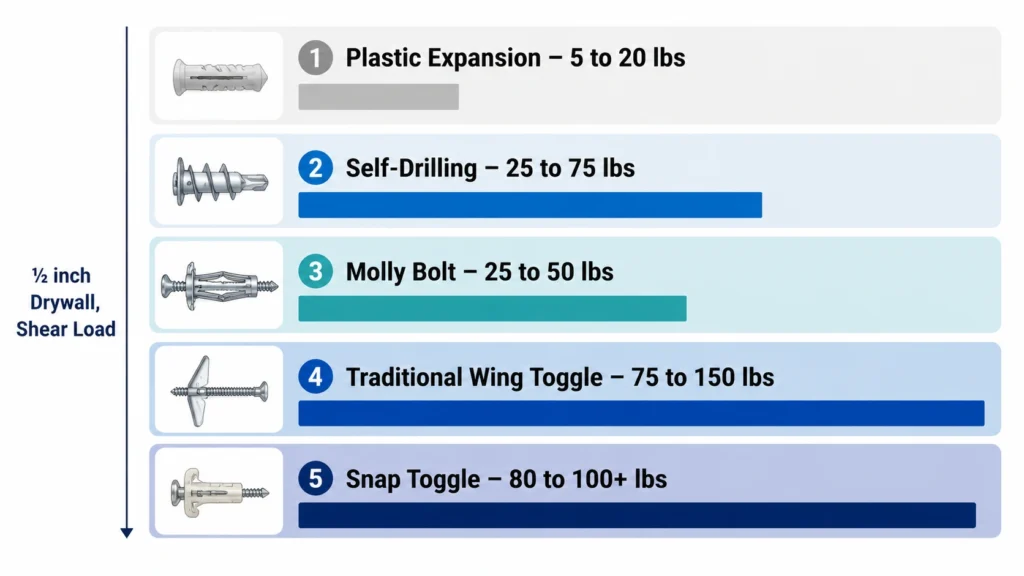
Weight Reference by Anchor Type (½” Drywall, Shear Load)
| Anchor Type | Holding Range |
| Plastic expansion | 5–20 lbs |
| Self-drilling (E-Z Ancor type) | 25–75 lbs |
| Molly bolt | 25–50 lbs |
| Traditional wing toggle | 75–150 lbs |
| Snap toggle (Snaptoggle) | 80–100+ lbs |
1. Plastic Expansion Anchors – Often: Skip These
The classic ribbed plastic sleeve you tap into a pre-drilled hole. A screw inserted into the sleeve forces it to expand outward against the surrounding gypsum. They’re cheap, widely available, and included in a lot of furniture kits.
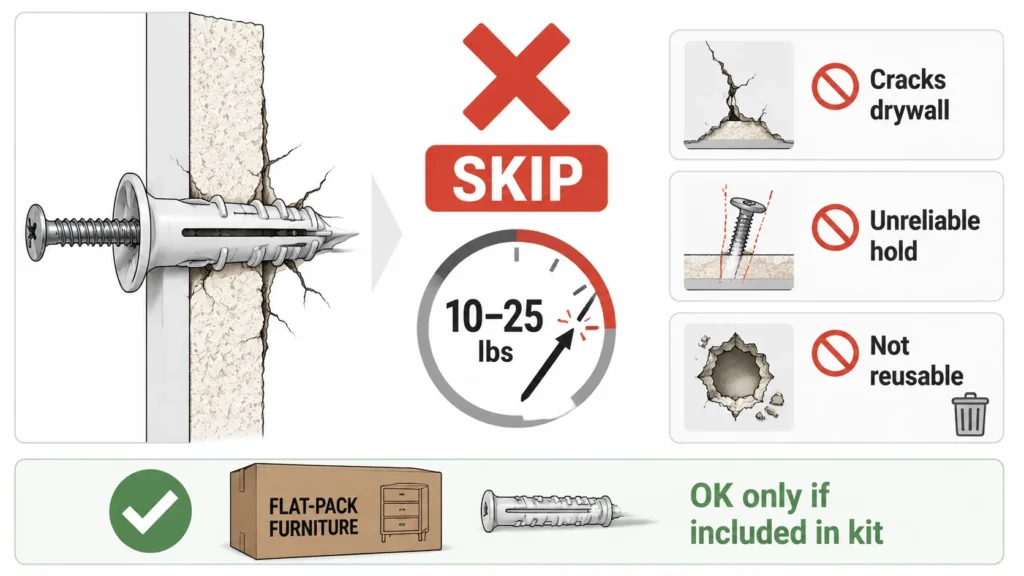
The honest assessment: rated for 10 to 25 lbs, but real-world performance often falls short of that. The expansion force can crack the surrounding gypsum in older or thinner drywall, and the grip degrades significantly if the screw is driven unevenly. For anything beyond a smoke detector, a small picture frame, or a lightweight hook, self-drilling anchors cost almost the same and are significantly more reliable.
The one situation where they make sense: furniture assembly kits that include them as part of the hardware spec. Use them as intended per the manufacturer’s instructions for that specific item.
Limitation: Cannot be reused. They tend to leave a crumbly, oversized hole when removed.
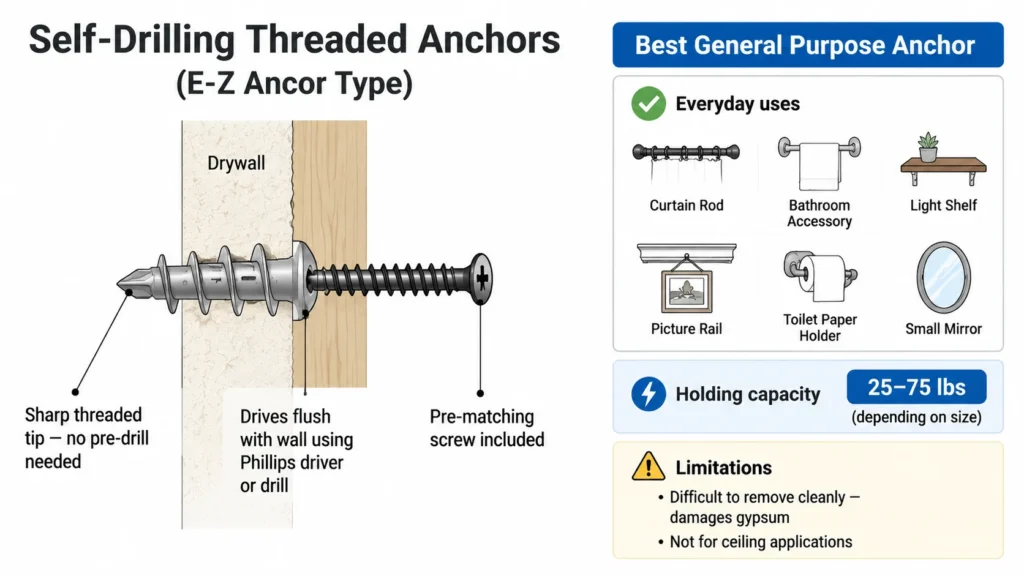
2. Self-Drilling Threaded Anchors (E-Z Ancor Type) – Best General Purpose
A sharp threaded tip that drills directly into drywall – no pre-drilled hole needed. Drive with a Phillips screwdriver or drill until the head sits flush with the wall, then insert the provided screw. That’s it.
Holding capacity runs 25 to 75 lbs depending on size, and these are the right anchor for the majority of everyday hanging tasks: curtain rods, bathroom accessories, light shelves, picture rails, toilet paper holders, small mirrors. E-Z Ancor dominates this category and is the most consistently reviewed brand across home improvement testing.
The medium-duty and heavy-duty variants cover a wide range of applications, and the installation speed is genuinely fast compared to any pre-drilling option.
Limitation: Difficult to remove cleanly – the threads damage the surrounding gypsum as the anchor comes out. Once you install one, commit to the location. Not suitable for ceiling applications.
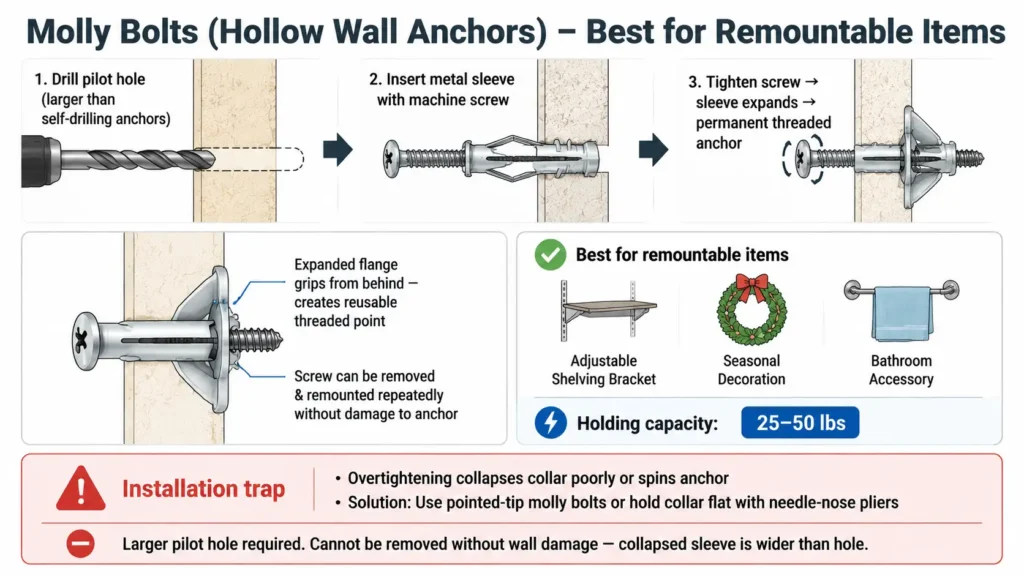
3. Molly Bolts (Hollow Wall Anchors) – Best for Remountable Items
A metal sleeve inserted into a pre-drilled hole. Tightening the machine screw collapses the sleeve behind the drywall, expanding it into a permanent flange that grips from the back. Holding capacity is 25 to 50 lbs.
What makes molly bolts worth the extra step: they create a permanent threaded anchor point that accepts the screw repeatedly without degrading. If you’re mounting something you’ll remove and remount periodically – adjustable shelving brackets, seasonal decorations, a bathroom accessory that comes down occasionally – molly bolts are the right choice.
Installation trap: Overtightening is easy and it either collapses the collar poorly or causes the anchor to spin in the hole. Use pointed-tip molly bolts that self-grip during installation, or hold the collar flat against the wall surface with needle-nose pliers while driving the screw.
Limitation: Requires a larger pilot hole than self-drilling anchors. Cannot be removed without causing wall damage – the collapsed sleeve is wider than the original hole.
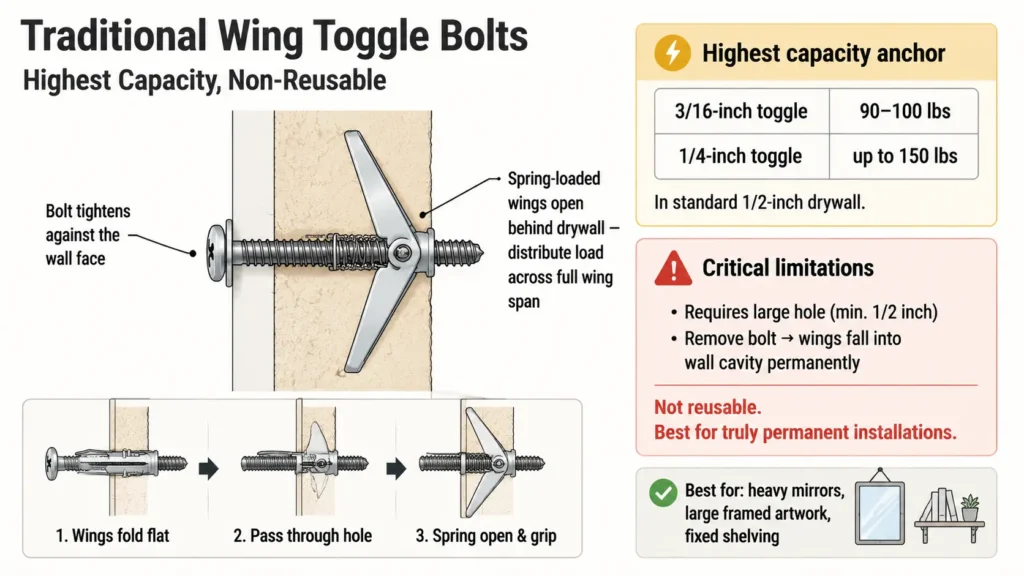
4. Traditional Wing Toggle Bolts – Highest Capacity, Non-Reusable
Spring-loaded metal wings fold flat to pass through a drilled hole, then spring open behind the drywall. The bolt tightens against the back of the panel, distributing load across the full wing span.
Capacity: 75 to 150 lbs. A 3/16-inch toggle holds 90 to 100 lbs; a quarter-inch toggle holds up to 150 lbs in standard half-inch drywall. These are the highest-capacity wall anchor available.
Critical limitation: They require a large hole (at least half an inch for the wings to pass through). More importantly: if you remove the bolt, the wings fall into the wall cavity permanently. You cannot recover or reuse them. For that reason, these are best suited for truly permanent installations – heavy mirrors, large framed artwork, fixed shelving.
5. Snap Toggle (Snaptoggle) – Best Overall for Heavy Items
A metal channel passes through a drilled hole and snaps flat against the back of the drywall. A separate bolt threads through the channel from the front. Holding capacity: 80 to 100+ lbs per anchor.
The key advantage over traditional wing toggles is reusability. With a standard toggle bolt, removing the bolt means losing the wings into the wall cavity forever. With a Snaptoggle, the metal channel stays permanently in place. You can remove the bolt, move the item, and reinsert a bolt later – or swap mounting hardware – without losing the anchor.
This matters a lot for items like mounted TVs, floating shelves, or heavy mirrors that you might eventually want to relocate. The Toggler Snaptoggle BA and E-Z Ancor Toggle Lock are the most tested and trusted variants.
Limitation: Requires a pre-drilled hole larger than self-drilling anchors. Plan your anchor placement before drilling.
Item-by-Item Decision Matrix
Use this to find the right anchor for a specific job. Quantities listed assume studs are not available at the desired location.
| Item | Best Anchor | Notes |
| Small picture frame (under 10 lbs) | Adhesive hook or plastic expansion | 1 anchor |
| Large mirror (20–40 lbs) | Self-drilling anchors | 2 anchors, 25+ lbs each |
| Heavy mirror (40–80 lbs) | Snap toggles | 2–4 anchors, verify combined rating |
| Curtain rod (light, 2 brackets) | Self-drilling anchors | 1 per bracket |
| Floating shelf (25–50 lbs loaded) | Snap toggles | Minimum 2 per shelf |
| Mounted TV (40–65″, 40–70 lbs) | Snap toggles or stud + snap toggle combo | 4–6 anchors |
| Mounted TV (65″+, 80+ lbs) | Always use studs | No anchor substitute at this weight |
| Towel bar / bathroom accessories | Self-drilling or molly bolt | 1 per mounting point |
| Toilet paper holder | Self-drilling anchors | 2 anchors |
| Ceiling light fixture (under 35 lbs) | Ceiling-rated toggle bolt or fan-rated brace box | See Section 4 |
| Ceiling fan (any weight) | Never use wall anchors | Requires fan-rated electrical box only |
| Garage overhead shelving | Always use studs/joists | No anchor adequate for overhead storage |
Mounted TV note: For a 55-inch TV weighing around 50 lbs, use four Snaptoggle BA anchors with the 2x safety factor applied – that puts you at 200 lbs combined rated capacity for a 50 lb load. If any studs align with your mount, use them and supplement with snap toggles for the remaining holes.
Ceiling Anchors – Completely Different Physics, Specific Rules
Most anchor guides treat ceilings like walls oriented horizontally. They’re not the same, and the physics difference is significant.
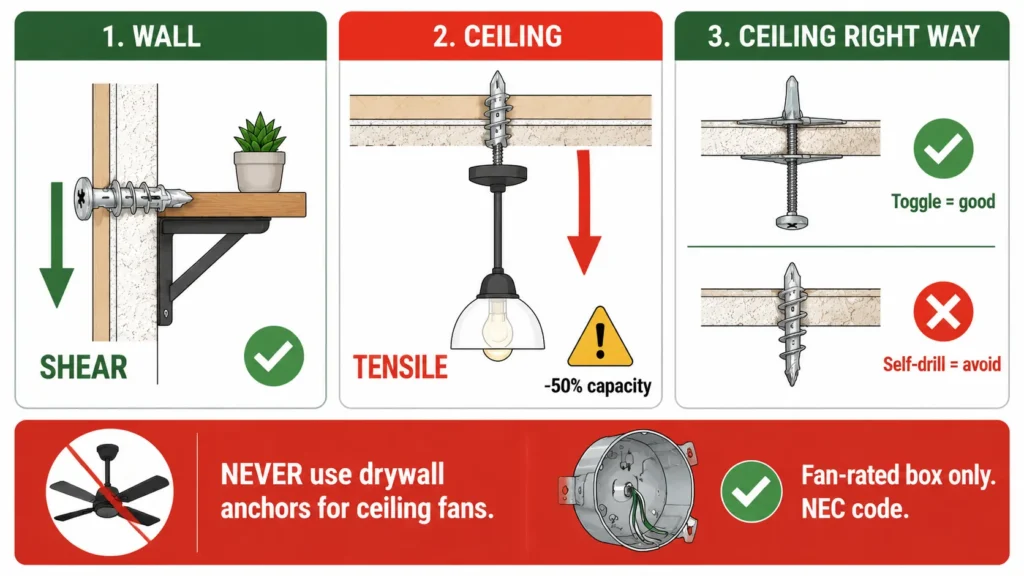
On a wall, gravity acts as shear force – pulling straight down along the face of the anchor. The anchor’s grip mechanism works with gravity. On a ceiling, gravity acts as tensile force – pulling the anchor directly away from the mounting surface. That same grip mechanism is now working against gravity instead of with it.
The result: wall-rated anchors used on ceilings typically perform at 50 to 60 percent of their stated wall capacity. An anchor rated for 75 lbs on a wall should be treated as a 37 to 45 lb anchor on a ceiling.
What actually works on ceilings:
Traditional wing toggle bolts work overhead. The wings grip the back of the drywall regardless of load direction, and they’re the most reliable option for ceiling applications. Use them at 50 percent of the stated wall rating to account for the tensile load difference. Snap toggles also work for light ceiling fixtures under 35 lbs.
Self-drilling anchors on ceilings: generally avoid them for anything permanent. Their grip relies on thread-to-gypsum friction, and gravity directly opposes that friction when the anchor is loaded overhead. They may hold temporarily, but over time that friction degrades under sustained tensile load. For lightweight temporary items they’re acceptable; for anything fixed or heavy they’re not.
The ceiling fan absolute rule: Never use any drywall anchor for a ceiling fan. Ceiling fans have dynamic rotational loads that change direction and magnitude constantly during operation – no drywall anchor can handle this safely. The National Electrical Code requires a fan-rated electrical box rated for the specific fan’s weight. This is a life-safety requirement backed by code, not a guideline you can work around with heavier hardware. A fan that comes down is a serious injury risk. Use the rated electrical box. No exceptions.
Standard light fixtures under 35 lbs: A ceiling-rated toggle bolt in half-inch or five-eighths-inch drywall can support a standard light fixture when properly installed. Verify the actual fixture weight (the spec sheet lists it), apply the 2x safety factor, and choose your toggle size accordingly.
Product Picks by Use Case
Best Overall: E-Z Ancor Toggle Lock Drywall Anchors
Self-drilling entry means no pre-drilling a separate large hole. The toggle wing opens behind the drywall after insertion. Simple installation, 100 lb weight capacity, works in standard half-inch drywall. This is the most versatile heavy-duty option for homeowners who need one anchor that handles most jobs.
Price: Around $12–$18 for a 10-pack.
Limitation: Slightly bulkier hole than pure self-drilling anchors. Visible if the anchor is ever removed and not patched.
Best General Purpose: E-Z Ancor Stud Solver Self-Drilling (Medium Duty)
25 to 50 lb capacity. No pre-drilling. Installs in seconds with a Phillips screwdriver. The right anchor for everyday hanging tasks: bathroom accessories, curtain rods, light shelves, picture rails, toilet paper holders. This is what belongs in most households as the standard go-to anchor.
Price: Around $8–$12 for a 25-pack.
Limitation: Difficult to remove without wall damage. Decide on your location before installing.
Best Heavy Duty: Toggler Snaptoggle BA Heavy-Duty Toggle Bolts
The only heavy-duty anchor that’s fully reusable. The metal channel stays in the wall permanently – remove and replace the bolt as many times as needed without losing the anchor. 80 to 100+ lb capacity per anchor. Best choice for mounted TVs, heavy floating shelves, large mirrors, and anything you might eventually want to move.
Price: Around $18–$25 for a 10-pack.
Limitation: Requires a pre-drilled hole larger than self-drilling anchors. Plan placement before drilling.
Best for Remountable Items: Hillman Steelex Zinc Molly Bolt Kit
25 to 50 lb capacity. The standout choice for items you’ll mount and dismount repeatedly – seasonal decor, adjustable brackets, removable shelving hardware. The permanent threaded point accepts the bolt repeatedly without degrading the grip.
Price: Around $10–$15 for an assorted kit.
Limitation: Installation requires careful torque control. Overtightening causes collar collapse and wastes the anchor.
Best Budget Kit: Qualihome Ribbed Plastic Drywall Anchor Kit
100 anchors plus matching screws and a drill bit. For genuinely light-duty use: small frames, smoke detectors, lightweight hooks.
Price: Around $10–$12 for a 100-pack.
Honest limitation: Real-world holding power often falls below the stated 25 lb rating. Use only for lightweight items and stay well under the listed maximum.
How to Remove Drywall Anchors Without Ruining the Wall
This is the question every homeowner has when redecorating, and almost no guide covers it.
Plastic expansion anchors: Insert a screw into the anchor deep enough to give it some grip, then grab the screw head with needle-nose pliers and pull straight out. Most come out cleanly with minimal wall damage. Patch the resulting hole with lightweight spackle.
Self-drilling anchors: Two options. First, back it out with a screwdriver – the threads will often strip out the surrounding gypsum as it exits, leaving a rough hole. Second (and cleaner): use a screwdriver to push the anchor forward into the wall cavity. This leaves a smaller, cleaner hole in the face of the drywall. Patch with spackle and sand smooth.
Molly bolts: These cannot be removed cleanly. The collapsed sleeve behind the drywall is wider than the original hole. Score around the flange with a utility knife, then use a punch and hammer to drive the entire assembly into the wall cavity. Spackle the resulting depression, feather it smooth, and sand.
Traditional toggle bolts: Remove the bolt – the wings will fall into the wall cavity and cannot be recovered. Push the washer flush with the wall surface, then spackle and sand over it.
Snap toggles: Remove only the bolt. The metal channel stays in the wall permanently – it’s designed to remain. If you no longer need the anchor point, cap the hole with spackle. If you might use it again, leave it as-is and reinsert a bolt whenever needed.
4 Anchor Mistakes That Cause Failures or Injuries
Loading anchors to their rated maximum. Packaging ratings are calculated under ideal conditions: perfect installation, half-inch drywall, straight-down static load. None of those conditions are guaranteed in a real installation. The 2x safety factor isn’t conservative – it’s the working standard. For anything that could cause injury or serious damage if it falls, use anchors rated for twice the actual load.
Using wall anchors on ceilings without adjusting for tensile load. Gravity pulls ceiling loads directly away from the mounting surface. Use only toggle bolt types overhead, and treat the stated wall rating as 50 percent when calculating ceiling capacity.
Using any drywall anchor for a ceiling fan. This comes up because toggle bolts technically have the capacity on paper. They don’t have the dynamic load tolerance. The NEC requires a fan-rated electrical box for a reason. No anchor type is an acceptable substitute, regardless of how it’s rated.
Using drywall anchors on hollow-core interior doors. Hollow-core doors have a cardboard honeycomb interior behind a thin wood veneer. There’s nothing substantial for an anchor to grip. Standard drywall anchors will pull straight through. For anything mounted on a hollow-core door, use adhesive hooks rated for the door material, or mount items on the door frame instead.
FAQ
What is the strongest drywall anchor?
Traditional wing toggle bolts and Snaptoggle BA anchors both reach 80 to 150 lbs in half-inch drywall – those are the highest-capacity options. The key difference is that wing toggles can’t be reused once removed, while the Snaptoggle’s metal channel stays in the wall permanently. For most heavy-duty applications, the Snaptoggle BA is the better choice because of that reusability.
How much weight can drywall anchors hold?
It depends on the type. Plastic expansion anchors hold 5 to 20 lbs; self-drilling anchors hold 25 to 75 lbs; molly bolts hold 25 to 50 lbs; toggle bolt types reach 75 to 150 lbs. These are ideal shear-load numbers. Always apply the 2x safety factor and reduce capacity by 30 to 50 percent if the load pulls outward rather than straight down.
What drywall anchor should I use for a TV mount?
For a TV between 40 and 65 inches, Snaptoggle BA anchors are the standard recommendation – use four to six anchors and verify the combined rating is at least twice the TV’s actual weight. For anything 65 inches or larger (typically 80+ lbs), use wall studs. No drywall anchor is an adequate substitute at that weight class.
Can you use drywall anchors on ceilings?
Yes, but only toggle bolt types, and at 50 percent of their stated wall capacity. Ceiling loads are tensile rather than shear, which is harder on anchor grip mechanisms. Self-drilling anchors are generally not suitable for permanent ceiling applications. And for ceiling fans specifically: no drywall anchor of any kind – a fan-rated electrical box is required.
How do I remove drywall anchors without damaging the wall?
Method depends on the type. Plastic anchors pull out with pliers. Self-drilling anchors are best pushed into the wall cavity to leave a smaller hole. Molly bolts have to be driven into the cavity since the collapsed sleeve won’t back out. Toggle bolts: remove the bolt and the wings fall in – spackle over the opening. Snap toggles: just remove the bolt; the channel stays.
What is the difference between toggle bolts and snap toggles?
Traditional toggle bolts use spring-loaded wings that open behind the drywall – if you remove the bolt, the wings fall into the wall cavity permanently. Snap toggles (like the Toggler Snaptoggle BA) use a metal channel that locks behind the drywall and stays in place permanently. You can remove and reinsert the bolt as many times as needed. For anything you might ever want to unmount and remount, snap toggles are worth the small additional cost.
Do I need drywall anchors if I hit a stud?
No. A screw driven into a stud has enough holding power for almost any household application – studs are solid wood, and a 2.5-inch coarse-thread drywall screw driven into one will hold far more than any anchor. When you can hit a stud, do it. Anchors are for when stud placement doesn’t line up with what you’re mounting.
Wrapping Up
The weight-class framework comes down to this: light items get self-drilling anchors, medium loads get molly bolts, heavy loads get snap toggles, and anything very heavy or installed overhead requires either studs or fan-rated hardware – no exceptions.
Apply the 2x safety factor to every installation. Anchor ratings describe the failure point, not the working load. For anything that could cause injury or significant damage when it falls, always use anchors collectively rated for twice the actual weight.
And for ceiling fans: fan-rated electrical box, full stop. No anchor type handles dynamic rotational load safely, and this is a life-safety issue, not a guideline.
If studs are accessible for your specific mounting location, always use them instead of anchors. Anchors are the solution when stud placement doesn’t cooperate – not a substitute for solid structure when solid structure is available.


Elena Hart is the founder and lead writer of Better Home Pro. She writes about drywall, home repair, and practical DIY home improvement topics, focusing on clear, useful information that helps homeowners make better decisions. Her work combines firsthand experience, manufacturer documentation, industry resources, and careful research to create content that is accurate, practical, and easy to understand. Through Better Home Pro, Elena aims to simplify complex home improvement topics and provide guidance that is genuinely helpful to homeowners and DIYers.








No Comments